
The most useful way to watch Daniela Filomeno's January 2025 visit to D.O.M. is not as a victory lap for one of São Paulo's most famous dining rooms.[1] The clip is in Portuguese, and on the surface it looks like a brisk star-chef segment: host enters, Alex Atala plates, a few striking bites appear, admiration follows.[1] But once you line it up with D.O.M.'s own menu language, the house overview on its official site, and the MICHELIN inspector's description, a different structure comes into focus.[3][4][5] The restaurant is not trying to impress by escalating luxury products beyond recognition. It is trying to prove that Brazilian ingredients, memory, and regional research can sustain a full fine-dining grammar without borrowing a foreign center of gravity.[2][3][5]
That is why cassava matters so much in the video. D.O.M.'s official pages describe a menu process built through repeated immersions in Brazilian food cultures and biomes, with Atala and Geovane Carneiro meeting producers and artisans, testing products, and rebuilding the restaurant's tasting-menu theme each year.[2] The current cardapio page says the menu takes inspiration from the phrase "Quando a onça bebe água", treats the meal as a surprise-led Menu Confiance, and unfolds through a ten-stage structure rather than a single signature dish.[3] The MICHELIN Guide's write-up says the result is a jaguar-themed tasting route through Brazil's natural regions, using lesser-known ingredients such as priprioca, jambu, tucupi, and yam inside a modern, creative frame.[5]
Taken together, those sources make the video more legible. Filomeno is not simply being shown clever bites. She is being shown how D.O.M. converts pantry research into service logic: a humble ingredient becomes an opening argument, another version becomes a technical variation, another becomes dessert, and by the end the restaurant has made "Brazilian gastronomy" feel less like branding than like a repeatable method.[1][2][3]
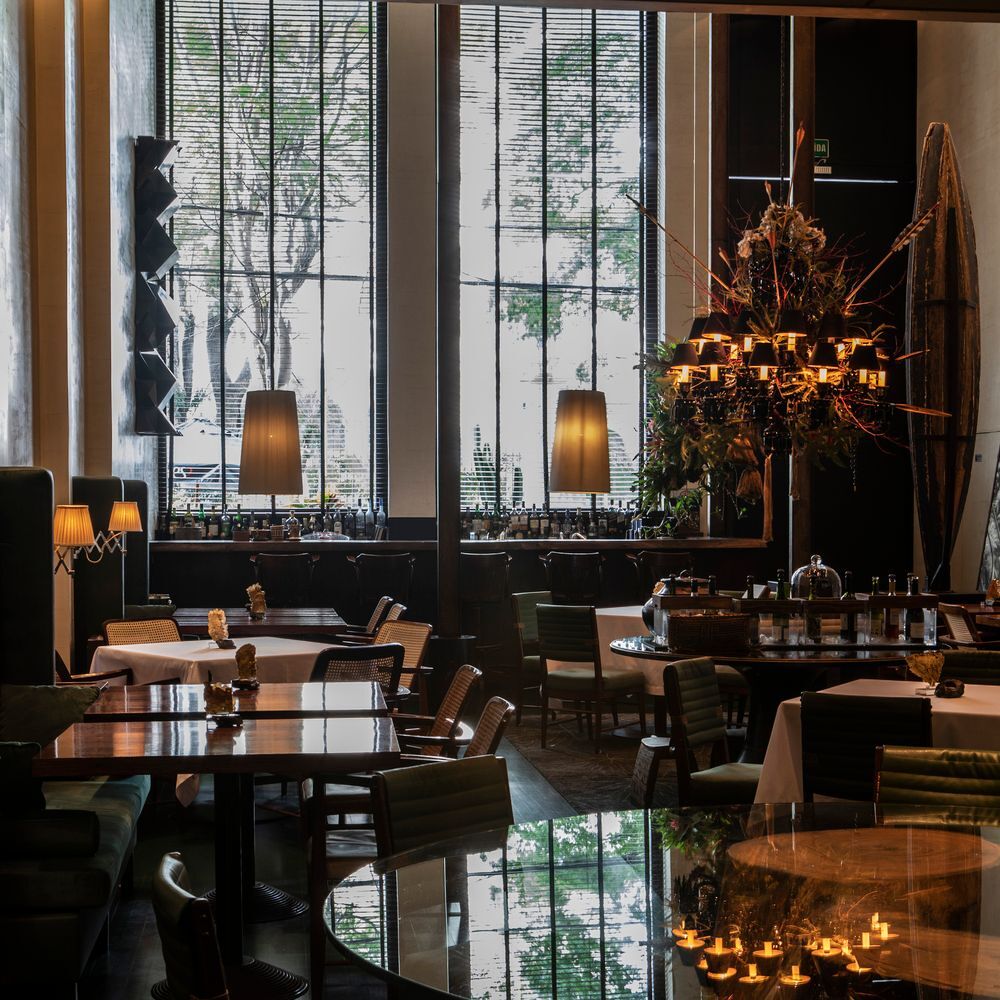
Image context: the cover uses the Michelin Guide's photograph of D.O.M.'s dining room. A real room photograph is the right visual here because the article is about how a research-heavy Brazilian pantry gets translated into an actual sequence of service, not into an abstract concept board.[5]
Around 0:50, Atala names the whole method in one sentence
The crucial line arrives before the food becomes visually elaborate. After Filomeno asks what they are making, Atala says the history of D.O.M. is built on Brazilian flavors, but what takes the restaurant to a different level is research and, above all, simplicity.[1] That sentence matters because it blocks the easiest misreading of the restaurant. D.O.M. is often introduced from the outside through rarity, Amazonian ingredients, or the chef's international status.[5] Atala's own framing is tighter. The prestige claim is not "we have unusual things." It is "we do the work that lets a Brazilian ingredient appear inevitable rather than folkloric."[1][2]
The first object in the video proves the point. Instead of opening with caviar logic or a piece of theater built around scarcity, Atala starts with cassava flour and water, then asks Filomeno to press a delicate, inflated crisp.[1] He immediately calls cassava the queen of Brazil, the ingredient that was there before the country was called Brazil and the one that crosses every phase of Brazilian history.[1] The idea lands because D.O.M.'s official texts are already built around national scope: annual immersion into different regions, collaboration with producers, and menu themes drawn from Brazilian imagery rather than imported haute-cuisine codes.[2][3]
So the opening move does two jobs at once. It keeps the restaurant anchored in a staple that belongs to ordinary domestic life, and it shows that fine dining at D.O.M. begins by altering texture and sequence, not by abandoning recognizability. In a lot of tasting-menu rooms, refinement means distance from the everyday. Here refinement means increasing the precision with which the everyday can be read.[1][2]
Around 2:30, rice and beans becomes a standard of judgment
The middle of the video sharpens the restaurant's philosophy by moving away from novelty and toward recognition. Filomeno praises the bite in front of her; the conversation turns to rice and beans, and Atala says Brazilians recognize themselves through that pairing. The difference between good, very good, and exceptional, he argues, comes from repertoire, and as a Brazilian restaurant he felt obliged to make a truly great rice and beans.[1]
This is one of the best moments in the clip because it reveals where D.O.M. places difficulty. The hard part is not making a diner say "I have never seen this before." The hard part is making a diner feel that a familiar national grammar has been deepened without being mocked, prettified, or emptied out. That reading also helps explain D.O.M.'s single-menu structure. The cardapio page frames the experience as a guided surprise and lists a ten-stage service, which means the house controls pacing closely enough to move from memory to experiment and back again.[3] The point of surprise, in other words, is not randomness. It is calibrated contrast.
That is also why the restaurant reads differently from places that mine locality as a decorative gesture. The official biography page does not describe ingredient scouting as occasional inspiration. It describes repeated field immersion, producer relationships, and a creative-testing process that helps define the yearly menu theme.[2] By the time Atala talks about rice and beans in the video, the line does not sound like a populist aside. It sounds like the ethical boundary around the whole project.[1][2]
Around 3:30, cassava stops being a staple and becomes a lab medium
The second great teaching sequence begins when Atala introduces another cassava variation. He says he cooks cassava, takes it into a chamber, creates the same mold associated with Brie, then turns the cooking liquid into an emulsion, freezes it, and uses liquid nitrogen so it lands like snow.[1] Filomeno's reaction is immediate: the result is extraordinary, complex, and yet still cassava.[1]
This is the point where the video most clearly matches the written sources. The MICHELIN inspector describes D.O.M. as a place where little-known ingredients and Brazilian natural-region references are worked through creative combinations informed by European culinary culture.[5] That description can easily sound vague if you read it cold. The cassava-Brie sequence clarifies what "creative" means in practice. European technique appears as a tool of transformation, but the ingredient identity is not being hidden inside borrowed luxury codes. D.O.M. is using fermentation language, emulsion, and cold techniques to widen the expressive range of cassava while insisting that cassava remain legible as the subject.[1][5]
That distinction matters for the broader fine-dining landscape. Many restaurants claim local identity, then rely on imported technical glamour to make that identity feel upscale. D.O.M., at least in this short video, appears to be doing the reverse. Technique is there, unmistakably, but it is subordinated to an argument about what a Brazilian ingredient can become while still carrying Brazilian reference. The restaurant's own annual-theme system supports that reading. When the menu changes yearly but remains built from research into ingredients and culture, technique becomes a grammar for translation rather than the restaurant's final message.[2][3]
Around 5:20, dessert explains why D.O.M. prefers surprise to explanation
The last important movement comes with the onion-farofa dessert. Atala introduces a farofa-like sweet element, then finishes the dessert tableside with ice cream and a final drop of chocolate, while explaining that farofa can move between sweet and savory and carry surprise in each bite.[1] This is where D.O.M.'s Menu Confiance language stops sounding like luxury-script boilerplate. The restaurant's surprise logic is not only about concealment. It is about teaching the diner that categories they thought were settled can still be reopened by sequence, texture, and timing.[1][3]
Seen that way, the clip's brevity becomes a strength. In under eight minutes it sketches the whole house position: staple ingredient, national memory, technical mutation, and then tableside finishing as a final act of controlled misdirection.[1] The Michelin description of the room as modern and elegant, filled with dishes that invite you to "open your mind and let yourself be surprised," lines up exactly with that closing dessert logic.[5] Surprise here is not spectacle for its own sake. It is the delivery system for a more ambitious claim: Brazilian ingredients contain more formal range than diners are used to granting them.
That is why this video is worth embedding now. It is not the most exhaustive D.O.M. documentary, and it assumes some cultural fluency from the viewer because the conversation remains in Portuguese.[1] But as an annotated viewing object it is unusually clean. It shows that Atala's strongest move is not exoticism, and not even invention in the abstract. It is compression. He takes cassava, rice and beans, farofa, and a jaguar-haunted national imaginary, then compresses them into a tasting-menu sequence that can survive the pressure of one of the world's most scrutinized dining rooms.[1][2][3][5]
Sources
- Daniela Filomeno | Viagem&Gastronomia, "MELHORES RESTAURANTES DE SP: D.O.M - O brilho das duas estrelas Michelin de Alex Atala," YouTube, published January 14, 2025.
- DOM Restaurante, "Alex Atala" - biography and note on annual menu development through immersions in Brazilian food cultures and biomes.
- DOM Restaurante, "Cardapio" - current "Quando a onca bebe agua" tasting-menu concept, Menu Confiance framing, and service structure.
- DOM Restaurante, "Sobre Nos" - restaurant overview and the house's positioning around Brazilian gastronomy.
- MICHELIN Guide, "D.O.M. - Sao Paulo - a MICHELIN Guide Restaurant" - two-star classification and inspector description of the current tasting-menu proposal.