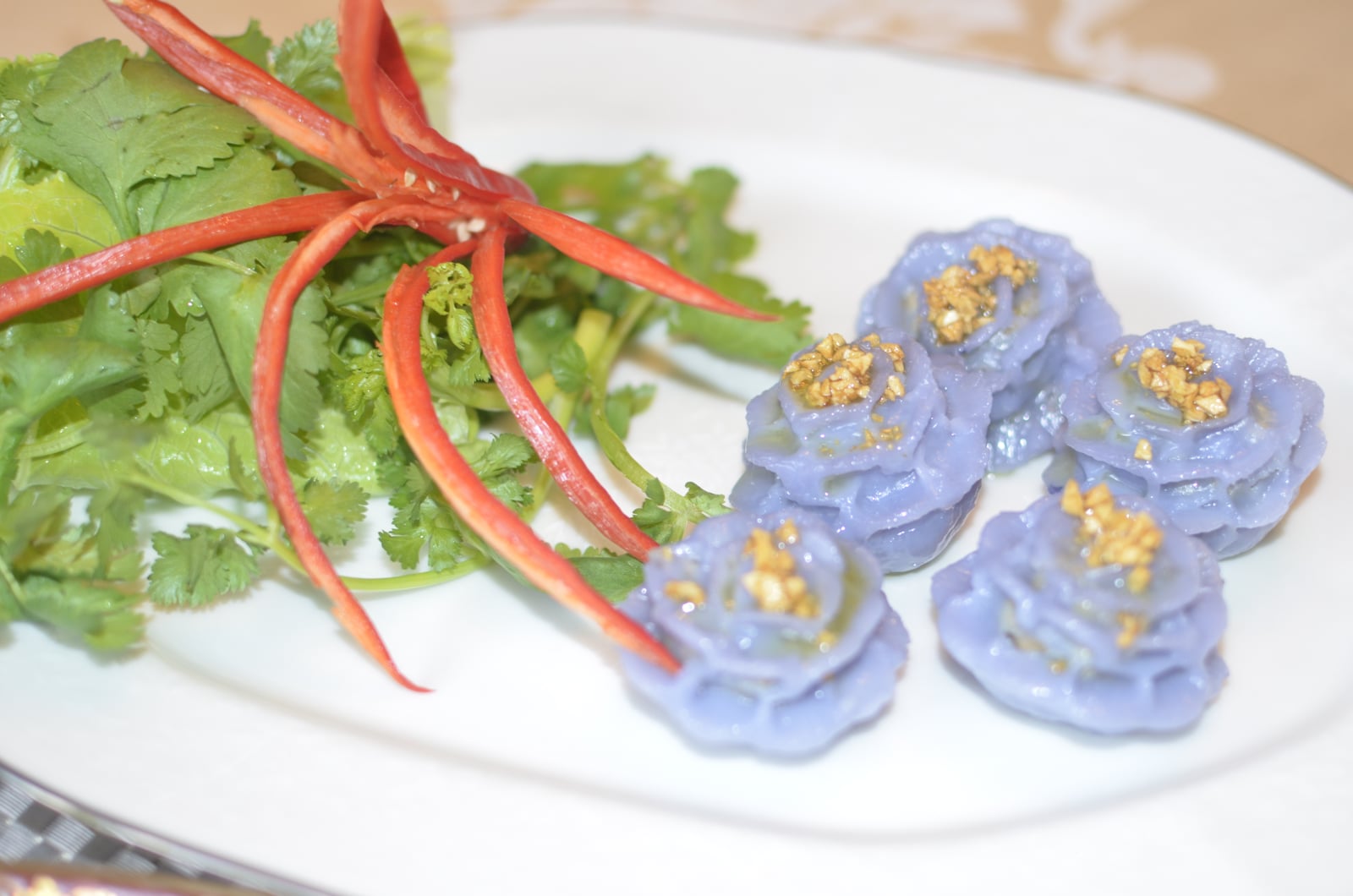
A plate of chor muang asks for a small pause before the first bite. The purple dumplings resemble flowers, their surfaces gathered into rows of petals. The effect is intricate enough to suggest a mold. Yet the characteristic shape comes from a cook working around each filled dumpling with tweezers.[1][2]
In Chawadee Nualkhair’s 2019 account of royal Thai cuisine, chef Sandra Steppe identifies the time spent forming these flowers as part of their courtly character. The distinction is useful: the grandeur sits in repeated, careful gestures. A small savory starter can contain a remarkable amount of somebody’s afternoon.[1]
The craft becomes easier to appreciate when followed backward from the table. Before the brief steaming, the cook has already managed the filling’s moisture, prepared a workable dough and made a succession of tiny pinches. The flower takes shape while dinner is still a long way from being served.
The filling has to cooperate
Jackie M’s account of learning chor muang from chef Wassana at Shangri-La Chiang Mai starts with chicken, prawn and onion, seasoned with garlic, fish sauce and sugar. Her published method cooks the filling until almost all the water has evaporated, then sets it aside to cool.[2]
That instruction deserves as much attention as the decorative work. The cook will soon need to place a teaspoonful inside a small wrapper and close it. A filling that can be gathered neatly makes that job more manageable. This is a practical reading of the sequence: the attractive exterior depends on preparation that will disappear inside it.
The filling also supplies a useful correction to the flower’s appearance. Garlic, seafood and fish sauce belong to a savory course, even though sugar participates in its seasoning. Violet petals alone tell a diner very little about what is waiting underneath. The kitchen must make both the appearance and the contents intelligible.
Make the dough before making the flower
Lada’s Kitchen documents a version using rice flour, a little glutinous rice flour and tapioca flour. Butterfly pea flowers steep in hot water; lime juice changes the resulting infusion toward violet. The colored liquid goes into the flour mixture, which is stirred over low heat until doughy, then cooled and kneaded.[3]
The order matters. Before any petals are pinched, the cook has turned a wet mixture into something that can be portioned, flattened and handled. Thinking only about the final steaming misses this earlier transformation at the stove.
Lada’s instructions keep the waiting dough under a damp towel. That modest piece of equipment belongs in the story beside the ornamental tweezers: while one dumpling receives attention, the rest must remain workable. The same method dusts the tweezers with flour to stop them sticking.[3] Making a neat petal involves both shaping the dough and releasing the tool cleanly.
Seal first, pinch second
Stefan’s Gourmet Blog offers a candid record of trying the dish at home, following a Hot Thai Kitchen recipe. Its photographs trace the wrapper around a compact ball of filling, the closing of the seam and the placement of that seam underneath. Only then do tweezers turn the surface into a flower.[4]
This makes the petals easier to understand. They are formed on an already enclosed dumpling; they are not separate decorations attached at the end. The underlying parcel must work before its surface can become elaborate.
The account also preserves the frustration that polished recipe photographs usually omit. The writer found the dough difficult to handle and stopped shaping flowers halfway through the intended batch. That is one cook’s experience, rather than a universal verdict on the recipe. Still, it usefully separates knowing the motions from being able to repeat them comfortably.[4] The first recognizable flower is an achievement. Producing a whole plate asks for another kind of fluency.
A restaurant needs the second flower, too
StarChefs’ September 2025 Houston reporting shows what that fluency means in a professional kitchen. At MaKiin, chef-owner Lukkaew Srasrisuwan described assigning one person to the dumplings. Training took roughly a week for appearance, followed by another two to three weeks for speed. The team also had to work before the dough dried out.[5]
Her version used a vegan filling of peanuts, shallots, radishes and palm sugar with coriander root, garlic and white pepper. Guests were encouraged to eat the dumplings with cilantro and Thai chile.[5] Those accompaniments bring the flower back into the business of eating: aromatic herbs, sweetness, spice and a tender wrapper, all in a small serving.
In the method Jackie M records, the shaped dumplings are moistened, steamed for about ten minutes and oiled before lifting; crisp fried garlic finishes the plate.[2] That timing belongs to this particular recipe. The flower must survive the final cooking as well as the work of shaping it.
Look at the petals, then notice the work they imply: the closed parcel beneath them and the repetition behind a consistent plate. Finally, eat. Chor muang’s craft is completed when something made so carefully gives way in a bite.
Sources
- Chawadee Nualkhair, “A Guide to Royal Thai Cuisine,” MICHELIN Guide, January 22, 2019 — Sandra Steppe on chor muang and the labor of presentation.
- Jackie M, “How to Make Chor Muang (Thai Royal Steamed Dumplings),” September 22, 2015 — lesson with chef Wassana at Shangri-La Chiang Mai; filling preparation and shaping sequence.
- Lada’s Kitchen, “How to Make Cho Muang (Thai Steamed Flower Dumplings),” July 21, 2018 — dough preparation, moisture management and original food photography.
- Stefan’s Gourmet Blog, “Thai Royal Flower Dumplings (Chor Muang),” April 10, 2021 — photographed home trial of Hot Thai Kitchen’s method, including sealing, shaping and handling difficulties.
- Team StarChefs, “2025 Houston Kitchen Notebook,” September 26, 2025 — MaKiin chef-owner Lukkaew Srasrisuwan on filling, staff training and service.