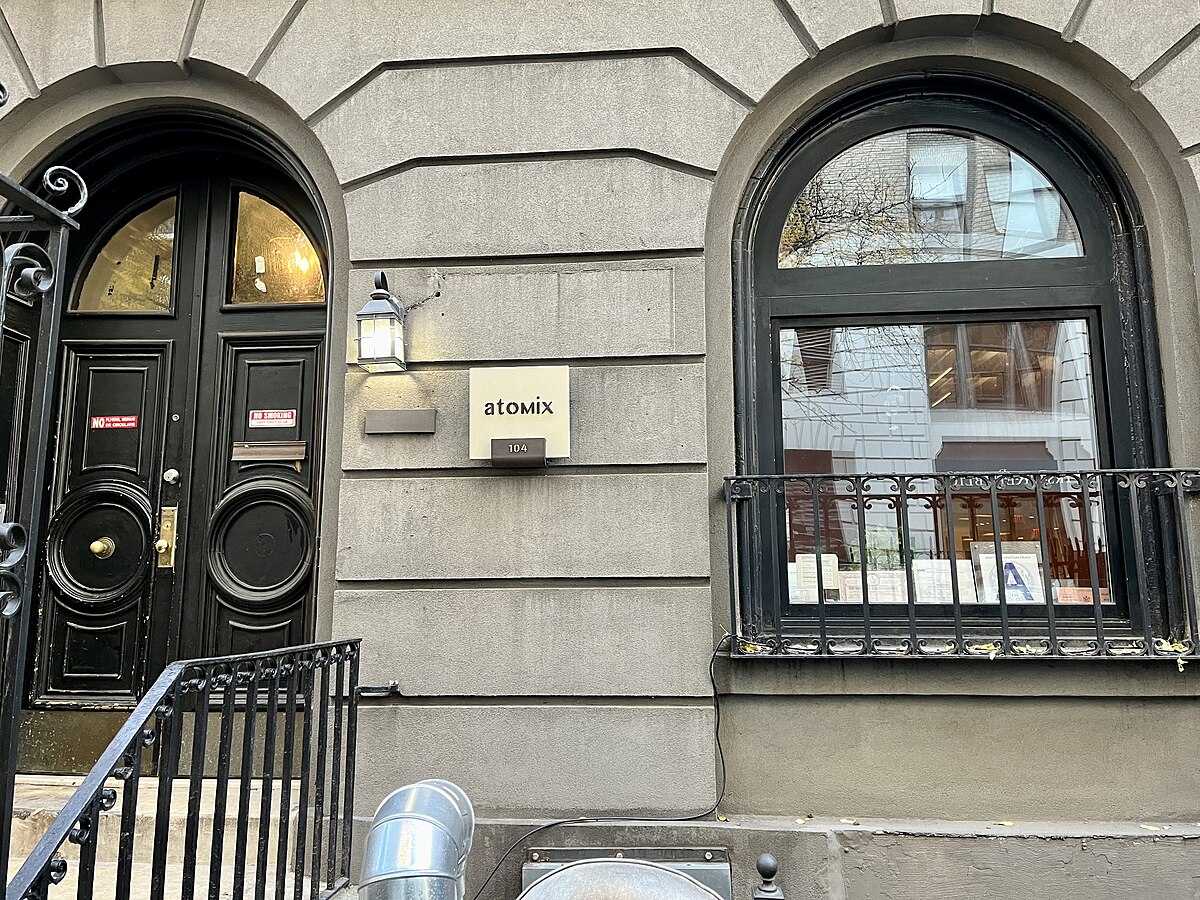
Most tasting-menu advice is either too romantic (“just surrender to the chef”) or too tactical (“maximize value per dollar”). Atomix rewards a third approach: read the room as a sequence engine.
This is one of the hardest reservations in New York because it combines scarcity, narrative structure, and unusually precise front-of-house timing.[1][4][8] If you know where the pivots are before you sit down, the same menu can feel either coherent and generous or slightly overloaded.
First, understand the operating geometry before you book
Atomix’s chef’s counter runs two seatings: 5:30 PM and 8:45 PM.[1] The restaurant describes the counter as an intimate U-shape around the open kitchen, with reservations required.[1] Eater’s 2026 report frames this as 28 nightly seats total at the counter, which is effectively two short allocation windows for high-demand inventory.[8]
Practical implication:
- If you care most about sensory acuity and cleaner palate calibration, take 5:30 PM.
- If you care most about social atmosphere and a more theatrical late-night arc, take 8:45 PM.
The point is not that one is universally better. The same dishes land differently depending on your fatigue, hydration, and alcohol load at the start.
The meal’s internal logic: contrast, then concentration, then lift
Atomix’s own positioning is “New Korean Cuisine,” with explicit emphasis on translating Korean ingredients, technique, and cultural context rather than simply plating familiar luxury products in Korean names.[3][7] Michelin’s current description highlights a rotating menu with dishes such as black banana with monkfish liver and perilla, and langoustine with truffle gel and squash foam.[4]
When you combine that with recent reporting from Eater’s latest visit (fried abalone in a tangsuyuk-inspired frame, monkfish liver with squid and tangerine, then lighter desserts), you can read a recurring arc:[8]
- Signal-setting courses that establish texture contrast and fermented/saline accents.
- Middle concentration where richer marine umami and aromatic fat carry the narrative weight.
- Late reset through cleaner dessert architecture rather than heavy pastry closure.
That is why pacing matters more here than in many classic French-sequence rooms: the peaks come from contrast management, not just progressive richness.
Beverage strategy is not an add-on at Atomix; it is structural
Atomix’s chef’s counter publishes a corkage rule of $100 per 750ml bottle, capped at two bottles per reservation.[1] Atomix’s separate bar-tasting format also documents a dedicated alcohol-free pairing path (selected at booking) and treats beverage sequencing as part of menu design.[2] Together, those signals support the same planning takeaway: beverage choices are structural, not incidental.
Eater reports a $110 nonalcoholic/low-ABV pairing in its 2026 coverage, with teas and fermented drinks as core components.[8]
A useful decision rule:
- If your goal is precision across all courses, the house pairing track usually keeps you closer to the kitchen’s intended cadence.
- If your goal is one or two personal bottles, treat corkage as a targeted intervention and avoid forcing one wine across the whole menu arc.
In other words, choose continuity or choose personalization, but do not accidentally do both halfway.
Dietary boundaries are unusually tight—plan early or skip this booking
Atomix explicitly states it cannot accommodate vegan, vegetarian, celiac, or broad aversions/allergies across fish, shellfish, seafood, dairy, gluten, or allium at the chef’s counter.[1] For many high-end rooms, policy language is flexible in practice; here it is direct and operational.
If those constraints conflict with your table, do not book first and negotiate later. This is a place where menu architecture depends on specific ingredient channels.
Why the room still matters globally in 2026
On current public rankings, Atomix sits at No. 12 on The World’s 50 Best Restaurants list and No. 1 on North America’s 50 Best list.[5][6] Michelin lists it at two stars.[4] Those are not interchangeable accolades, but together they point to one thing: the restaurant is being rewarded both for technical execution and for format coherence.
That coherence is the useful takeaway for diners too.
A one-night walkthrough that actually improves your experience
If you get one shot this year, use this sequence:
- Book by physiological fit, not calendar convenience: pick 5:30 PM unless you know you perform better at late seatings.
- Treat beverage choice as a menu-design decision: pairing track for continuity, corkage for targeted personalization.
- Enter with explicit constraint awareness: Atomix is not a broad-allergy-flex room; verify fit before payment.
- Read the menu as a contrast system: look for transitions in texture, fermentation, and acidity instead of waiting for one “main event” protein.
That framework preserves what Atomix does best: making Korean fine dining feel both intellectually legible and viscerally satisfying in the same two-and-a-half-hour window.
Sources
- Atomix official — Chef’s Counter (seatings, policy, corkage)
- Atomix official — Bar Tasting (format difference, pairing policy)
- Atomix official — About (concept framing, New Korean Cuisine)
- MICHELIN Guide — Atomix (stars, format description, hours)
- The World’s 50 Best Restaurants — 1–50 list (Atomix current global placement)
- North America’s 50 Best Restaurants — 1–50 list (Atomix No. 1)
- MICHELIN Guide Magazine — interview with Junghyun Park (culture/mission framing)
- Eater NY (2026) — Atomix dining report (current menu/pricing/service observations)