Priced: transformer shortages keep order books full, delivery slots scarce, and grid-equipment pricing firm. New: the shortage diagnosis is no longer enough. Manufacturers are adding capacity just as U.S. utilities are being pushed toward interchangeable specifications, so the investor question is who can convert a reserved factory slot into repeatable output, margin, cash, and service revenue.[1][4][6]
That distinction matters because a backlog can signal two opposite futures. It can be a moat: scarce engineering and factory slots support price and customer deposits. It can also be a warning: customized orders, imported materials, skilled-labor constraints, and long build cycles trap revenue in work in progress. The beneficiaries will be the suppliers that shorten the path from order to tested equipment without teaching the market that transformers have become a commodity.
Data cut-off: August 2, 2026. Company disclosures below are broad segment indicators, not pure transformer economics, and named issuers are representative listed exposures rather than security recommendations.
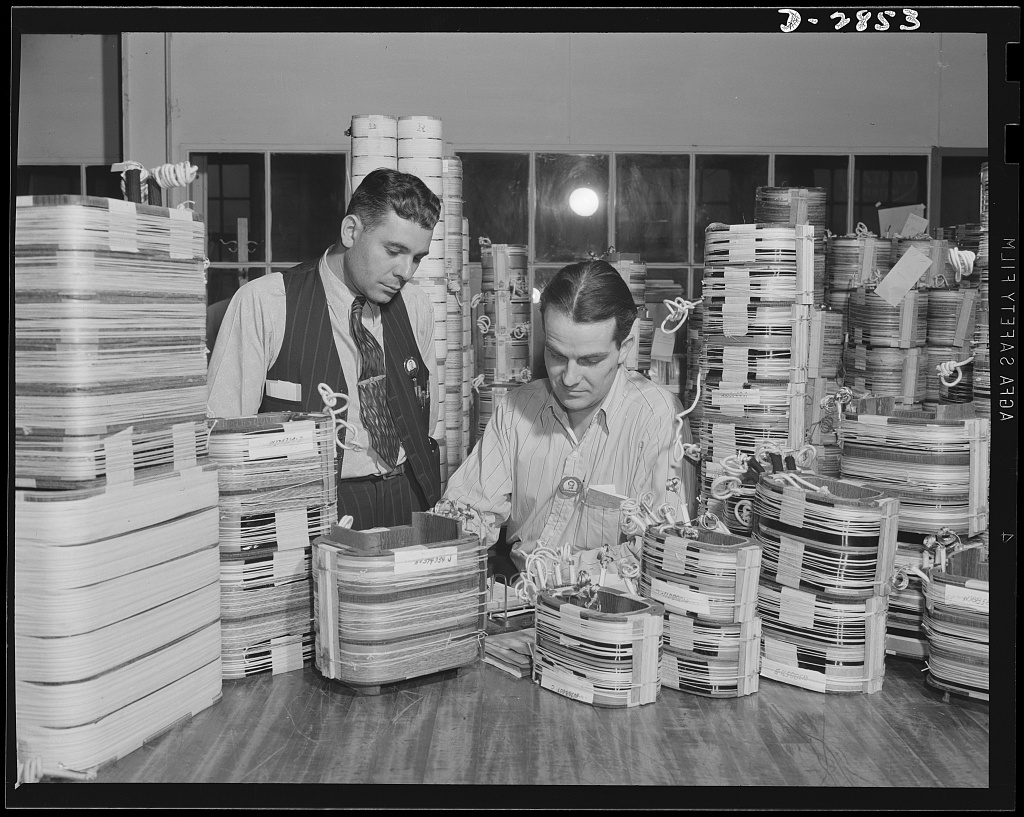
Image context: the cover comes from a 1942 U.S. Office for Emergency Management assignment at Westinghouse. The coils are for the small distribution transformers used on utility poles, not the giant power transformers moved by rail. The photograph is useful precisely because it shows the common production truth beneath both markets: throughput is physical, sequential, and labor-dependent.[9]
One shortage, two production systems
“Transformer” is not one trade. Distribution units sit on poles or pads and step local voltage down for homes, shops, chargers, and factories. Large power transformers connect generation, transmission, and substations; they are bespoke, enormous, and difficult to transport. The equipment can share constraints—electrical steel, copper, insulation, winding talent, test bays—but it does not share one interchangeable order book.
The shortage is nevertheless broad. At a March 2026 Department of Energy webinar, officials said U.S. demand for distribution transformers had risen 41% since 2019. Quoted delivery times had moved from three to six months in 2019 to one to two years or longer in 2024; large power transformers could take three to four years.[1] Those windows explain why utilities order defensively and why customers value a credible delivery slot.
Demand is not just a data-center story. NREL estimates that the United States has 60 million to 80 million distribution transformers and that roughly 55% are more than 33 years old. It estimates annual additions and replacements at 1.5 million to 2.4 million units. Replacement, new connections, resilience work, transport electrification, renewable generation, and larger average unit sizes all pull on the same manufacturing base.[2]
This installed-base arithmetic is the durable part of the thesis. Even if one flashy load forecast is revised down, transformers still fail, age, and get upsized. The demand floor is less exciting than artificial-intelligence power headlines—and more useful.
The hidden factory tax is variety
The most important 2026 number is not another gigawatt forecast. It is 80,000 possible configurations.
DOE's working group reached that count by combining ten base attributes across voltage, winding, mounting, phase, size, and construction choices. Accessories and other options add yet more combinations on top of that base. Many differences are legitimate: utility systems evolved locally, environmental duties vary, and an accessory that looks optional in a catalog can be essential in a flood, wildfire, or constrained right-of-way. But every legacy choice can also force a new drawing, bill of materials, component search, setup, inspection path, or stock-keeping decision.[1]
That is the economic release valve. A common taxonomy does not create copper or electrical steel, but it can turn fragmented demand into longer production runs. An interchangeability matrix can let a utility accept an available bushing or accessory instead of waiting for a single source. Moving noncritical options to the field can reduce the number of features that must be installed before factory test.
For manufacturers, the first-order effect is better throughput: fewer changeovers, less engineering touch time, more predictable purchasing, and lower work-in-process complexity. For utilities, the gain is shorter procurement and a larger emergency pool. For investors, the tradeoff is sharper. Standardization can raise volume and cash conversion while gradually eroding the scarcity pricing embedded in today's backlog.
Backlog is proof of demand, not yet proof of conversion
Siemens Energy shows why the distinction matters. Its Grid Technologies business ended March 2026 with a €49 billion order backlog after a quarter in which orders again ran well ahead of revenue. The segment's 17.1% profit margin before Special items was strong, but lower than a year earlier even as revenue rose—evidence that mix, execution, capacity ramping, and project timing still matter inside an exceptional demand environment.[4]
Eaton offers a broader adjacent read-through. Its first-quarter disclosure showed accelerating Electrical Americas orders and backlog alongside significant capacity investment. But Eaton serves data centers, utilities, industrial buildings, and many other electrical markets; its results cannot be treated as a transformer price index. The useful signal is whether electrical capacity additions support shipment growth without allowing restructuring, acquisition, tariff, and material costs to consume the operating leverage.[5]
Hitachi Energy and Siemens Energy are now putting steel and concrete behind the supply response. Hitachi broke ground in June on a new large-power-transformer facility in South Boston, Virginia. Siemens is expanding transformer production in Nuremberg, with new space expected to be available by 2028.[6][7] Those projects validate the demand signal. They also start the clock on the counter-signal: every new winding station, test bay, and trained crew eventually competes with the scarcity that justified it.
The cleanest equity lens therefore separates four steps:
- Orders: customers reserve capacity because lead times are long.
- Throughput: factories turn engineering and materials into tested units.
- Cash: customer advances and shipment collections outrun inventory and expansion spending.
- Aftermarket: service, repair, monitoring, and replacement deepen the installed-base relationship after delivery.
A supplier that wins only the first step owns a queue. A supplier that wins all four owns a franchise.
The strongest counterweight: utilities cannot standardize away the grid
The bear case on standardization is that the easy variants are not the ones causing delay. Utilities cannot casually harmonize voltage systems, seismic requirements, impedance, loss performance, fire safety, transport limits, or protection practices built around their networks. DOE's own interchangeability work acknowledges sole-source components, duty ratings, raw materials, and location constraints that sit below the final configuration choice.[1]
Policy adds another moving boundary. In June 2026, DOE opened a request for information on whether the distribution-transformer efficiency standards due for compliance in 2029 interact badly with domestic capacity, material availability, and national-security goals.[3] The inquiry is not a rollback. It is evidence that efficiency, resilience, electrical-steel supply, and factory conversion cannot be optimized independently.
There is also a timing mismatch. A utility can revise a procurement manual faster than a manufacturer can qualify a new design, build a test bay, and train coil winders. New capacity may arrive into a market whose mix has changed, yet still fail to relieve the most constrained specifications. If that happens, long lead times and premium pricing can persist even while headline capacity rises.
What would break the view
The thesis is that standardization and commissioned capacity will shift the transformer value pool from pure scarcity pricing toward throughput, working-capital discipline, and service. It fails if quoted distribution-transformer lead times remain above 18 months through the end of 2027 despite measurable adoption of common configurations and new North American capacity.
That outcome would imply the real bottleneck sits deeper—in electrical steel, components, test infrastructure, or skilled labor—and that scarcity remains the dominant earnings mechanism. The opposite extreme also breaks the bullish version: if lead times normalize rapidly but manufacturer grid margins and cash conversion fall together, added throughput will have proved less valuable than the price umbrella it displaced.
Three dates that move the thesis
- August 5, 2026 — Siemens Energy fiscal Q3 results. Grid Technologies orders, revenue conversion, margin, and cash commentary will show whether the €49 billion backlog is becoming output without new execution slippage.[8]
- 2028 — Siemens Energy expects its expanded Nuremberg production space to be available by then. Watch commissioning and qualified output, not ribbon-cutting capacity; an installed machine is not a shipped transformer.[7]
- April 23, 2029 — current U.S. compliance date for amended distribution-transformer efficiency standards. Any DOE change before then will alter material choice, redesign work, and the capital manufacturers need to deploy.[3]
Takeaway
Transformer demand is real enough that the debate has moved beyond whether a shortage exists. Aging assets and annual replacement needs provide the floor; electrification, resilience, generation, and new industrial load add the upside. The open question is who can manufacture through it.
The next winning disclosure will not be the longest lead time or the largest backlog. It will be a cleaner bridge from standardized order to tested shipment, from shipment to cash, and from installed equipment to service revenue. Scarcity opened the door. Throughput decides who keeps the economics when more factories walk through it.
Sources
- U.S. Department of Energy, Office of Electricity, “Distribution Transformer Webinar Text Alternative,” March 5, 2026 — demand, lead-time, taxonomy, configuration, and interchangeability discussion.
- National Renewable Energy Laboratory, Distribution Transformer Demand: Understanding Demand Segmentation, Drivers, and Management Through 2050, November 2024 — installed-base, age, replacement, and capacity-demand estimates.
- U.S. Department of Energy, “Energy Conservation Program: Energy Conservation Standards for Distribution Transformers,” 91 FR 35903, June 15, 2026 — request for information on supply-chain and 2029 compliance interactions.
- Siemens Energy, Q2 FY2026 Analyst Presentation, May 12, 2026 — Grid Technologies orders, revenue, margin, free cash flow, and backlog.
- Eaton, “Eaton Reports Record First Quarter 2026 Results,” May 5, 2026 — Electrical Americas orders, backlog, margins, guidance, and capacity-expansion context.
- Hitachi Energy, “Hitachi Energy breaks ground on the nation's largest facility for the production of large power transformers in South Boston, Virginia,” June 29, 2026.
- Siemens Energy, “Siemens Energy invests €220 million in German transformer factory,” September 5, 2025 — Nuremberg expansion and expected 2028 availability.
- Siemens Energy, “Third Quarter Results FY 2026,” event page for August 5, 2026.
- Library of Congress, “Transformer manufacture. Veteran coil winders ... check stacks of finished coils,” photograph by Alfred T. Palmer, Westinghouse, Sharon, Pennsylvania, February 1942.