A bid for bare timberland based only on its first harvest can leave a productive asset unpriced: the ground that grows the next forest. The valuation gap comes from repeating the planting cycle, including its costs, rather than treating the first timber sale as the end of the investment.[1]
That is a claim about a calculation, not evidence that timberland currently trades below fair value. A seller may already charge for future harvests, recreational appeal, or another use. The useful question is how much of the asking price timber production alone can support.
Start with an empty acre
Foresters call the period from establishing a stand to its final harvest a rotation. Land expectation value, or LEV, values bare ground through a continuing sequence of those rotations. It measures productive capacity before the first trees are planted, separating the land from any standing timber a purchaser might also acquire.[1]
Consider a deliberately simplified, hypothetical plantation. Establishment costs $400 per acre, paid immediately. A final harvest after 25 years produces $2,000 per acre after selling and harvesting expenses. The required return is 4% a year in real terms. All amounts are in constant purchasing power, so the model does not add inflation to the harvest receipt. Matching real cash flows with a real discount rate follows Alabama Extension's forestry-investment guidance.[2]
Assume no thinning income, recurring management charges, property taxes, or income taxes. Those omissions make the arithmetic visible; they would have to be replaced with actual cash flows in a property appraisal. The example also assumes successful establishment and harvest, with no separately modeled loss from fire, storms, or disease.
Discount the harvest receipt and deduct establishment:
Single-rotation net present value = $2,000 ÷ (1.04)^25 − $400 ≈ $350 per acre.
That is the surplus available today after paying for planting and allowing for the required return, but before paying for the land. It is not the undiscounted profit on the eventual timber sale.
If the land ceased to offer any benefit after that harvest, this would finish the example. Here, however, it can be planted again.
The next planting belongs in today's price
Suppose each subsequent rotation has the same duration, real receipts, and real costs. At the end of the first rotation, the buyer can begin another investment identical to the one just valued. Its surplus has value then, which must itself be discounted back to today.
Repeating that process gives:
Bare-land value = single-rotation net present value ÷ [1 − (1.04)^−25] ≈ $560 per acre.
The calculation uses the unrounded single-rotation result. This is the perpetual-rotation method described in forestry valuation guidance, applied to this article's invented cash flows.[1][2]
The larger amount is still a price for empty ground. Every future cycle includes another establishment payment. Counting repeated harvest receipts while charging for planting only once would overstate the bid.
Nor does “perpetual” mean unlimited value. More distant surpluses contribute progressively less at a positive discount rate. The calculation compresses a long sequence of delayed receipts and expenses into an amount payable now.
Selling the land after the first harvest can express the same logic. If the next owner values the same future rotations on the same assumptions, the resale proceeds represent those later cycles. Adding both that resale value and the full future harvest sequence would count the same earning capacity twice.
An existing forest requires a different starting point. The University of Florida's forest-value approach combines the remaining cash flows of the current stand with the value of land available after harvest, then discounts them to the valuation date. A buyer acquiring established trees should not charge the project anew for planting that has already happened.[3]
Waiting has a land cost, too
A larger eventual harvest does not automatically produce a higher land value. Keeping the current trees standing also postpones the next planting and every rotation after it.
Mississippi State's harvest-timing analysis therefore includes the opportunity cost of the land alongside the return forgone on standing timber and the expenses of another year. Waiting must earn enough through additional timber value or other benefits to compensate for those costs.[4]
This is why the example's rotation length is an assumption, not a recommendation or an optimized harvest age. Comparing possible schedules means changing yields, product mix, thinning receipts, and costs together. Extending the calendar while leaving everything else unchanged is a sensitivity exercise, not a growth forecast.
What could erase the premium
The strongest counterweight is that a repeatable spreadsheet does not establish a repeatable business. Higher regeneration expenses, weaker yields, or recurring charges omitted here could sharply reduce the surplus. The discount rate also matters because much of the income arrives far in the future.[1][2]
The falsifier for applying this repeat-cycle premium to a property is evidence that later rotations cannot earn a positive net present value after their full costs. The owner might still harvest an already established stand profitably, but that would not justify capitalizing profitable replanting indefinitely.
Conversely, a market price above timber-only LEV need not signal an irrational buyer. Hunting income, recreation, and other uses can contribute value. Alabama Extension explicitly treats non-timber revenues as part of evaluating forest investments.[2] They need their own evidence and must be compatible with the proposed harvesting schedule.
What to watch before the bid becomes binding
- At the next forest inventory and management-plan update: compare the site's projected yields and harvest schedule with the assumptions behind the bid. For established trees, value the remaining rotation separately from the bare ground.[1][3]
- When regeneration tenders and the annual operating budget arrive: replace the illustrative planting cost and omitted recurring charges with documented amounts. Recalculate the whole sequence, because repeated costs reduce the value of repeated harvests.[1][2]
- At the pre-harvest decision: compare the benefit of waiting with carrying costs and the delayed next rotation. Any proposal to retain the stand for habitat, recreation, or another payment should enter that comparison explicitly.[4]
Sources
- Rajan Parajuli, Mark Megalos, and Colby Lambert, “Valuing Immature Forest Stands,” NC State Extension (2018) — land expectation value, cost inputs, and the distinction between land and standing timber.
- Becky Barlow and colleagues, “A Guide to Analyzing Forestry Profit Potential,” Alabama Cooperative Extension System, FOR-2007 — real and nominal returns, forestry cash flows, net present value, land expectation value, and non-timber income.
- Andres Susaeta and Chris Demers, “What Is the Value of an Existing Forest Stand?,” University of Florida IFAS Extension, FOR354 — valuing the remaining current rotation together with the land after harvest.
- Mississippi State University Extension, “Cut or Wait Decision-Making for Landowners,” Publication 3593 — timber growth, carrying costs, the land's opportunity cost, and the economics of postponing harvest.
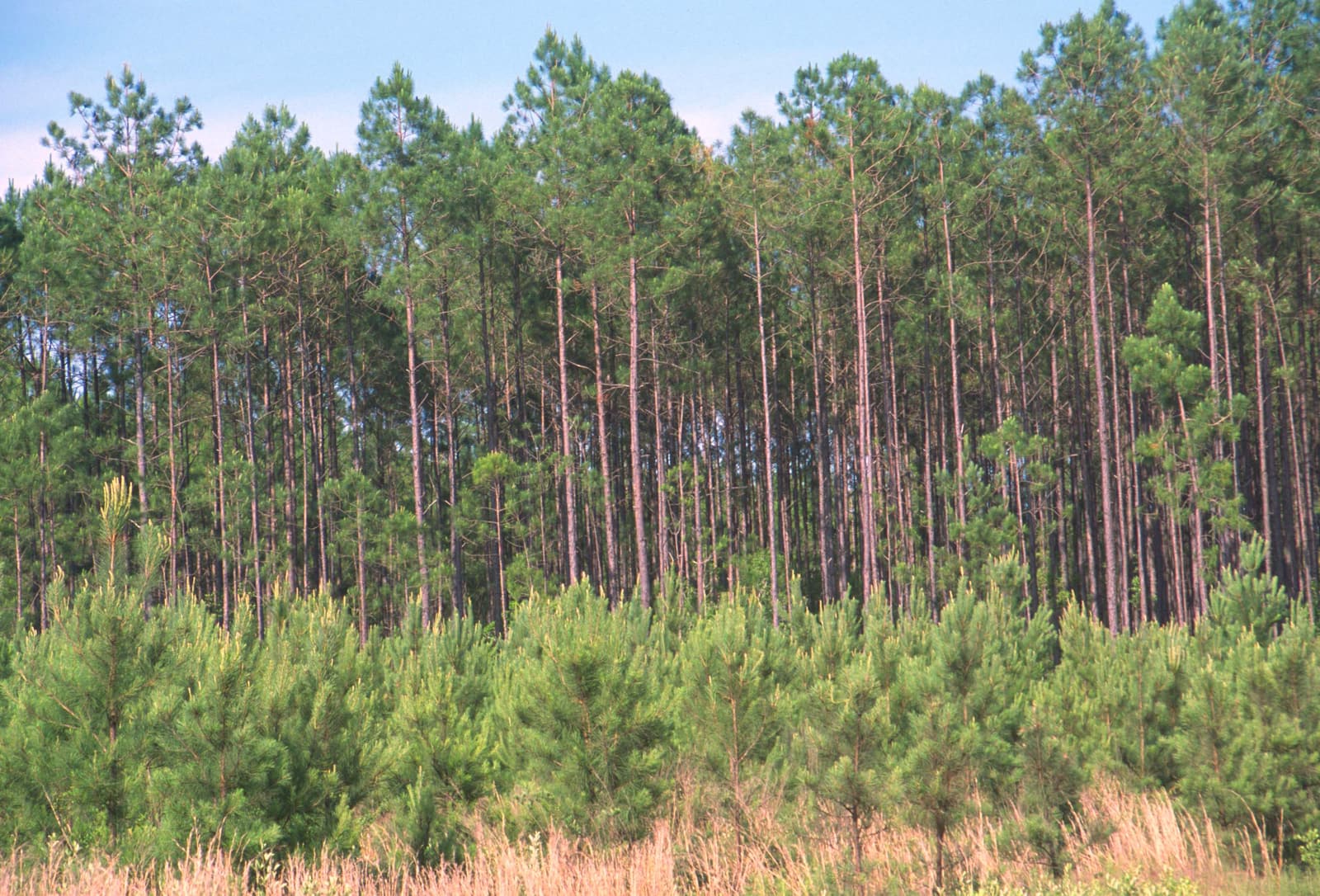
- U.S. Geological Survey, “Young and old pines on a pine plantation in the Southern Coastal Plain” (May 13, 2003) — Florida photograph from the Land Cover Trends project, used as the article image.