Priced: timber REITs already get credit for scarce land, biological inventory, and an eventual U.S. housing recovery. New: the 2026 spread is narrower. Housing starts have to improve, but so do mill utilization, lumber realizations, local sawtimber prices, and the conversion of logs into cash at Weyerhaeuser and post-merger Rayonier.[1][2][4][5]
That distinction matters because timber is not a clean commodity screen. A tree can be deferred, harvested, sold as a log, processed into lumber, monetized through real estate, or left standing for a better local market. The stock-market shorthand says "housing beta." The operating reality says "where is the mill, what is it paying, and can the spread survive weak orders?"
The Mechanism
The clean timber REIT story has three layers. First, housing and repair demand set the broad pull on lumber. Second, mill capacity and utilization decide whether that demand becomes higher product realizations. Third, local log markets decide whether timberland owners capture enough of the lumber move through stumpage, delivered log prices, harvest volume, or internal mill margins.
The first layer is still under pressure. The Census Bureau's May 2026 construction release put privately owned housing starts at a seasonally adjusted annual rate of 1.177 million, down 15.4% from April and 8.7% from May 2025. Single-family starts were 882,000.[1] That is not a collapse in the long-term need for housing, but it is a poor near-term tape for anything tied to framing packages.
The second layer is more interesting. NAHB's July 6 update said framing lumber prices were up 1.4% week to week as of July 3, up 4.7% from one month earlier, and up 5.1% from one year earlier, reaching the highest level of the index since August 2025.[6] That sounds constructive, but a lumber-price uptick does not automatically mean timberland cash flow has turned. University of Georgia Extension's 2026 timber outlook says more than 70% of U.S. softwood lumber and structural panel consumption is tied to residential construction, yet it also notes that southern softwood lumber mill capacity exceeded 27.7 billion board feet in 2025, up 31% from 2017, while U.S. softwood lumber mill utilization fell from 81% in Q2 2021 to 78% in Q2 2025.[2]
That is the important spread. More capacity can be good when orders return. It can also keep mills selective while housing is soft. A USDA Forest Service study of southern U.S. lumber and timber prices makes the same point from another angle: standing timber inventory can widen the gap between lumber and stumpage prices because excess standing supply pressures local timber prices even when lumber markets move.[3]
The Company Split
Weyerhaeuser is the integrated version of the trade. Its fourth-quarter release says the company owns or controls more than 10 million acres of U.S. timberlands, manages additional public timberlands in Canada under long-term licenses, and remains one of North America's largest wood-products manufacturers.[4] That integration is a strength when lumber and panels recover. It is also why weak product margins show up quickly.
The latest numbers show the problem. In Q4 2025, Weyerhaeuser's Wood Products segment generated $1.085 billion of net sales, recorded a $78 million net charge to pretax earnings before special items, and posted negative $20 million of adjusted EBITDA.[4] Management said lumber and oriented strand board realizations fell versus Q3, while lumber sales volumes were lower and unit manufacturing costs were slightly higher because of reduced production levels.[4] In finance terms, the acreage is durable, but the near-term earnings bridge still runs through mill-level realization and cost.
Rayonier now carries a different shape after completing its merger with PotlatchDeltic on January 30, 2026.[5] The combined company reported first-quarter 2026 revenue of $276.8 million and adjusted EBITDA of $94.1 million. More important for this thesis, the merger added approximately 1.5 million acres to Southern Timber, approximately 623,000 acres of Idaho timberlands to Northwest Timber, and a new Wood Products segment with seven mills.[5]
That makes Rayonier less of a pure timberland wrapper than it used to be. In Q1, Southern Timber harvest volume rose to 2.78 million tons, but average delivered pine sawtimber prices fell to $44.59 per ton from $47.69 a year earlier, and delivered pine pulpwood prices fell to $30.20 from $37.83.[5] The Wood Products segment shipped 199 million board feet of lumber at average realizations of $437 per thousand board feet.[5] Those numbers are the article in miniature: acres, mills, harvest volume, and lumber price all matter, but they do not all move together.
Why Housing Is Not Enough
The bullish timber argument is easiest when the U.S. is short homes, mortgage rates are expected to ease, and lumber prices are no longer falling. That setup is real enough to respect. A weak May starts number can reverse, especially if builders work through inventory and financing costs loosen. The Census release also showed single-family permits at 886,000, slightly above April, so the forward indicator was less ugly than total starts.[1]
But the equity case should not stop there. A timber REIT can own excellent land and still have a disappointing year if local mills are underutilized, pulpwood markets are oversupplied, product prices recover only modestly, or harvest timing pushes volume into weak basins. UGA's outlook captures that local texture: South Georgia sawtimber improved after Hurricane Helene tightened some inventory, while pulpwood weakened under salvage activity and paper-mill closures; North Georgia stumpage prices declined across the main timber categories.[2]
South Carolina's current timber price table is another useful warning. Pine sawtimber in the state moved from $21.87 to $21.91 over the listed one-year comparison, essentially flat, while pine pulpwood and chip-n-saw were lower.[7] A national lumber quote can be up while a local landowner's stumpage check barely moves. That is why this is a basin-by-basin cash-flow problem, not only a housing-starts call.
Counterweight
The strongest counterweight is that standing timber has option value. Unlike a factory that must run or sit idle, a forest can often defer harvest when pricing is unattractive. That biological flexibility is one reason timberland has historically been treated as a patient real-asset class rather than a pure industrial input.
There are also non-lumber outlets. Weyerhaeuser reported $119 million of Climate Solutions adjusted EBITDA in 2025 and said its real estate, energy, and natural resources segment would be renamed Strategic Land Solutions in 2026.[4] Rayonier's first quarter included a solar-developer land sale at more than $10,000 per acre.[5] These are not the core timber thesis, but they matter because timberland portfolios can monetize location, conservation, development, solar, mitigation, minerals, and recreational demand when local circumstances line up.
That counterweight keeps the article from being simply bearish. The point is not that timber REITs need a perfect housing tape to work. The point is that the next rerating should be earned through better conversion. If starts recover, lumber stays firm, mills run harder, and local log prices stop leaking the benefit, then acreage quality will finally show up in cash flow instead of only in net asset value arguments.
Falsifier
The thesis fails if the next several reporting windows show a clean pass-through chain: June and July housing starts recover from May's trough, framing lumber prices hold their recent gains, southern mill utilization improves, Weyerhaeuser's Wood Products margin rebounds, and Rayonier's combined Southern Timber and Wood Products segments show higher sawtimber realizations without giving the gain back through costs.[1][2][5][6][8]
If that happens, the simple housing-beta story deserves more credit. A better housing tape would not be just sentiment; it would be visible in mill orders, utilization, delivered log prices, harvest planning, and segment EBITDA.
Watchlist
First, watch the Census Bureau's July 17, 2026 New Residential Construction release for June housing starts and permits. The key line is not total starts alone; it is whether single-family permits and starts confirm that May was a bad month rather than a lower demand path.[1][8]
Second, watch weekly framing lumber indexes through the summer. A one-month improvement helps sentiment; a sustained move matters only if it lifts mill margins and encourages operating rates rather than merely repricing a thin market.[6]
Third, watch Weyerhaeuser's next Wood Products bridge. The Q4 base was weak enough that small realization gains can matter, but the proof is adjusted EBITDA and manufacturing cost conversion, not just lumber volume.[4]
Fourth, watch Rayonier's post-merger integration. The cleaner signal is whether the enlarged Southern Timber footprint and new Wood Products segment improve realized pricing and EBITDA together, rather than making the company bigger but more exposed to mixed local basins.[5]
The practical conclusion is narrow. Timberland is valuable, but it is not self-converting. In 2026, the spread belongs to owners that can turn housing demand into mill utilization, turn mill utilization into lumber margin, and turn lumber margin into local log cash without losing too much of the gain along the way.
Sources
- U.S. Census Bureau, "Monthly New Residential Construction, May 2026" (June 16, 2026) - building permits, housing starts, single-family starts, and completions.
- Yanshu Li, University of Georgia Extension, "Timber Situation and 2026 Outlook" (January 23, 2026) - Georgia timber prices, housing-demand pressure, mill capacity, utilization, closures, and supply factors.
- Zou, Khanal, and Parajuli, "Examining divergence in softwood lumber and timber prices in the southern United States," USDA Forest Service Treesearch PDF (2025) - lumber-to-stumpage price-gap mechanisms and standing-timber inventory effects.
- Weyerhaeuser Company, "Weyerhaeuser Reports Fourth Quarter, Full Year Results" PDF (January 29, 2026) - timberland scale, 2025 results, Wood Products Q4 results, Climate Solutions results, and 2026 segment framing.
- Rayonier, "Rayonier Reports First Quarter 2026 Results" PDF (May 6, 2026) - PotlatchDeltic merger, segment changes, harvest volumes, log prices, Wood Products shipments, and adjusted EBITDA.
- National Association of Home Builders, "Framing Lumber Prices" (published July 6, 2026) - Madison's Lumber Price Index weekly, monthly, and year-over-year changes.
- South Carolina Forestry Commission, "Current timber price report" - current state timber-price table for pine sawtimber, chip-n-saw, pulpwood, and hardwood categories.
- U.S. Census Bureau, "2026 Economic Indicator Release Schedule: List View" - scheduled July 17, 2026 release date for June 2026 New Residential Construction.
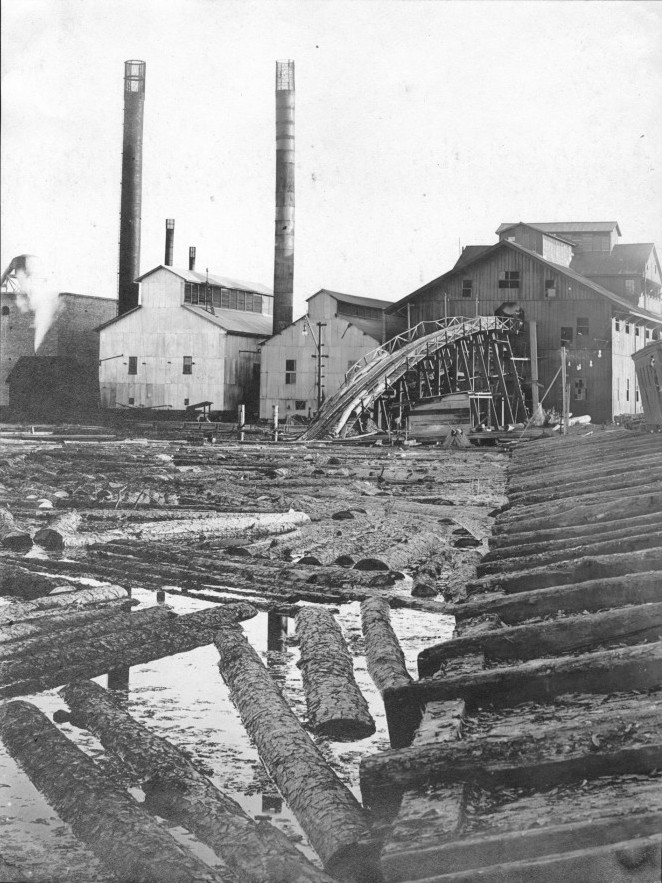
- Wikimedia Commons, "File:Southern Pine Lumber Company sawmill, TX.jpg" - public-domain 1907 J. D. Cress photograph of the Southern Pine Lumber Company yellow pine mill used as the article image.