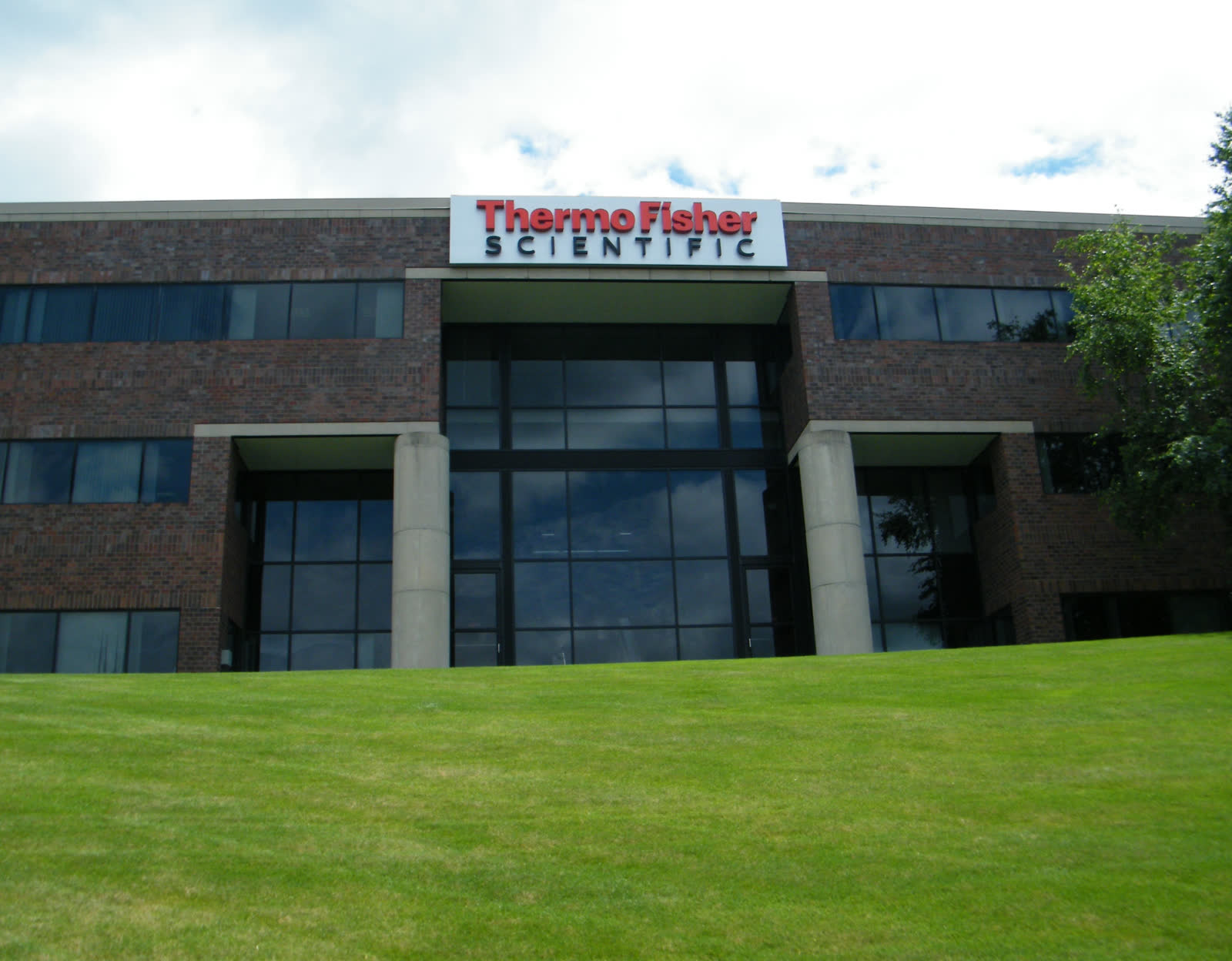
Thermo Fisher is no longer priced like a broken post-pandemic lab supplier. At roughly $173 billion of market value and about 25.5x trailing earnings, the stock already gives management credit for a cyclical recovery, the Clario acquisition, and the company's claim that scale plus process discipline can keep earnings compounding.[4] What is new is the narrow proof investors need from here: reported growth is not enough. Organic growth has to do the work.
The first quarter looked strong on the surface. Revenue rose 6% to $11.01 billion, GAAP EPS rose 11% to $4.43, adjusted EPS rose 6% to $5.44, free cash flow more than doubled to $825 million, and Thermo Fisher repurchased $3.0 billion of stock.[1] Those numbers justify revisiting the name. They do not settle the valuation. The same filing shows that organic revenue growth was only 1%, with acquisitions contributing 3% and currency translation contributing 2%.[1]
That split is the whole stock. Priced is a world where Thermo Fisher's customers slowly resume ordering instruments, bioproduction inputs, diagnostics, lab products, and outsourced pharma services. New is whether that recovery can become self-funded operating leverage rather than a bridge built from M&A, foreign exchange, and buybacks.
Six Anchors
- $11.01 billion: Q1 2026 revenue, up 6% from the prior year.[1]
- 1% organic growth: the cleanest warning inside the quarter, after stripping out acquisitions and currency.[1]
- 21.8% adjusted operating margin: essentially flat versus 21.9% a year earlier, despite higher revenue.[1]
- $47.3 billion to $48.1 billion: updated 2026 revenue guidance, implying 6% to 8% reported growth.[3]
- 3% to 4% organic growth: the full-year 2026 organic assumption management kept after Q1.[3]
- 7% long-term organic CAGR: the Investor Day target that defines the real rerating bar.[2]
Those anchors make Thermo Fisher a valuation walkthrough, not a simple earnings recap. The stock can work if Q1 was a low organic-growth starting point and the lab cycle keeps normalizing through the year. It becomes fragile if Q1 was closer to the underlying run rate and the long-term story depends too heavily on bolt-on growth, AI language, and capital deployment.
Why The Franchise Still Deserves A Premium
Thermo Fisher is a rare scale asset in life-science infrastructure. The company touches research labs, analytical testing, diagnostics, bioproduction, clinical trials, pharma services, instruments, consumables, and service contracts. In Q1, Laboratory Products and Biopharma Services produced $6.04 billion of revenue, Life Sciences Solutions produced $2.64 billion, Analytical Instruments produced $1.72 billion, and Specialty Diagnostics produced $1.14 billion.[1] That mix matters because the business is not one product cycle. It is a basket of customer budgets.
The Investor Day case is that those budgets sit inside a $255 billion addressable market with improving demand trends.[2] Management also framed AI as a demand accelerator, arguing that better drug discovery productivity can feed more investment into customer pipelines while Thermo Fisher captures value across the drug-development chain.[2] That is plausible, but it should be read as a mechanism, not a slogan. AI only matters financially if it increases instrument utilization, speeds trials, improves lab productivity, or expands outsourced work.
Clario fits that strategy. Thermo Fisher completed the acquisition in late March, adding a clinical endpoint-data business that management says is complementary to its clinical research capabilities.[1][3] The call transcript says Clario contributed only $30 million of revenue and $0.01 of adjusted EPS in Q1 because it closed late in the quarter, but full-year guidance now includes $900 million of Clario revenue and $0.32 of adjusted EPS accretion net of financing costs.[3] That is meaningful. It also makes the organic-growth gate more important, because acquisitions can make the company larger while leaving the underlying customer cycle only partly healed.
The Margin Bridge Is Tight
Thermo Fisher's margin story is respectable but not yet explosive. Q1 adjusted operating income rose 6% to $2.40 billion, while adjusted operating margin slipped 10 basis points to 21.8%.[1] Management later said the updated 2026 guide assumes 70 basis points of adjusted operating-margin expansion for the year, helped by Clario and Q1 performance.[3] That is the bridge investors are being asked to buy: low organic growth early, better phasing later, and enough productivity to protect margins while inflation, mix, and customer timing remain uneven.
The PPI Business System is central to that argument. Investor Day described PPI as the company's continuous-improvement engine for quality, productivity, customer allegiance, and colleague engagement.[2] In finance terms, PPI is the mechanism that is supposed to turn a broad portfolio into margin discipline rather than bureaucracy. If Thermo Fisher can keep taking cost out, route customers across its brands, and integrate acquisitions without operational drag, the premium multiple is easier to defend.
The counterweight is that scale can hide softness. A company with $11 billion of quarterly revenue can look stable even when academic/government demand, China volume, instrument timing, or pharma-service phasing is uneven. The transcript itself notes that Q1 organic revenue was in line with prior guidance, not that demand had suddenly broken out.[3] A valuation rerating needs more than stability. It needs evidence that order patterns are turning.
Capital Deployment Helps, But It Is Not The Thesis
Buybacks provided a real per-share support in Q1. Thermo Fisher repurchased $3.0 billion of stock and increased the dividend by 10%.[1] The transcript says the full-year plan assumes those buybacks were already completed in January and roughly $700 million of dividends will be returned to shareholders during 2026.[3] That discipline matters because the company is not asking investors to wait passively for the lab cycle.
Still, buybacks are secondary. At 25.5x trailing earnings, the market is not pricing Thermo Fisher as a deep-value capital-return story.[4] It is pricing a quality compounder whose customer base should improve. If organic growth reaches the 3% to 4% 2026 guide and moves toward the 7% long-term target, the multiple can look reasonable. If organic growth stays near 1%, the same multiple begins to look like investors are paying a recovery price before the recovery has arrived.[1][2][3][4]
Falsifier
The falsifier is two consecutive quarters in which organic growth fails to approach the 2026 guide while margin expansion depends mainly on acquisition accounting, cost actions, or buybacks. More concretely: organic growth remains near 1%, adjusted operating margin does not move toward the planned 70 basis points of full-year expansion, and management keeps leaning on Clario accretion rather than broad customer-demand improvement.[1][3]
Under that branch, Thermo Fisher would still be a high-quality scientific-infrastructure company. It would not deserve a clean lab-cycle rerating yet. The market would be paying for a recovery that remains visible in guidance before it is visible in the base business.
Watchlist
- Q2 organic growth: management expected about 3% organic growth for the second quarter, so the next print is the first hard test of Q1 phasing.[3]
- Adjusted operating margin: the company needs visible progress toward the full-year expansion target, not just EPS support from buybacks.[1][3]
- Life Sciences Solutions vs Analytical Instruments: Q1 showed strong Life Sciences segment income but weaker Analytical Instruments margin, making mix important.[1]
- Clario integration: watch whether the acquisition remains accretive without distracting from the base organic-growth recovery.[3]
Thermo Fisher's best case is straightforward: a normalized lab cycle, clinical research data expansion, disciplined M&A, and PPI productivity combine into mid-single-digit organic growth and low-teens adjusted EPS compounding. The harder case is equally clear: Q1's headline growth was helped by non-organic factors, and the stock already assumes improvement. Organic growth is the gate. Until it opens wider, the valuation is a conditional premium, not a bargain.
Sources
- Thermo Fisher Scientific, Exhibit 99.1, "Thermo Fisher Scientific Reports First Quarter 2026 Results" (April 23, 2026) - Q1 revenue, organic growth bridge, margins, segment results, free cash flow, buybacks, and balance-sheet details.
- Thermo Fisher Scientific, "Thermo Fisher Scientific Highlights Industry Leadership, Growth Outlook and Long-Term Value Creation at 2026 Investor Day" (May 20, 2026) - market-size, PPI, AI, capital-deployment, and long-term organic-growth targets.
- The Motley Fool, "Thermo Fisher (TMO) Q1 2026 Earnings Transcript" (April 23, 2026) - updated 2026 guidance, Clario contribution, Q2 phasing, margin-expansion assumptions, and capital-return details.
- Yahoo Finance, "Thermo Fisher Scientific Inc. (TMO) Stock Price, News, Quote & History" (accessed June 19, 2026) - market capitalization, trailing P/E, quote context, and 52-week range.
- Wikimedia Commons, "File:Thermo Fisher headquarters.jpg" - Coolcaesar photograph of Thermo Fisher Scientific headquarters in Waltham, Massachusetts, used as the article image.