Darden's third quarter was strong enough that the market no longer needs to be told the simple bull case. Priced is that Olive Garden and LongHorn can keep taking share inside full-service dining when consumers want a sit-down meal that still feels like value. New is narrower: whether that traffic can keep converting into earnings while beef costs, smaller-portion menu mix, Bahama Breeze cleanup, and a heavier development plan all press on margin at the same time.
The headline was good. For the quarter ended February 22, 2026, Darden reported $3.345 billion of sales, up 5.9%, with blended same-restaurant sales up 4.2%.[1] LongHorn Steakhouse was the cleanest growth engine, with same-restaurant sales up 7.2% and segment sales up 11.2%.[1][3] Olive Garden was less spectacular but still important: same-restaurant sales rose 3.2%, segment sales rose 4.7%, and management said the brand outperformed the industry benchmark by 440 basis points even with fewer price-point promotions.[1][3]
That is not a broken consumer story. It is a value-calibrated consumer story. The customer is still eating out, but the winning chains are the ones that make the trade feel controlled: reliable food, visible service, enough portion choice, and a bill that does not feel like a fine-dining experiment. The 2026 ACSI restaurant study fits that read: LongHorn and Texas Roadhouse tied at the top of the full-service category with scores of 82, while Olive Garden sat close behind at 81.[4] Satisfaction is not the same thing as profit, but it helps explain why Darden can still talk about traffic and retention while much of casual dining feels more promotional.
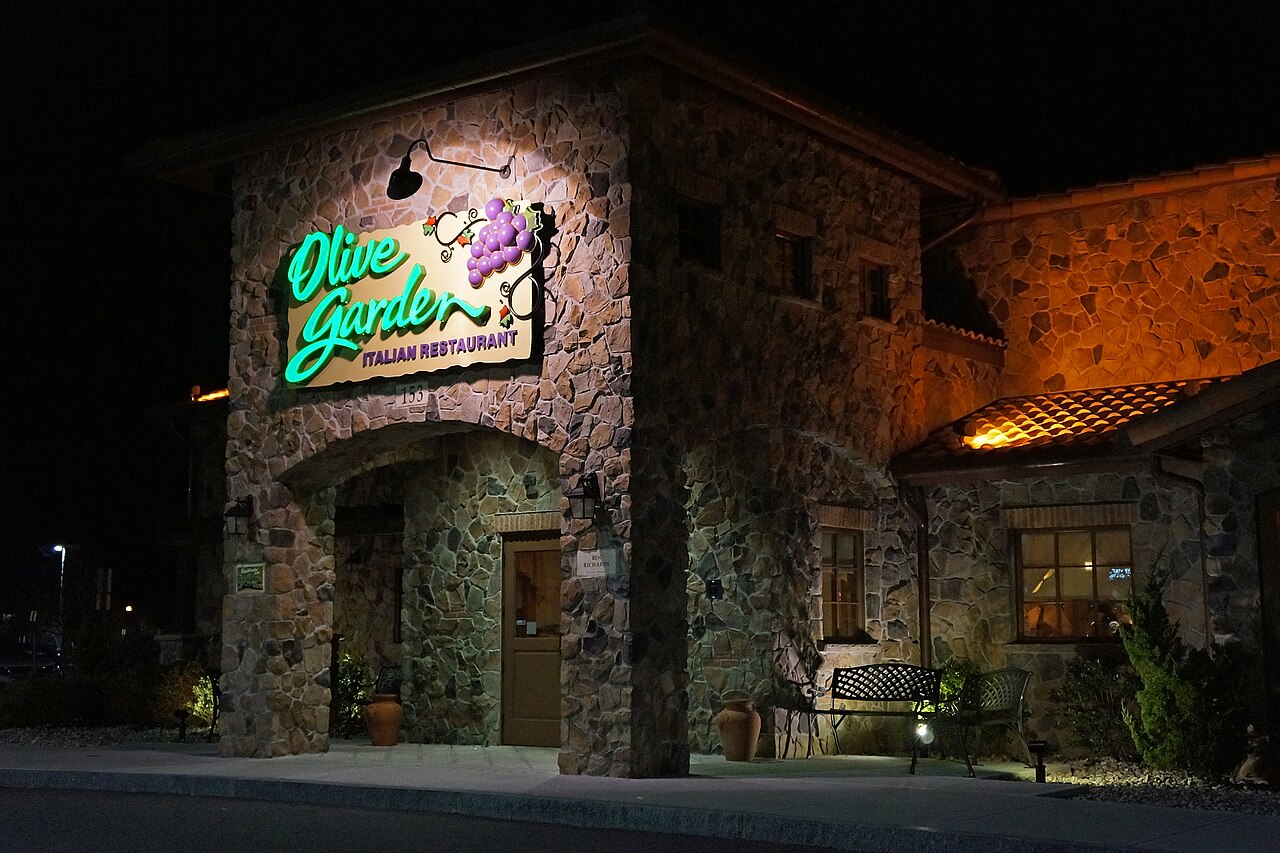
Image context: the cover uses Anthony92931's real 2012 Wikimedia Commons photograph of an Olive Garden in Danvers, Massachusetts.[5] The choice is deliberately operational rather than symbolic. This earnings story is about what happens inside and around thousands of physical restaurants: pricing, portions, staffing, grill execution, closures, conversions, and whether the guest still sees the meal as fair value.
What The Quarter Actually Proved
The quarter proved Darden has demand breadth. Every reported segment posted positive same-restaurant sales: Olive Garden at 3.2%, LongHorn at 7.2%, Fine Dining at 2.1%, and Other Business at 3.9%.[1] That matters because Darden is not a one-brand stock even if LongHorn is currently the cleanest story. A portfolio can absorb unevenness better than a single concept, but only if the weaker brands do not dilute the stronger ones.
The quarter also proved that LongHorn's value position has not cracked under beef inflation. Management said LongHorn's same-restaurant sales exceeded the industry benchmark by 840 basis points and traffic exceeded the benchmark by 640 basis points, while segment profit margin still reached 18.6% despite elevated beef costs.[3] That is the part investors should respect. A steakhouse that can gain traffic while beef is expensive is doing more than pushing price. It is making guests believe the trade is still favorable.
Olive Garden's proof was different. The chain is not producing LongHorn-style comps, but it is defending scale with a more flexible value architecture. Management tied some of the quarter's margin investment to the lighter-portion section of the menu, estimating about 40 basis points of Olive Garden margin effect from the menu addition and delivery fee impact.[3] That is not obviously bad. Smaller portions can pressure check and mix, but they can also protect frequency from guests who want lower price points, less food, or a meal that fits new weight-loss-drug eating patterns. The finance question is whether Olive Garden can keep that traffic without teaching guests to trade down permanently.
Where Margin Still Owns The Stock
The margin bridge is the reason this is not a victory-lap recap. Adjusted diluted EPS from continuing operations reached $2.95, up 5.4%, but restaurant-level EBITDA margin was 21.0%, down 30 basis points year over year.[1][2] Food and beverage costs were 30.7% of sales, 50 basis points unfavorable, while restaurant labor was 31.3% of sales, 20 basis points favorable.[2] That is a mixed operating signal: Darden is getting enough labor and sales leverage to soften the blow, but commodity and menu pressure are still visible.
Segment margins show the same pattern. Olive Garden margin was basically flat at 23.0% versus 23.1% a year earlier. LongHorn, despite the best sales growth, fell to 18.6% from 19.7%. Fine Dining slipped to 22.0% from 22.5%, while Other Business held at 15.6%.[2] This is the essential equity debate. Sales strength is already accepted. The next rerating needs proof that sales strength can survive the cost stack without forcing Darden into either too much price or too much margin sacrifice.
The Bahama Breeze decision adds another layer. Darden said it would permanently close 14 Bahama Breeze locations and convert the remaining 14 to other Darden brands over the next 12 to 18 months.[3] Management does not expect a material financial impact, and that may be true at the consolidated level.[3] Still, the move is a useful reminder that portfolio discipline matters. A multi-brand operator creates value when it moves capital, real estate, and teams toward concepts with better returns. It destroys value when weak banners absorb management attention and capex.
The Capital Plan Is Getting Heavier
Darden is not behaving like a company that wants to coast. Its fiscal 2026 outlook calls for about 70 new restaurant openings, $750 million to $775 million of capital spending, 9.5% total sales growth, and adjusted diluted EPS of $10.57 to $10.67, including about $0.25 from the 53rd week.[1][2] Those are not defensive numbers. They imply that management still sees enough white space to fund growth while returning cash.
The early fiscal 2027 framing is even more revealing. On the Q3 call, management said it expects 75 to 80 new restaurants in fiscal 2027, plus the 14 Bahama Breeze conversions, with roughly $850 million of capital spending: about $475 million for new restaurants, $25 million for conversions, and $350 million for maintenance, refresh, and technology.[3] That is a bigger check than the current-year outlook. It can be good capital if new units and conversions attach to strong brands. It can become a drag if the consumer weakens just as the buildout accelerates.
This is why Darden's story differs from a simple restaurant traffic read. The stock is really asking investors to underwrite a capital-allocation loop: use Olive Garden and LongHorn cash flow to fund new units, convert weaker boxes, protect service quality, hold labor stability, and still return cash through dividends and repurchases. In Q3, Darden declared a $1.50 quarterly dividend and repurchased $127 million of stock, leaving $516 million on its authorization.[1] Capital return is still there. The debate is whether growth capex will keep earning enough to justify taking that much room in the model.
Six Numeric Anchors
- Sales: Q3 sales rose 5.9% to $3.345 billion.[1]
- Comp growth: blended same-restaurant sales rose 4.2%, led by LongHorn at 7.2% and Olive Garden at 3.2%.[1]
- Earnings: adjusted diluted EPS from continuing operations was $2.95, up 5.4%.[1]
- Margin pressure: restaurant-level EBITDA margin was 21.0%, down 30 basis points, with food and beverage costs 50 basis points unfavorable.[2]
- Brand margin split: Olive Garden segment margin held near flat at 23.0%, while LongHorn margin fell to 18.6% from 19.7% despite stronger sales.[2]
- Growth capital: fiscal 2026 capex is guided to $750 million to $775 million, and early fiscal 2027 planning points to about $850 million.[1][3]
Strongest Counterweight
The strongest bullish counterargument is that the margin pressure is a deliberate investment phase, not a structural deterioration. Darden is defending guest value, keeping service execution high, and letting LongHorn and Olive Garden win share while competitors fight for traffic. If customer satisfaction remains high and sales stay ahead of the industry benchmark, then accepting some short-term margin pressure may be the right way to preserve the brands' long-run frequency.[3][4]
That argument is especially credible because Darden is not relying on one lever. It has menu work at Olive Garden, grill-and-service execution at LongHorn, private-dining strength in Fine Dining, Yard House momentum in Other Business, and a real-estate cleanup path for Bahama Breeze.[1][3] The portfolio is more flexible than the headline "Olive Garden parent" label suggests.
The caution is that flexibility does not make cost inflation disappear. Beef can still squeeze LongHorn. Smaller portions can still change Olive Garden mix. New-unit spending can still arrive before new-unit earnings. Conversions can still look easy in slides and harder in local execution.
Falsifier
The cautious read is wrong if Q4 and early fiscal 2027 show three things together: same-restaurant sales stay near or above the guided path, LongHorn margin stabilizes despite elevated beef costs, and the Bahama Breeze conversions begin without visible disruption to labor, capex, or brand focus.[1][3] In that case, Q3 margin pressure should be treated as a controlled investment in share gains rather than as a warning that traffic is being bought too expensively.
The bearish falsifier is just as concrete. If comps remain positive but restaurant-level EBITDA margin keeps sliding, especially at LongHorn, then the market will have to separate guest demand from shareholder economics. A full restaurant is not automatically a high-return restaurant.
Watchlist
- June 25, 2026 results: Darden's fiscal Q4 and full-year release is the next proof point for whether the 3.5% to 5.0% implied Q4 same-restaurant sales range held.[3]
- LongHorn margin: the 18.6% Q3 segment margin is the line to watch because it shows whether steakhouse traffic can outrun beef cost.[2][3]
- Olive Garden mix: lighter portions need to protect visits without permanently lowering check or four-wall economics.[3]
- Fiscal 2027 capex: the planned step toward about $850 million matters only if new units and conversions earn their way into the multiple.[3]
Takeaway
Darden's Q3 FY2026 report was a good quarter, but the investment question has moved beyond "can the brands bring people in?" They can. LongHorn is gaining share, Olive Garden still has scale, and the portfolio remains broad enough to manage weaker banners.
The harder question is whether value-led traffic can keep becoming high-quality earnings. That is the proof Darden still owes investors: not more evidence that guests like the brands, but more evidence that the brands can keep turning that affection into margins, returns, and disciplined growth.
Sources
- Darden Restaurants via PRNewswire, "Darden Restaurants Reports Fiscal 2026 Third Quarter Results; Declares Quarterly Dividend; And Updates Fiscal 2026 Financial Outlook" (March 19, 2026) - Q3 sales, comp sales, EPS, dividend, repurchase, and fiscal 2026 outlook.
- Darden Restaurants, "Q3 FY2026 Earnings Release Deck" PDF (March 19, 2026) - margin bridge, restaurant-level EBITDA, segment margins, and annual target framework.
- Darden Restaurants, "Q3 FY2026 Earnings Call Transcript" PDF (March 19, 2026) - management commentary on Olive Garden lighter portions, LongHorn benchmark outperformance, Bahama Breeze closures/conversions, Q4 guide, and early fiscal 2027 capex.
- American Customer Satisfaction Index, "Restaurant and Food Delivery Study 2026" press release (June 16, 2026) - full-service restaurant satisfaction scores for LongHorn, Texas Roadhouse, and Olive Garden.
- Wikimedia Commons, "File:Olive Garden restaurant.jpg" - real photograph by Anthony92931 of an Olive Garden restaurant in Danvers, Massachusetts, taken October 22, 2012.