As of 2026-03-30 UTC, copper is easy to misread as a pure demand trade. The market already knows the headline drivers: more grids, more transformers, more electric vehicles, more cooling load, more data-center power equipment. That part is increasingly priced. The newer issue is that copper supply is no longer behaving like a quick price-response function. The real bottleneck is duration: even with strong prices, replacing aging capacity takes longer, costs more, and depends on a narrower set of mines and smelters than many equity narratives admit.[1][2][3]
That distinction matters for capital allocation. The sector's next dispersion will not come from who can say "electrification" loudest. It will come from which producers already control permitted, long-life ore bodies and processing access, and which names still require heroic assumptions about discovery, grade, infrastructure, and midstream bargaining power.[1][3][5]
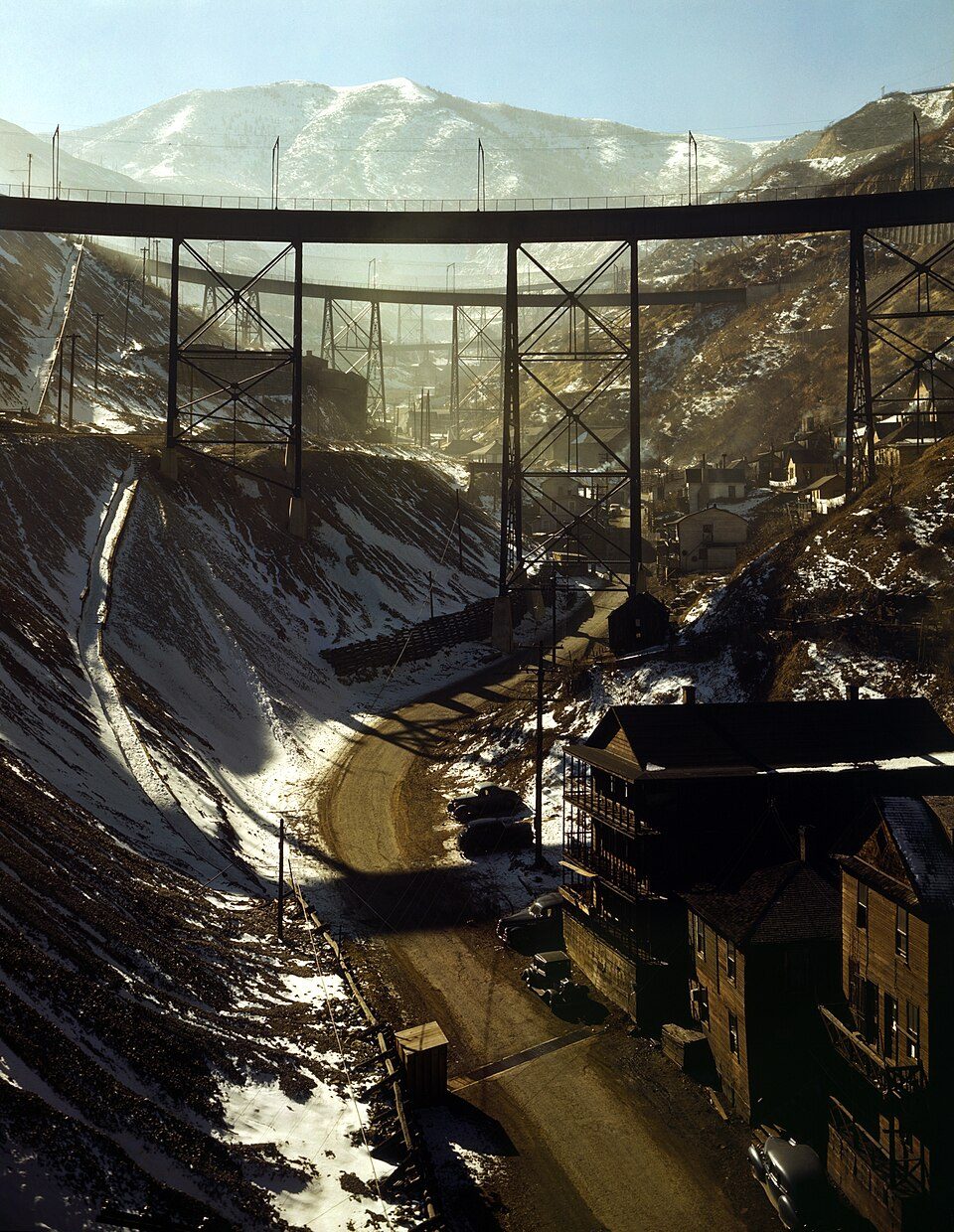
Image context: the cover photo shows Bingham Canyon Mine in Utah in November 1942, photographed by Andreas Feininger for the U.S. Office of War Information. It fits this article because copper supply is still an earth-moving business. However digital the end demand looks, the replacement problem still starts with rock, grade, haulage, concentration, and time.[7]
Priced vs new
Priced: copper demand should keep growing as electricity networks expand and transport, buildings, and industry electrify. Investors are also already aware that copper prices have broken into a higher range, with the USGS estimating the 2025 COMEX average at $4.80 per pound, a record annual level.[1]
New: the supply side looks slower and more fragile than the usual "high prices cure high prices" script. USGS estimates world mine production at 23.0 million tonnes in 2025, essentially flat from 2024, even before you get to the bigger pipeline problem.[1] The IEA's 2025 outlook says announced copper mine projects cover only about 70% of 2035 requirements, implying a potential 30% shortfall under current policy settings.[2]
That is the gap investors need to price correctly. This is no longer just a demand story. It is a question of how quickly the industry can replace and expand supply without running into geology, permitting, and capital-intensity drag at the same time.
The supply stack has become a duration problem
First, ore quality is doing more of the work than most slide decks admit. The IEA notes that the average global grade at copper mines has fallen 40% since 1991.[3] Lower grades do not just mean lower margins. They usually mean more rock moved, more water handled, more energy used, and more plant intensity for each tonne of copper delivered.
Second, discovery is no longer refreshing the pipeline fast enough. Of the copper deposits discovered over the last 35 years, the IEA says only 5% were found in the last decade.[3] That is a weak replenishment rate for a market that increasingly needs not only more metal, but more reliable metal from politically acceptable jurisdictions.
Third, brownfield expansion is no longer cheap enough to treat as a free option. The IEA says average capital intensity for brownfield copper expansions has risen 65% since 2020, moving toward levels once associated with greenfield projects.[3] That is the crucial finance point. Even when producers own the land, the pit, and the workforce, preserving or adding copper output is becoming more capex-heavy.
Fourth, midstream concentration is getting sharper exactly when concentrate is tightest. The IEA's March 2026 copper commentary says China accounted for more than 90% of growth in global copper smelter output since 2005, lifting its share from roughly 15% to half of global supply in 2025.[3] In a looser market that might just be an efficiency story. In a tighter market it becomes a bargaining-power story, especially for miners and non-Chinese custom smelters.
Six anchors that constrain the thesis
- World mine production: 23.0 million tonnes in 2025, flat year over year.[1]
- Major-country concentration: Chile still leads at 5.3 million tonnes, Congo (Kinshasa) at 3.2 million, and Peru at 2.7 million in 2025.[1]
- Price backdrop: the USGS estimated the 2025 COMEX high-grade copper average at $4.80/lb.[1]
- Pipeline gap: announced mine projects meet only about 70% of 2035 copper requirements, implying a 30% shortfall.[2]
- Project-speed constraint: new copper projects take around 17 years from discovery to production on average, while recent discoveries account for just 5% of deposits found over the last 35 years.[3]
- Replacement capex reality: BHP's March 2026 Escondida filing proposes $4.4 billion to $5.9 billion of investment for a new concentrator that would add 220,000 to 260,000 tonnes per year of replacement capacity, with first production targeted for 2031 to 2032.[5]
These anchors point to a narrower conclusion than the commodity bull case usually offers. Copper may still have a strong long-run demand path, but the investable issue is not "more demand equals easy upside." The investable issue is whether existing producers can defend and extend supply fast enough to justify how the market is capitalizing the cycle.
What this means for miners, smelters, and valuation
The cleanest beneficiaries of this setup are not necessarily the loudest copper storytellers. They are the producers that already control tier-one ore bodies, existing concentrators or clear brownfield options, and enough balance-sheet room to fund replacement projects without turning every expansion into a financing event. BHP's own operating data capture the tension. In its half-year FY2026 operational review, Escondida posted record concentrator throughput, but the average concentrator feed grade still fell to 0.93% from 1.03% a year earlier.[4] That is exactly what a duration problem looks like in practice: better operations can offset declining grade for a while, but not for free and not forever.
For custom smelters, the setup is harsher. The IEA notes that the annual TC benchmark settled at $0 per tonne in January 2026, while spot TC/RCs had already gone negative earlier.[3] That means the tightest part of the market is no longer just the mine. It is the negotiation between concentrate supply and processing capacity. Outside China, that raises a simple question: who has enough by-product value, premium product positioning, or long-term commercial protection to survive a market where processing income itself has collapsed?[3]
For equity valuation, the consequence is that "high copper price" should no longer be treated as a one-line bullish shortcut. You have to ask what portion of the price signal actually survives after lower grade, sustaining capex, replacement plant spend, water constraints, and midstream dependency are taken into account. In that sense, copper is starting to look less like a clean spot-price beta trade and more like a long-duration industrial infrastructure story with real execution risk.
Strongest counterweight
The strongest counterweight is that a structurally tight market does not guarantee a straight-line supercycle. Demand can still slow cyclically, scrap can respond, substitution can advance, and policy support can accelerate recycling and project delivery. The IEA's recycling work argues that copper's secondary-supply share has stagnated since 2015, but that a post-2030 rise in end-of-life scrap could reverse that pattern.[8] If growth softens and recycled supply improves faster than expected, the market can feel loose for long stretches even inside a longer-duration supply problem.
Falsifier
This thesis is wrong if the next 12 to 18 months produce a three-part shift: world mine production breaks decisively above the 2025 plateau, brownfield replacement projects stop showing escalating capital intensity, and non-Chinese smelter economics improve enough that concentration risk eases rather than worsens. In that world, copper would prove more cyclical and less duration-constrained than this framework assumes.[1][3][5]
Watchlist
- 2026-04-22 BHP Operational Review: the nine-month update for the period ended 31 March 2026 is the next clean read on grade, throughput, and guidance at one of the world's most important copper assets.[4][6]
- Escondida permit progress in Chile: if a flagship brownfield project slips even at this quality tier, the market should assume replacement capacity across the sector is harder than advertised.[5]
- 2026-07-16 and 2026-08-18 BHP reporting dates: BHP's year-end operational review and FY2026 results will test whether copper's share of earnings can keep rising without a parallel jump in replacement-capex anxiety.[5][6]
- TC/RC behavior and custom-smelter cuts: if benchmark and spot treatment charges remain near current stressed levels, the industry is still telling you that concentrate is the binding constraint, not end demand.[3]
Takeaway
Copper bulls are broadly right about one thing: the world does need more metal. But that statement is now too blunt to be useful on its own. The more important question is where the next tonnes come from, how long they take to appear, and how much capital they consume on the way. In 2026, copper is less a pure demand story than a supply-duration story, and the winners are likely to be the incumbents that can replace depletion without relying on fantasy timelines.[1][2][3][4][5]
Sources
- U.S. Geological Survey, Mineral Commodity Summaries 2026: Copper.
- International Energy Agency, Global Critical Minerals Outlook 2025 — executive summary.
- International Energy Agency, "Copper prices have hit record highs, but smelters face mounting strategic pressures" (2 March 2026).
- BHP, Operational Review for the half year ended 31 December 2025 (20 January 2026).
- BHP, "Escondida | BHP submits environmental permit to build a new concentrator plant" (17 March 2026).
- BHP, "Financial calendar".
- Wikimedia Commons, "File:Bingham Canyon Mine 1942c.jpg".
- International Energy Agency, Recycling of Critical Minerals — executive summary.