Texas Instruments finally printed a quarter that looked like demand, not just less-bad digestion. Revenue reached $4.83 billion, up 9% sequentially and 19% year over year, while EPS came in at $1.68 and second-quarter guidance moved to $5.00 billion to $5.40 billion of revenue and $1.77 to $2.05 of EPS.[1][2]
That is enough to keep the recovery case alive. Priced is that analog and embedded demand were going to bottom and rebound with time. New is narrower: TI is finally showing the kind of broad industrial recovery, data-center pull, and inventory improvement that can make the 300mm manufacturing buildout look like operating leverage rather than a multiyear cash drag.
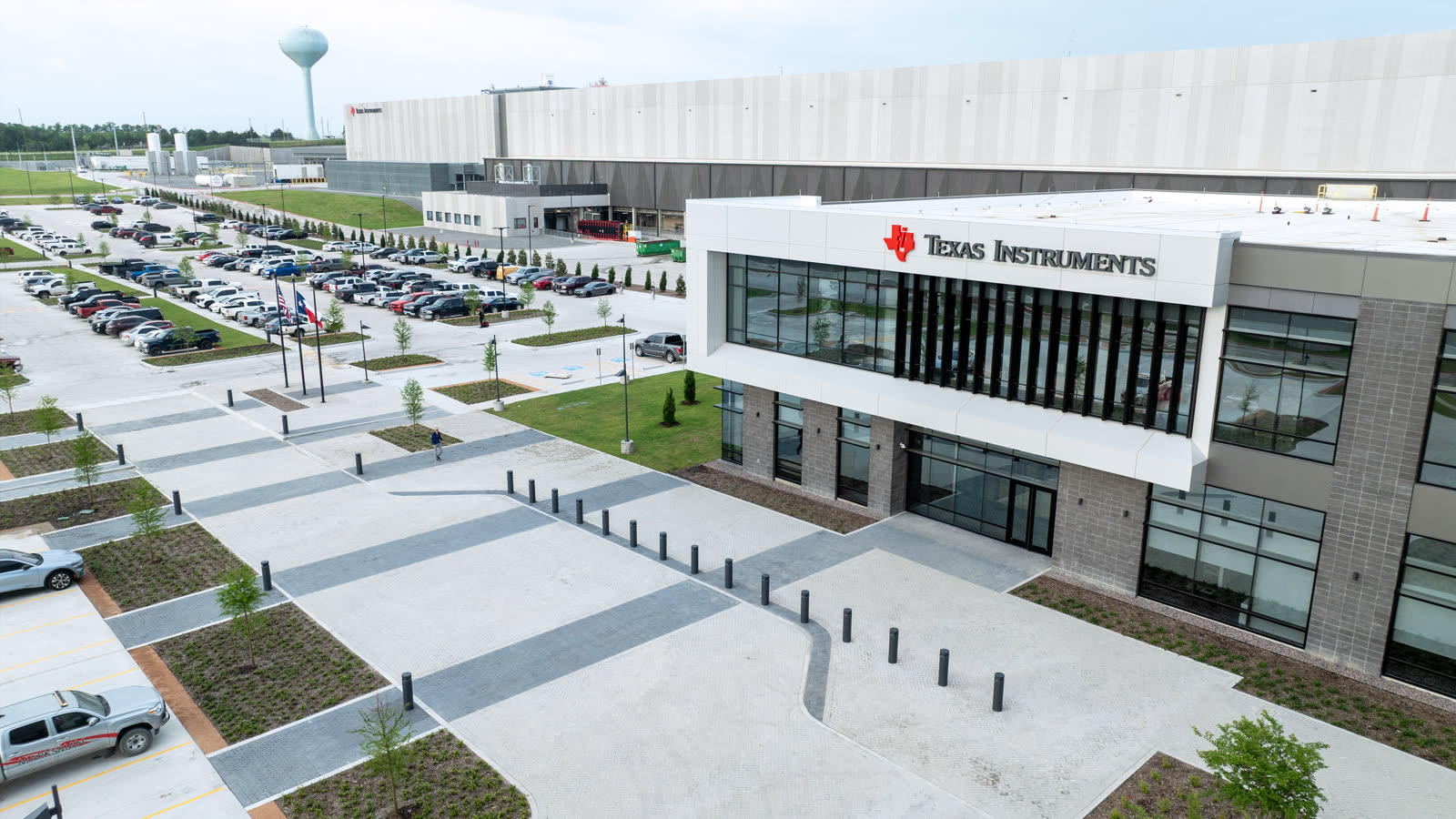
Image context: the cover uses a real TI Sherman wafer-fab photograph rather than a semiconductor graphic or stock-chart screenshot. That fits the article because TI's earnings argument still begins with physical capacity, internal wafer ownership, and the cost curve of real manufacturing assets.[5]
The quarter looked broad enough to matter
The most important detail in the call was breadth. Management said first-quarter revenue came in above the top of the guided range as industrial and data center continued to accelerate.[2] Industrial increased more than 30% year over year and more than 20% sequentially, with growth broad across sectors and regions. Data center grew about 90% year over year and more than 25% sequentially. Communications equipment also grew about 25% year over year and more than 30% sequentially, while automotive was up only mid-single digits and roughly flat sequentially.[2]
That mix matters because TI does not need one hot pocket of AI infrastructure to carry the whole company. In its 2025 Form 10-K, TI said industrial and automotive represented about 70% of revenue, and management keeps framing those two markets as the company's best long-term growth lane.[4] So the real positive in Q1 was not merely that data center was strong. It was that the ordinary industrial base finally moved with it.
Why the 300mm story matters more now
TI has spent years asking investors to underwrite an unusual semiconductor model: own more of the wafer base internally, push more production onto 300mm, accept heavy capital spending, and harvest the cost advantage over a long cycle. That story was easy to believe in theory and harder to reward when end demand was soft.
The reporting now shows why the debate is changing. In the 2025 Form 10-K, TI said it was still working toward sourcing more than 95% of its wafers internally by 2030, with more than 80% on 300mm.[4] The same filing also showed $17.68 billion of 2025 revenue, giving a sense of the scale against which that manufacturing system has to pay off.[4] In Q1, management tied the improving cash picture directly to that production base: trailing twelve-month cash flow from operations was $7.8 billion, free cash flow was $4.4 billion, and the company again highlighted the benefit of 300mm production.[1]
But the cleaner read needs one adjustment. The free-cash-flow line is better, yet it is not pure operating leverage. Management said trailing free cash flow included $965 million of CHIPS Act incentives, including a $555 million payment received in the first quarter related to the start of production at TI's newest 300mm wafer fab in Sherman, Texas.[2] That does not invalidate the manufacturing thesis. It does mean investors should separate structural cost advantage from temporary funding support while the fab network is still being built out.
Six numeric anchors
- Quarterly beat: Q1 revenue was $4.83 billion, net income was $1.55 billion, and EPS was $1.68, including a 5-cent benefit that was not in the original guidance.[1]
- Breadth of recovery: industrial grew more than 30% year over year and more than 20% sequentially, while data center grew about 90% year over year and more than 25% sequentially.[2]
- Still uneven mix: automotive was only up mid-single digits year over year and about flat sequentially, which matters because it is still one of TI's biggest strategic end markets.[2][4]
- Inventory improvement: quarter-end inventory was $4.7 billion, and inventory days were 209, down 13 days sequentially.[2][3]
- Near-term guide: second-quarter revenue guidance is $5.00 billion to $5.40 billion, with EPS of $1.77 to $2.05.[1][2]
- Cash and buildout frame: trailing twelve-month cash flow from operations was $7.8 billion, free cash flow was $4.4 billion, capital expenditures were $4.1 billion, and CHIPS Act incentives included a $555 million first-quarter payment tied to Sherman.[1][2]
Those anchors point to the same conclusion. TI no longer needs investors to imagine the upcycle from a distance. The demand rebound is visible. The harder question is whether that rebound will now convert into cleaner incremental margins and cash generation as the 300mm system scales.
Strongest counterweight
The strongest pushback is that this article may still be too conservative. TI does not need a heroic rerating argument if the business has simply re-entered a more normal volume environment. Pricing was stable in Q1, better than management's usual seasonal model, and Haviv Ilan said prices could rise in the second half if demand stays strong enough.[2] If industrial really is broadening again and inventory is already coming down, the margin structure could improve faster than skeptics expect even before every new fab reaches fuller utilization.
That is plausible. It is also why the watch items now matter more than the headline beat. When a company spends years building internal capacity, the market eventually stops rewarding the promise and starts rewarding the conversion.
Falsifier
This recap is too bullish if the next two quarters show that Q1 was mostly a mix-and-incentive quarter rather than a durable operating turn. The clean falsifier would be a combination of slowing industrial orders, flatter data-center growth, inventory days stalling or rising back above the current trajectory, and free-cash-flow improvement that continues to lean heavily on incentives instead of volume, pricing, and factory absorption.[1][2][3]
In that scenario, the 300mm roadmap remains strategically interesting but financially early.
Watchlist
- Q2 execution versus guide: the first question is whether TI merely lands inside the $5.00 billion to $5.40 billion range or starts making the rebound feel self-sustaining.[1][2]
- Inventory days: the move to 209 days was real progress; the next proof is whether inventory keeps falling while service levels remain competitive.[2][3]
- Pricing into the second half: management said pricing was stable in Q1 and could move higher later in the year if demand holds.[2]
- 300mm cash conversion: investors should keep separating structural operating leverage from CHIPS-assisted cash flow as Sherman and the rest of the network ramp.[2][4]
Takeaway
TI's first quarter was good enough to change the burden of proof. The company no longer looks like a cyclical analog name waiting for recovery in theory. It now looks like a manufacturer getting the early shape of that recovery in industrial, data center, and inventory movement. The next rerating step is more specific: show that the 300mm footprint can turn visible demand into sustained margin and cash-flow leverage after the incentive tailwind is stripped out.
Sources
- Texas Instruments, "TI reports first quarter 2026 financial results and shareholder returns" (April 22, 2026).
- Texas Instruments, Q1 2026 earnings call transcript (April 22, 2026).
- Texas Instruments, Form 10-Q for the quarter ended March 31, 2026 (filed April 24, 2026).
- Texas Instruments, 2025 Form 10-K / annual report (filed February 6, 2026).
- Texas Instruments, "TI's Sherman, Texas 300mm wafer fabs" press kit.