Investors already see the photogenic half of the undersea network: Meta’s planned Waterworth system, more than 50,000 kilometres long, is a multi-billion-dollar route designed to carry AI-era traffic across five continents. The less visible constraint is waiting time. The industry’s latest public repair sample shows that a broken telecom cable spent an average 23.4 days between fault notification and vessel departure in 2025, followed by another 7.7 days in transit before work at sea could begin.[1][2]
That gap changes the finance question. More fibre creates capacity and, when routes are genuinely diverse, redundancy. It does not create a crewed repair ship, a load of compatible spare cable, a marine permit, or priority in a regional maintenance queue. The scarce asset is not only glass on the seabed. It is the option to reach that glass when the route is already down.
The growth story is measured in kilometres
Meta’s Waterworth announcement captures why capital keeps arriving. The project is meant to open three new ocean corridors and use 24 fibre pairs, against the 8 to 16 pairs Meta describes as typical for other new systems. It also pushes much of the route into deep water and calls for heavier burial in risky shallows.[1] That combination promises more capacity, more geographic reach, and less exposure to anchors near shore.
The existing base is already enormous. The International Cable Protection Committee, or ICPC, puts the global telecom network at roughly 1.8 million kilometres. It says deployed length rose from about 1 million kilometres in 2014 to 1.7 million in 2025.[3] The obvious investment logic is that traffic growth and route diversification require still more wet plant, landing stations, terrestrial backhaul, and long-lived marine construction.
Yet a route’s economic value is not simply lit capacity multiplied by years of service. A cable is useful because it can carry traffic when demanded and because other cables can take over when it cannot. Once one route breaks, rerouting may spare customers an obvious outage, but the network has spent some of its redundancy. The broken asset is then a clock: every day without repair extends the period in which a second fault can turn an invisible incident into congestion or disconnection.
A fault becomes a queue before it becomes a splice
Cable damage is operationally routine rather than exceptional. ICPC estimates 150 to 200 telecom faults a year, with 70–80% caused by accidental human activity, chiefly fishing and anchors.[3] Better route design, burial, armour, and maritime awareness have kept the number of faults broadly stable even as the network has lengthened. That is a real engineering success.
It is not the same thing as fast restoration. ICPC’s 2026 plenary reported 178 repairs in 2025, an average 23.4 days from notification to departure, and another 7.7 days in transit.[2] The lower repair count is encouraging: ICPC attributed the improvement in kilometres per repair to better cable protection. But TeleGeography’s 2025 testimony found that total repair delays had been increasing, driven largely by notification-to-departure friction in Asia and the Middle East.[10]
The delay begins before the ship moves. Operators must locate the fault, identify the responsible maintenance agreement, confirm a vessel and qualified crew, load the right cable and jointing kit, secure port access, and obtain authority to work in the relevant waters. Most faults happen in coastal waters, precisely where national processes, cabotage rules, and port clearance can dominate mobilisation time.[3][10] Once on site, the crew still has to grapple or cut the cable, bring its ends aboard, splice and test a replacement section, lower it back, and sometimes rebury it.
The visible invoice is only part of the cost. ICPC estimates a telecom repair after anchor damage at roughly £500,000 to £1 million per incident.[4] The larger economic exposure is route-specific: lost capacity, traffic bought elsewhere, service credits, a weaker negotiating position with wholesale customers, and the value of redundancy consumed while the cable remains unavailable. One dragged anchor can also damage several nearby systems and turn a sequence of individual jobs into a vessel backlog.[4]
A maintenance contract is a real option
New cable capital and repair readiness solve different problems. Construction spending buys a route. A maintenance agreement buys access to a response system: a vessel stationed within a defined zone, trained jointing teams, compatible spares, marine-base support, and rules for deciding which fault goes first.[8][9]
That makes the contract resemble an insurance policy with a physical exercise mechanism. The owner pays while the ship is waiting because the option is valuable precisely when nothing has broken. When a fault arrives, the return on that standby cost appears as priority and reduced exposure to a second event. Orange Marine states the commercial rule plainly: maintenance customers know where its vessels are and have priority.[8]
Keppel Infrastructure Trust’s investment materials make that cash flow visible. Global Marine Group maintains about a third of the world’s maintained subsea-cable length with its partners; its long-term agreements pay fixed annual sums regardless of actual vessel use, and KIT described fleet utilisation as close to full.[9] Availability becomes revenue before the repair invoice arrives. The same fact is also a warning: a busy fleet has less obvious slack when faults cluster.
The fleet owner faces the mirror-image economics. A dedicated repair vessel must remain ready enough to sail, but an idle ship, crew, depot, and inventory are expensive. Installation work can improve utilisation, yet a ship committed to a long build is not automatically available for an urgent repair. The market therefore has an awkward capacity problem: society values spare readiness, while an operator earns the cleanest revenue by keeping an expensive asset busy.
Orange’s replacement plan shows both confidence and constraint. In November 2025 it ordered two maintenance-focused ships for delivery in 2028 and 2029. They will replace vessels dating from the 1980s rather than simply add two net units, while Orange explicitly called fleet ageing a major industry concern.[6] New steel can improve reliability and operating cost, but replacement alone does not shorten every regional queue.
Europe is now paying for the option
Public money is entering the gap because the benefit of rapid repair extends beyond the cable owner. In June 2026 the European Commission opened a €40 million call for emergency repair capacity in the Mediterranean and Atlantic, including outermost regions.[5] The design is revealing: it will fund modular equipment for at least three preconfigured vessels, with installation required within three days after a vessel reaches the host port or shipyard following a request. Applicants must be public bodies with an emergency-response mandate.[5]
This is not a subsidy for laying another glamorous transoceanic route. It is funding for convertibility—the ability to turn a suitable vessel into a repair platform when commercial capacity cannot respond to a serious incident. In finance terms, Europe is paying to reduce mobilisation time and tail dependence on a small specialist fleet.
The model also sets a useful test. Modules solve only one part of readiness. A credible proposal still needs vessels in the right basin, trained people, cable and jointing supplies, port access, seabed intelligence, permits, and an operating protocol that works during a real emergency. Hardware sitting ashore is inventory; a rehearsed chain that can reach a fault is capacity.
The strongest counterweight: the network usually absorbs a break
It would be wrong to turn every fault into a systemic-crisis thesis. Cable kilometres have risen sharply while annual fault counts have stayed broadly stable.[3] Most damage is accidental, so routing, burial, anchor management, and fishing-industry coordination can prevent incidents without building an unlimited repair fleet. On well-connected corridors, traffic switches to other submarine or terrestrial paths and most end users never notice one cut.[3]
TeleGeography’s 2025 testimony to the U.S. Congress sharpens the objection: it describes the global specialist fleet as robust and attributes most of the present repair wait to notification-to-departure friction—often permits, cabotage rules, customs, and port clearance—rather than too few ships or slow transit.[10] The distinction matters. A new hull adds nominal supply; a pre-cleared hull in the right jurisdiction adds effective supply.
New routes can strengthen that defence. Waterworth’s deep-water routing and burial plans address the physical risk directly, while three new corridors should add diversity if their landings and terrestrial paths avoid existing concentration points.[1] More capable fibre can also carry rerouted traffic with less congestion. The repair-dock thesis is therefore not “new cables are fragile.” It is narrower: capacity and repairability are complements, and a route should not receive full strategic credit until both are funded.
What would prove this view wrong
The thesis fails if deployment continues to grow while repair response improves without a sustained increase in standby resources. A clean falsifier would be successive industry updates showing shorter notification-to-departure and transit times across the pressured Asian and Middle Eastern regions, stable fault frequency, and no rise in multi-fault backlogs—even as old ships retire and new cable mileage enters service.[2][3][10]
That outcome would mean better prevention, routing, contracting, and vessel utilisation are supplying resilience more efficiently than the current waiting-time evidence suggests. In that case, public repair reserves would be useful insurance, not proof of a binding capacity gap.
Watchlist
October 8, 2026 — the EU call closes. The quality signal is not the number of applications but whether credible proposals pair named vessels, trained operators, host ports, and a protocol that can fit each module within three days of the vessel’s arrival.[5]
April 13–15, 2027 — the ICPC plenary in Nairobi. This is the next scheduled annual repair-time read. Watch the departure and transit components separately: faster ships cannot compensate for longer permitting or queue delays at the dock.[2]
2028 and 2029 — Orange’s replacement ships arrive. The key distinction is replacement versus net regional readiness: which older vessels leave, where the new ships are based, and whether maintenance coverage or response guarantees actually improve.[6]
The undersea AI trade is easy to photograph as a construction boom. Its harder asset sits at the quay, provisioned and waiting. For cable owners, carriers, and the governments that depend on them, the right diligence question is not only “How much capacity will this route carry?” It is “Who is already under contract to retrieve it?”
Sources
- Meta Engineering, “Unlocking global AI potential with next-generation subsea infrastructure” (February 14, 2025) — Waterworth’s scale, investment horizon, fibre-pair design, routing, burial, and resilience rationale.
- International Cable Protection Committee, “2026 Plenary Highlights” (updated April 20, 2026) — 2025 repair count, departure and transit times, protection trend, repair-preparedness context, and the announced 2027 plenary dates.
- International Cable Protection Committee, “Media Enquiries & Frequently Asked Questions” (updated 2026) — global network length, fault frequency, causes, rerouting, maintenance framework, and permitting guidance.
- International Cable Protection Committee, “Damage to Submarine Cables from Dragged Anchors” (updated February 24, 2025) — anchor-fault share, telecom repair-cost range, multi-cable damage, and vessel-backlog risk.
- European Health and Digital Executive Agency, “CEF-Digital second call for proposals to increase Europe’s submarine cable repair capacities” (June 18, 2026) — funding, eligible regions and applicants, module design, vessel-readiness condition, and deadline.
- Orange, “Orange Marine modernizes its fleet of cable ships to secure digital infrastructure in Europe, Africa and the Middle East” (November 3, 2025) — replacement-vessel roles, operating regions, delivery years, and fleet-ageing rationale.
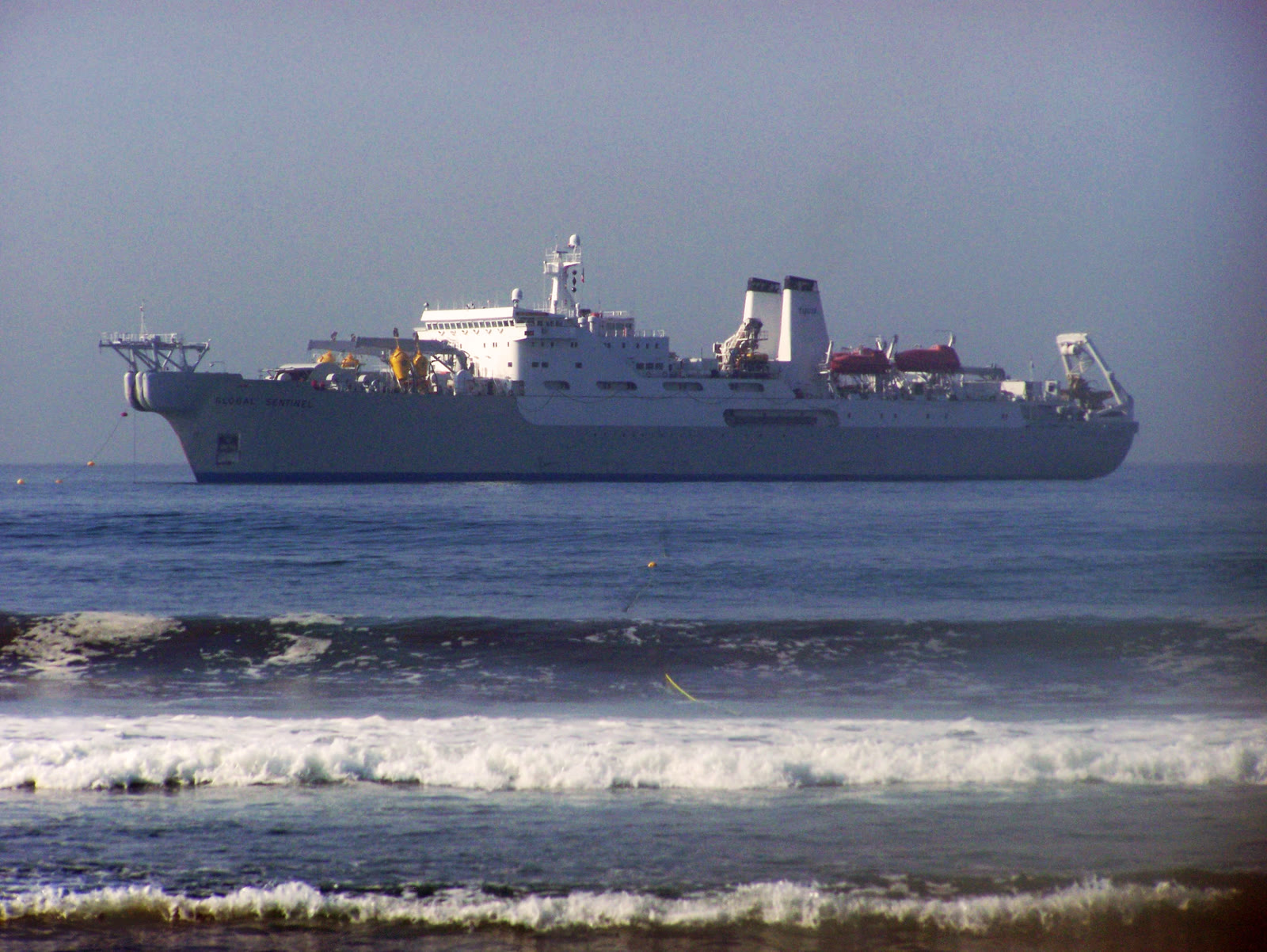
- Nc tech3, “Cable Ship — Global Sentinel — Tyco Telecom” — Wikimedia Commons source page for the real photograph of Global Sentinel laying a submarine cable system; resized for this article; CC BY-SA 4.0.
- Orange Wholesale, “How we power global subsea connectivity with Orange Marine” (May 3, 2024) — maintenance priority, fleet readiness, and an operational account of concurrent repairs in African waters.
- Keppel Infrastructure Trust, “Keppel Infrastructure Trust to co-invest in Global Marine Group” (April 1, 2025) — maintained-network share, fleet, contract payments, utilisation, and recurring-cash-flow rationale.
- TeleGeography, Written testimony of Tim Stronge to the U.S. House Energy and Commerce Committee (November 19, 2025) — repair-fleet readiness, delay mechanism, regional permitting friction, route investment, and the counter-case to a general vessel shortage.