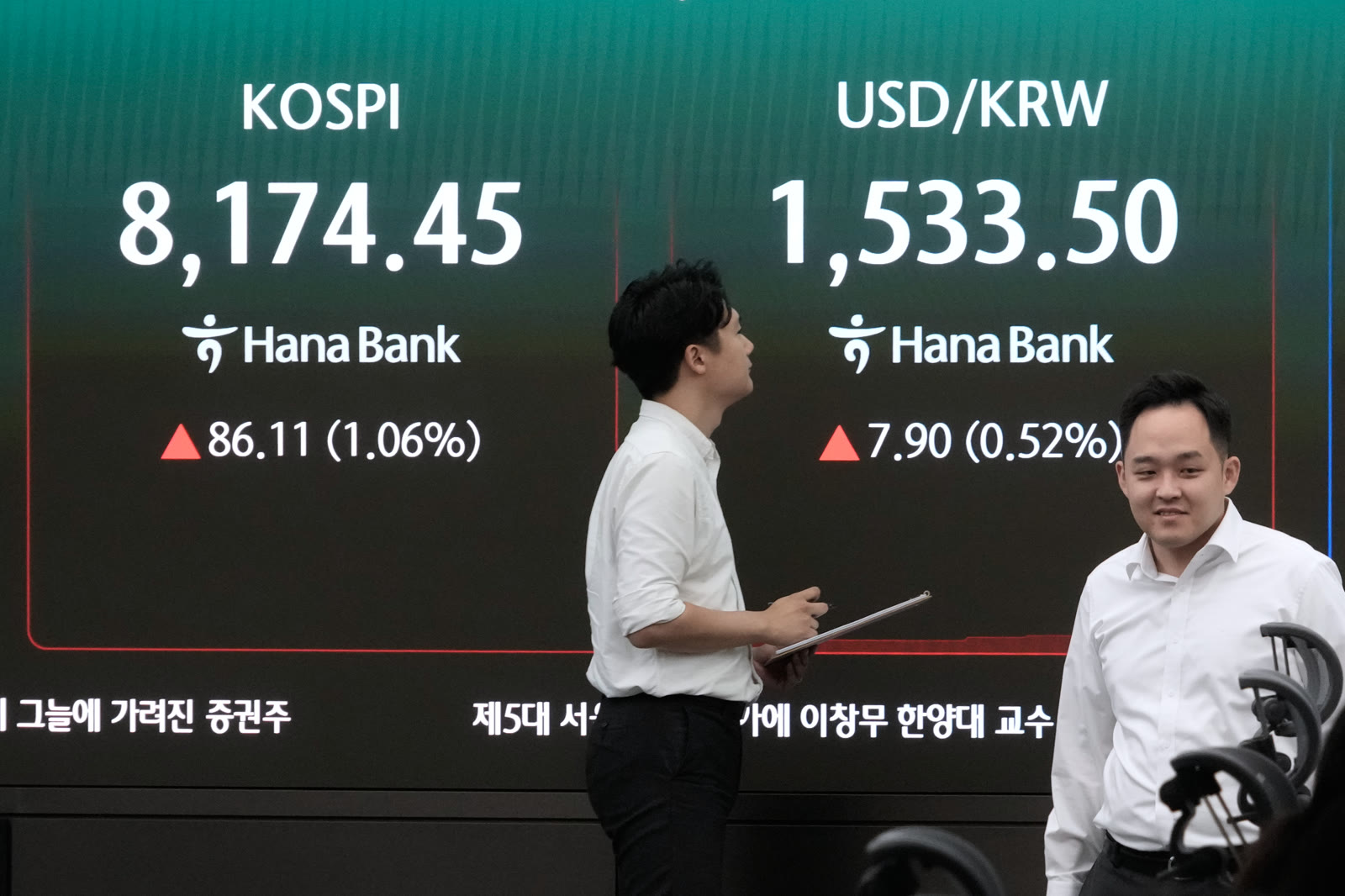
As of 2026-07-10 12:38 UTC, SK hynix's U.S. depositary shares have been priced but have not yet made their first Nasdaq trade. The easy headline is access: a leading supplier of high-bandwidth memory is arriving in U.S. hours and dollars, trading when-issued as SKHYV on July 10 before regular-way SKHY begins July 13. The harder read is that American investors are not getting a new business. They are getting a new wrapper around the same Korean common shares, plus a very large primary capital raise.[1][2][4]
That distinction sets up the opening trade. The final prospectus priced each American depositary share, or ADS, at $149. Using the prospectus's own conversion of SK hynix's July 9 Seoul close, one-tenth of the underlying common share was worth about $142.13. That is a roughly 4.8% gap to the filing's fixed-currency reference, not a synchronized live-market premium. Some premium may reward easier access and a deeper dollar order book. But the first price investors should watch is not the U.S. line in isolation; it is the U.S. line relative to Seoul after adjusting for the ten-to-one ratio, spot won, time zones, and conversion costs.[1]
Before the First Print
This is a cross-listing and an equity financing at the same time. SK hynix is selling 177.9 million ADSs, each representing one-tenth of a newly issued common share. Gross proceeds are about $26.5 billion, with the company estimating roughly $26.2 billion after underwriting discounts, commissions, and expenses. The 17.79 million underlying new shares equal about 2.5% of the issued common-share count immediately before the deal.[1]
That makes the debut more consequential than a convenience listing. A sponsored ADS program can widen the shareholder base without changing the operating company. A $26.2 billion cash injection can change how quickly that company builds, packages, and equips capacity. Existing holders pay for that option through dilution; management then has to earn a return on the new capital.
The filing-reference gap needs a boundary around it. The prospectus converted the July 9 Seoul close of ₩2,186,000 into $1,421.28 per common share using a July 2 exchange rate of ₩1,538.05 per dollar. Dividing by ten produces the $142.13 ADS reference. Because the stock close and currency fixing are not simultaneous, 4.8% is a historical reference gap, not a risk-free arbitrage quote. Live USD/KRW, the next Korean session, depositary procedures, and the U.S. opening auction can all move the comparison.[1]
Six Numbers That Constrain the Read
- $149 per ADS: the U.S. offer price and the opening cost basis for allocated buyers.[1]
- $26.5 billion gross; about $26.2 billion net: large enough to make capital allocation, not listing ceremony, the central long-run issue.[1]
- Ten ADSs for one common share: the conversion ratio that lets investors compare SKHY with KRX code
000660.[1] - 2.5% new-share issuance: meaningful dilution, though far smaller than the cash raise looks when expressed in dollars.[1]
- 56.4% HBM market share by revenue: IDC's first-quarter estimate in the prospectus explains why U.S. buyers are willing to fund the company at scale.[1]
- 72% first-quarter operating margin: SK hynix reported ₩52.5763 trillion of revenue and ₩37.6103 trillion of operating profit, evidence of extraordinary scarcity economics—and a demanding baseline for future capacity to defend.[3]
These anchors pull in opposite directions. The ADS is not merely a speculative receipt attached to an unproven issuer: it represents a company with exceptional current earnings and an estimated majority share of the HBM market. Yet a 72% operating margin is also a warning against straight-line valuation. Memory margins rise when demand outruns qualified supply; the very capital attracted by those margins eventually works to close the shortage.
What the Wrapper Changes
The ADS program removes several practical barriers for U.S. investors. It trades on Nasdaq during the American session, settles through U.S. market infrastructure, is quoted in dollars, and can fit mandates or brokerage platforms that do not handle direct Korean shares. AP's debut report also notes the strategic fit: the United States is SK hynix's largest sales geography, so the listing brings the shareholder channel closer to a major customer market.[2][4]
If the ADS develops a deep book, the benefits can compound. More investors can compare SK hynix directly with Micron and the broader U.S.-listed AI supply chain. Dollar liquidity can improve price discovery around U.S. technology news. A liquid stock can also become a more useful currency for future financing or transactions. None of those outcomes is guaranteed on day one, but they are the credible case for a valuation rerating.
The wrapper is not frictionless, however. Citibank is the depositary, and the prospectus allows holders to surrender ADSs for underlying shares or deposit common shares to create ADSs, subject to procedures and legal limits. Issuance or cancellation can cost up to $5 per 100 ADSs before brokerage, tax, and currency expenses. Withdrawal can be delayed, and re-deposit may require company consent if program limits would be exceeded. The filing explicitly warns that arbitrage between Nasdaq and Seoul can create volatility rather than eliminate it instantly.[1]
This is why a first-day premium is ambiguous. It could be a genuine access bid. It could be an opening-auction imbalance while Seoul is closed. It could compensate arbitrageurs for FX, conversion time, and inventory risk. Only repeated closes, adjusted on a like-for-like basis, can separate a durable U.S. liquidity premium from debut mechanics.
What the Wrapper Cannot Change
Ten ADSs still represent one SK hynix common share. The ADS does not remove won exposure from the underlying business. It does not grant direct Korean shareholder status: ADS holders send voting instructions through the depositary. It does not erase customer concentration, export-control exposure, fabrication risk, or the tendency of memory supply to arrive after the best pricing has already encouraged expansion.[1]
Most important, the listing cannot make today's margins permanent. SK hynix's first-quarter result validates the HBM scarcity story, but it also raises the hurdle. New capacity has to move through construction, equipment installation, process yield, customer qualification, and advanced packaging before it produces saleable memory. When it does, returns depend on demand absorbing the bits without forcing a price reset.[3]
The offer proceeds are broad rather than project-locked. The prospectus says management expects to use the net cash for general corporate purposes, including capital expenditures, and retains substantial discretion over timing and allocation.[1] That flexibility is useful in a fast-moving technology cycle. It is also the governance question investors inherit: a record-sized raise should be judged by incremental returns, not by the prestige of the listing.
The Strongest Counterweight
The strongest bullish argument is that the wrapper can still alter the cycle indirectly by lowering the friction around capital. SK hynix already holds a leading HBM position, and its latest reported earnings give it unusual internal funding power. Adding roughly $26.2 billion of net proceeds could let the company invest through bottlenecks without leaning as heavily on debt or waiting for retained cash.[1][3]
If management directs that money toward capacity customers have effectively committed to absorb, the dilution can be highly productive. A broader U.S. owner base could then support a lower cost of equity, while dollar trading makes the company easier to own alongside the rest of the AI infrastructure chain. Under that branch, the listing is not just a wrapper: it becomes a financing advantage that helps protect technical leadership.
The counterweight has a condition. Capital must reach qualified output before competitors close the technology gap, and the added supply must earn an attractive return after memory prices normalize. A large cash balance is optionality, not proof.
Falsifier
The wrapper-not-cycle thesis fails if two things become durable rather than theatrical: SKHY holds a meaningful premium to the FX- and ratio-adjusted Seoul share across several weekly closes after creation and cancellation activity is functioning, and the new capital funds capacity that lifts shipments without compressing returns as industry supply grows.[1]
That combination would show that U.S. access has changed SK hynix's cost of equity enough to alter operating economics. A first-day pop alone would not. Nor would higher output paired with falling margins.
Watchlist
- July 10 — the when-issued close: compare ten
SKHYVshares with one Seoul common share translated at spot USD/KRW. Volume, bid-ask spread, and the adjusted premium matter more than the unadjusted percentage move.[1][2][4] - July 13 — regular-way trading: Nasdaq says the temporary
SKHYVsymbol switches toSKHY. Watch whether spreads and the cross-market gap normalize when the permanent ticker and ordinary settlement convention take over.[4] - July 14 — offering delivery: the prospectus schedules delivery of the ADSs through DTC for the third business day after pricing, while ordinary secondary trades generally settle in one day. Watch whether that unusual opening settlement bridge creates borrow or delivery noise.[1][4]
- July 30 — Samsung Electronics' second-quarter call: Samsung's scheduled results provide the closest dated public read on a major memory competitor's pricing, mix, and capacity posture.[5]
The cleanest conclusion before SKHY's first trade is also the least promotional. Nasdaq can reroute demand for SK hynix shares, and $26.2 billion can expand the company's choices. Neither changes what investors ultimately own: a formidable HBM franchise operating at exceptional margins inside one of technology's most capital-intensive cycles.
Sources
- SK hynix Inc., Form 424B4 final prospectus (filed July 10, 2026) — final offer price, ADS ratio, proceeds, dilution, Seoul reference price, HBM share, depositary mechanics, fees, settlement, and risk factors.
- Associated Press, "SK Hynix hits the U.S. stock market as demand for memory chips soars amid AI frenzy" (July 10, 2026) — debut context, offering scale, U.S. revenue exposure, and the Ahn Young-joon photograph used for the cover.
- SK hynix Newsroom, "SK hynix Announces 1Q26 Financial Results" (official Korean release, April 23, 2026) — first-quarter revenue, operating profit, margin, and business commentary.
- Nasdaq Trader, "SK hynix Inc. American Depositary Shares When-Issued and Regular-Way Trading" (July 7, 2026) — temporary and permanent ticker symbols, trading dates, and settlement timeline.
- Samsung Electronics Investor Relations, "Notices" — official notice scheduling the second-quarter 2026 earnings call for July 30.