Priced: the 2027 Saver's Match is a better retirement subsidy because it can put federal money directly into an eligible retirement account. New: the uptake trade is not the match formula. It is the tax-return pipe, the account destination, and whether providers make the claim feel automatic instead of like a second tax project.[1][2]
That distinction matters for households, payroll platforms, IRA providers, state auto-IRA programs, and retirement-policy investors. A government match can be generous on paper and still miss the people it is meant to reach if the claimant needs to know a new form, designate the right non-Roth destination, file a return despite owing little tax, and choose a provider that accepts the payment. The rule change is real. The distribution channel is the spread.
The Mechanism
The current Saver's Credit is a tax credit. IRS Form 8880 says eligible taxpayers calculate a credit for qualified retirement savings contributions, with the 2025 form capping the credit at $1,000 for individuals and $2,000 for married joint filers.[3] The catch is structural: the credit is limited by tax liability. A worker who owes little federal income tax may not be able to use the full benefit, even if the worker managed to contribute to an IRA or workplace plan.
The Saver's Match changes the product. New Internal Revenue Code section 6433 allows an eligible individual who makes qualified retirement savings contributions to receive a matching contribution equal to the applicable percentage of up to $2,000 of contributions. The default percentage is 50%, so the headline match can reach $1,000 per individual.[1] The match is generally paid by Treasury as a contribution to the person's designated eligible retirement savings vehicle after the person files a tax return claiming it.[1][2]
That is the economic upgrade. A nonrefundable credit asks, "Do you owe enough tax to use this?" A direct retirement contribution asks, "Did you save, are you eligible, and can the government route the match into a valid account?" The second question is more powerful for lower-income savers, but it is also operationally heavier.
The law sets the first eligibility gate by income. For 2027, joint filers get the full 50% match up to a $41,000 applicable dollar amount, with a $30,000 phaseout range; single filers use half those amounts, meaning the full-match line begins at $20,500 and phases out by $35,500.[1] Head-of-household filers use three-quarters of the joint amounts.[1] Inflation adjustments begin after 2027, rounded to the nearest $1,000.[1]
The second gate is account type. Notice 2024-65 says qualified retirement savings contributions can include traditional and Roth IRA contributions, elective deferrals to 401(k), 403(b), governmental 457(b), SIMPLE IRA, or SEP arrangements, certain voluntary after-tax employee contributions, and section 501(c)(18) contributions.[2] But the match itself must land in an applicable retirement savings vehicle: a traditional non-Roth IRA or the non-Roth portion of a qualifying 401(k), 403(b), or governmental 457(b) plan that accepts Saver's Match contributions and is designated by the individual.[2]
That non-Roth destination is not trivia. Many state auto-IRA programs default workers into Roth IRAs. The worker's own payroll contribution can qualify for the match, but the federal match may need a separate traditional destination if the default account is Roth. The money is therefore not only a tax incentive. It is a routing problem.
Why the Old Credit Underreached
The old credit had three problems: awareness, refundability, and friction. The IRS page for the Saver's Credit lists the familiar eligibility screens: age 18 or older, not a dependent, not a student, and contribution to an eligible account.[3] Form 8880 then asks the taxpayer to work through contribution amounts, income tiers, and a tax-liability limitation.[3] For a high-engagement taxpayer, that is manageable. For the target population, it is a leak.
The Center for Retirement Research at Boston College puts the failure plainly: less than 6% of taxpayers claimed the Saver's Credit in 2021, and the nonrefundable design meant many lower-income workers could not use it fully.[6] That is the macro point. A tax preference is not the same thing as a cash-flow incentive if the people it is meant to help lack tax liability, account access, filing support, or awareness.
The Saver's Match tries to fix the highest-value part of that problem by changing the benefit from "reduce tax owed" to "deposit a match." But the claim still starts with a tax return. Notice 2024-65 says Treasury and the IRS were asking for comments on all aspects of implementation, including how contributions are reduced by certain distributions during a testing period, how the applicable retirement savings vehicle is designated, and how providers handle the contribution.[2]
In other words, the fiscal design moved forward before the retail experience was solved. That is normal for tax policy, but it is exactly where uptake gets won or lost.
The Auto-IRA Bridge
The largest practical use case is the worker without a workplace retirement plan. Pew estimates that nearly 57 million American workers, almost half of the private-sector workforce, do not receive retirement benefits at work.[5] State auto-IRAs are designed for that gap: automatic payroll deduction into an IRA, usually with opt-out rights and low employer administration.
The match could make that channel materially stronger. Pew surveyed workers without employer-sponsored retirement benefits and found that 87% of respondents said they would be more likely to save in an auto-IRA program if the Saver's Match were added; 79% said the match would lead them to consider increasing contributions.[5] Those are intentions, not realized deposits, but they point to the right mechanism. A match works best when it is attached to payroll habit, not when it is discovered once a year during tax prep.
The April 30, 2026 executive order tries to address the access layer from a different angle. It directs Treasury to establish TrumpIRA.gov by January 1, 2027, with information about qualifying low-cost IRAs for workers such as independent contractors, self-employed workers, and others without employer-sponsored plans.[4] The order also says listed IRAs should accept Saver's Match contributions, have no minimum contribution or balance requirements, and keep overall net expense ratios, including operating, management, and administrative costs, limited to 0.15%.[4]
The market read is simple. If that website becomes a low-friction account-selection and routing layer, the match gets easier to claim. If it becomes a static directory that still leaves taxpayers to solve account opening, contribution setup, tax-form routing, and traditional-vs-Roth confusion, the match will look bigger than it behaves.
The Counterweight
The strongest bullish case is that the policy finally aligns with behavior. A 50% match on the first $2,000 saved is legible. It feels closer to an employer match than to a tax worksheet. It can also be combined with auto-IRA defaults, payroll deduction, and tax software prompts. If the worker is already saving, the match can turn a small contribution into a more meaningful first balance.
The match also avoids one common political weakness of retirement tax subsidies. It is explicitly targeted lower in the income distribution. The full-match thresholds and phaseouts make the benefit less dependent on high marginal tax rates than a deduction. For workers who have been largely outside the 401(k) system, this is a better-shaped incentive than another deduction they cannot use.
But the bearish counterweight is also strong. The eligible worker still needs spare cash to contribute. A $1,000 maximum federal match requires the worker to save $2,000 first. For someone making the income levels the law targets, that can be a large ask. The match can raise the return on saving, but it cannot eliminate rent, childcare, debt service, or irregular income.
The Roth mismatch is the second counterweight. CRR highlights the mechanical concern: state auto-IRAs often use Roth accounts, while Saver's Match funds are pre-tax and need compatible account treatment.[6] If the worker has to understand why one payroll deduction is post-tax but the federal match needs a traditional bucket, the policy loses some of the simplicity that makes matches powerful.
The third counterweight is provider participation. Section 6433 and Notice 2024-65 both make acceptance by the account or plan part of the delivery chain.[1][2] Plans and IRA providers need systems for receiving, identifying, reporting, correcting, and explaining federal match contributions. The more bespoke the process feels, the more likely the benefit remains concentrated among savers with better tax help.
Falsifier
The thesis fails if the implementation becomes nearly invisible to the saver. Specifically: tax software and IRS forms prepopulate eligible contributions, providers broadly accept Saver's Match deposits, state auto-IRA programs give every eligible saver a clean traditional destination for the match, nonfilers get a simple claim path, and the first 2028 deposit cycle shows low rejection or error rates.[2][5][6]
Under that branch, the tax-return pipe stops being the bottleneck. The market would then be right to treat the Saver's Match as a true participation shock for low- and moderate-income retirement saving, not just a statutory upgrade.
Watchlist
First, watch January 1, 2027. The executive order sets that date for Treasury to establish TrumpIRA.gov. The site does not need to be flashy; it needs clear eligible-account routing, low-cost filters, and provider acceptance signals.[4]
Second, watch the 2027 IRS form package. The 2025 Form 8880 already says a new separate form will be used to claim the Saver's Match for 2027 tax returns filed in 2028.[3] The key question is whether that form behaves like a short claim path or another worksheet.
Third, watch state auto-IRA updates during 2027. The real adoption bridge is payroll deduction plus a match-compatible account. If states and providers make that handoff obvious, the Saver's Match gains scale; if they leave the Roth/traditional distinction to the taxpayer, leakage rises.[5][6]
Fourth, watch the first filing season in early 2028. The clean metric is not press awareness. It is whether claimed matches successfully land in designated accounts without large numbers of rejected deposits, provider corrections, or taxpayer notices.[2]
The bottom line is narrow. The Saver's Match is a better-designed subsidy than the old Saver's Credit, but the investment case for retirement access does not turn on generosity alone. It turns on plumbing: payroll, tax software, IRS forms, account acceptance, and whether a low-income worker can claim the match without becoming a retirement-plan administrator for a day.
Sources
- Cornell Law School Legal Information Institute, "26 U.S. Code section 6433 - Saver's Match" - statutory text for match amount, phaseout thresholds, account destination, effective date, and special rules.
- Internal Revenue Service, "Notice 2024-65: Request for Comments Regarding Implementation of Saver's Match Contributions" - IRS and Treasury implementation background, qualified contribution categories, testing-period rules, and account-routing questions.
- Internal Revenue Service, "2025 Form 8880: Credit for Qualified Retirement Savings Contributions" - current Saver's Credit mechanics and IRS note that a separate Saver's Match form will be used for 2027 returns filed in 2028.
- Federal Register, "Executive Order 14403 of April 30, 2026: Promoting Retirement-Savings Access for American Workers by Establishing TrumpIRA.gov" - January 1, 2027 website deadline, provider criteria, and 0.15% expense-ratio standard.
- The Pew Charitable Trusts, "Federal Saver's Match, Coming in 2027, Could Boost Automated Retirement Savings Programs" (September 11, 2025) - auto-IRA access gap, survey results, participation intentions, and implementation recommendations.
- Alicia H. Munnell, Center for Retirement Research at Boston College, "The Savers Match Could Really Help Low- And Middle-Income Workers" (September 24, 2025) - analysis of the old Saver's Credit limits, match opportunity, auto-IRA/Roth mechanics, and simplicity risk.
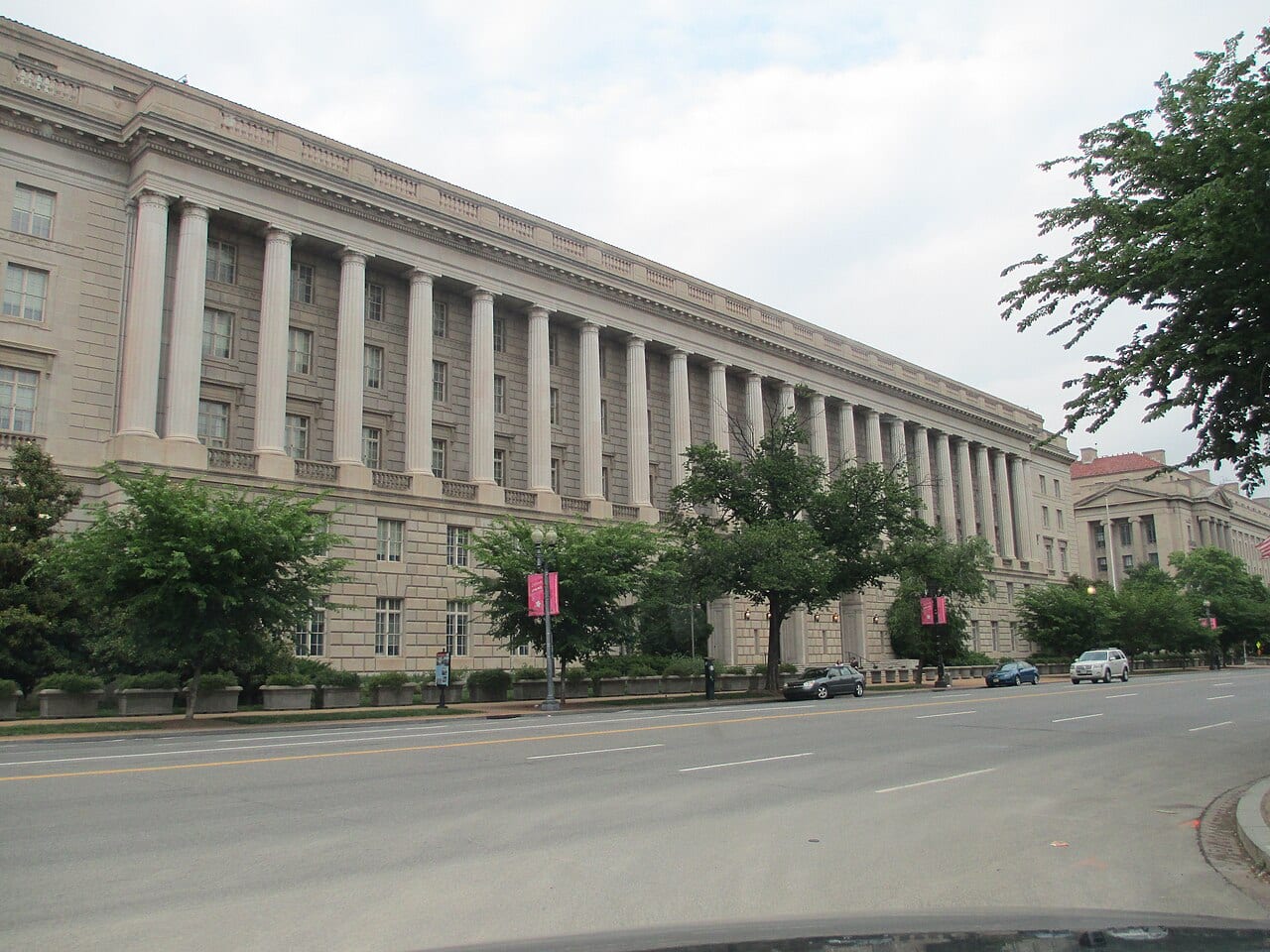
- Wikimedia Commons, "File:Home of the Internal Revenue Service.JPG" - Joshua Doubek photograph of the IRS building in Washington, D.C., used as the article image.