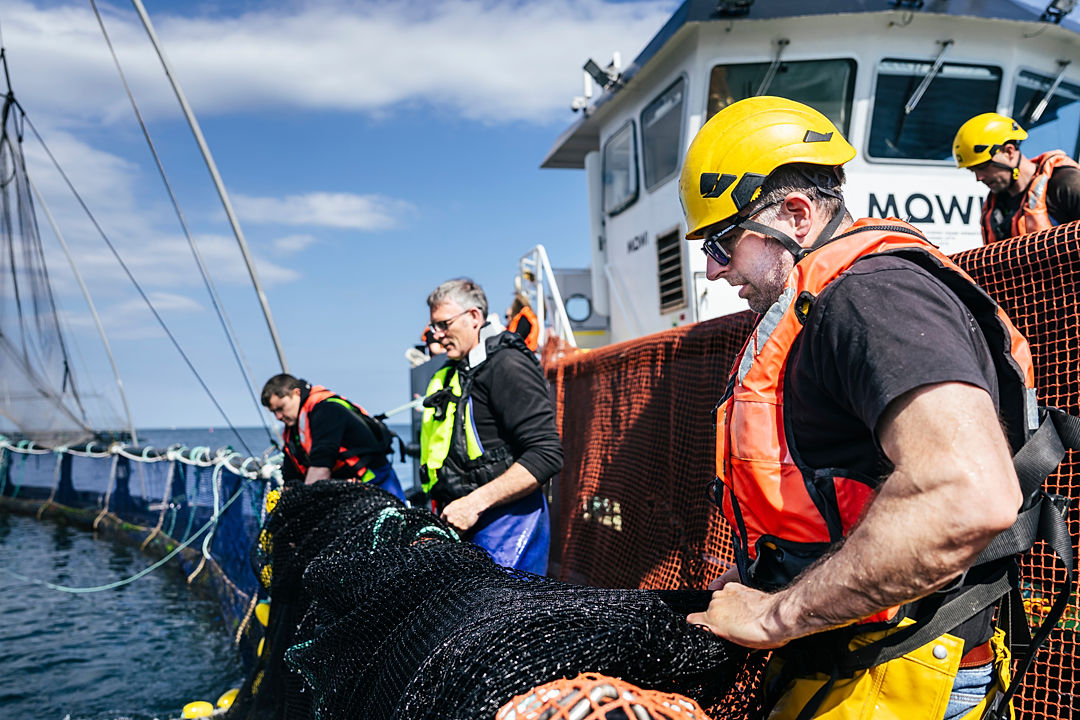
The recovery case for salmon farmers rests on firmer prices and cheaper production. Mowi’s latest quarter adds a complication for anyone valuing that recovery from reported earnings: harvesting fish can reverse profits recognised while they were still growing.[4][5]
Evidence cut-off: September 21, 2026. The financial example uses Mowi’s unaudited second-quarter report.
Value can arrive before the customer
At sea, a salmon is both a living animal and an asset awaiting sale. Feeding it changes its size; market prices change what a buyer might eventually pay. Accounting has to describe that unfinished transformation before the fish reaches a processing plant.
IAS 41 generally measures biological assets at fair value less costs to sell and puts changes in that value through profit or loss. The same measurement basis applies to agricultural produce at harvest. That allows an economic gain to appear before a sales invoice exists.[3]
The distinction matters to a reader of the accounts. A valuation gain says something about the estimated worth of an asset on the reporting date. It does not say that a customer has paid, that the fish has survived to harvest, or that the farmer can stop financing its growth. Those are separate events.
Mowi’s valuation model uses assumptions about biomass, quality, size, costs and prices, with much of the input unobservable. Biological progress and changing price expectations can therefore affect reported value before they affect cash.[2]
Harvest removes an earlier gain
Mowi separates revaluation of growing fish from reversals on harvested fish. Operational EBIT excludes both, alongside other specified adjustments; it is a company-defined measure rather than an IFRS subtotal.[2]
Consider the sequence. A gain is recognised while a fish grows. At harvest, the earlier uplift leaves inventory. Counting both that gain and the whole realised margin as fresh profit would double-count part of the return. The reversal allocates earnings between periods.[2][3]
In Mowi’s second quarter, €231.3 million of operational EBIT coexisted with negative €71.7 million of reported EBIT. Note 6 shows a €193.2 million net biomass charge: the €251.2 million reversal on harvested fish outweighed €58.0 million of positive adjustments on biological assets, with a small mortality adjustment and rounding completing the reconciliation. The EBIT gap also includes other items, notably a write-down associated with the planned Canada East disposal.[1]
That composition changes the interpretation. The net biomass charge cannot be read as a matching collapse in the value of fish still swimming. Nor can every exclusion from operational EBIT be dismissed as harmless bookkeeping: a write-down concerns capital that previously had a higher carrying value.
The next generation still needs feeding
Expansion requires more fish growing before higher harvests arrive. Mowi’s handbook describes the resulting working-capital commitment: feed and production costs accumulate, with the sale of one generation releasing capital while younger fish keep absorbing it.[4]
Temperature makes this seasonal: the handbook describes faster growth in summer and autumn, and slower growth in colder periods. Quarterly working capital therefore reflects the production calendar as well as management performance.[4]
This suggests a practical valuation discipline: follow a full production cycle. Ask whether the company can replenish healthy stocks, maintain its equipment and service its financing while retaining cash. A temporary inventory release can make cash conversion look unusually strong; investment in future harvests can temporarily make a sound operation look cash-hungry. Neither observation settles the longer-term return.
The consolidated cash-flow statement recorded €281.1 million from operations in the quarter. That is before investing and financing cash flows; lease repayments and interest appear later. Mowi’s headline operating-cash measure also excludes IFRS 16 lease-accounting effects, so it differs from this statutory figure.[1]
Operating cash is evidence of collection, but it is not automatically the amount available to shareholders. The question is what remains after the business funds the next harvest and pays its other bills.
Biology can make the recovery durable
The strongest counterweight to caution is operational improvement already visible in the farms. Mowi Scotland reported better survival, feed conversion and the proportion of fish achieving superior quality than in the comparable quarter. It attributed part of the survival improvement to its post-smolt programme involving fish initially reared in Loch Etive.[5]
Those are company claims, but they identify mechanisms worth testing. More surviving, saleable fish can spread production costs over a larger harvest. Better feed conversion can reduce the inputs needed for growth. If those improvements endure, cash returns can strengthen even while valuation adjustments make reported earnings erratic.
The falsifier: the recovery thesis fails if subsequent harvests show worsening realised costs and weaker operating cash across the seasonal cycle despite firmer selling prices, with the shortfall persisting after allowing for planned growth investment. A rising biomass valuation would not rescue that operating result.
What to watch
- November 4, 2026, scheduled third-quarter results: check harvested cost, survival and quality alongside operational EBIT. Separate the harvest reversal from changes in the valuation of remaining fish.[1][2][6]
- The December 31 year-end balance sheet: compare biological stocks and working capital with the previous year-end, allowing for disposals and currency movements. Seasonal expansion needs a like-for-like comparison.[4]
- February 10, 2027, scheduled fourth-quarter results: trace operating cash through investment, lease payments and interest, then assess what remains for distributions. The calendar is subject to change.[6]
Sources
- Mowi, Quarterly Report Q2 2026, August 18, 2026 — highlights, consolidated cash-flow statement, Notes 4 and 6, and alternative-performance-measure definitions.
- Mowi, Annual Report 2025 — accounting policy for biomass, Note 6 on valuation inputs, and definitions of operational EBIT.
- IFRS Foundation, IAS 41 Agriculture — biological assets, agricultural produce at harvest and recognition of fair-value changes.
- Mowi, Salmon Farming Industry Handbook 2026, sections 8.6 and 10.1 — accounting treatment, the production cycle and seasonal working capital.
- Mowi Scotland, “Record-high revenues and volumes for Mowi in the second quarter,” September 2, 2026 — Scottish biological performance, the company’s recovery case and photograph provenance.
- Mowi, Financial calendar — scheduled third- and fourth-quarter reporting dates, checked September 21, 2026.