Priced: SAIC reported fiscal Q2 adjusted EPS of $3.01 against a $2.31 consensus estimate reported by Investing.com, then lifted the midpoint of its full-year revenue outlook by $150 million, to $7.25 billion.[1][7] New: the quarter reported only $1.2 billion of net bookings against $1.88 billion of revenue. Quarterly book-to-bill was 0.6x, pulling the trailing-twelve-month ratio down to 0.8x.[1]
That is the handoff investors need to underwrite. SAIC is converting signed work into revenue faster than it replenished that work during Q2. Delayed government awards may make the bookings figure look worse than the underlying demand, and one large recompete arrived two days after quarter-end. But timing is now the proposition to prove, not a reason to ignore the ratio.
Evidence cut-off: September 1, 2026. Guidance-midpoint changes below are simple calculations from company ranges. Book-to-bill is a contract-flow indicator, not revenue guidance or a valuation multiple. This is an earnings analysis, not a recommendation to buy or sell the shares.[1][6]
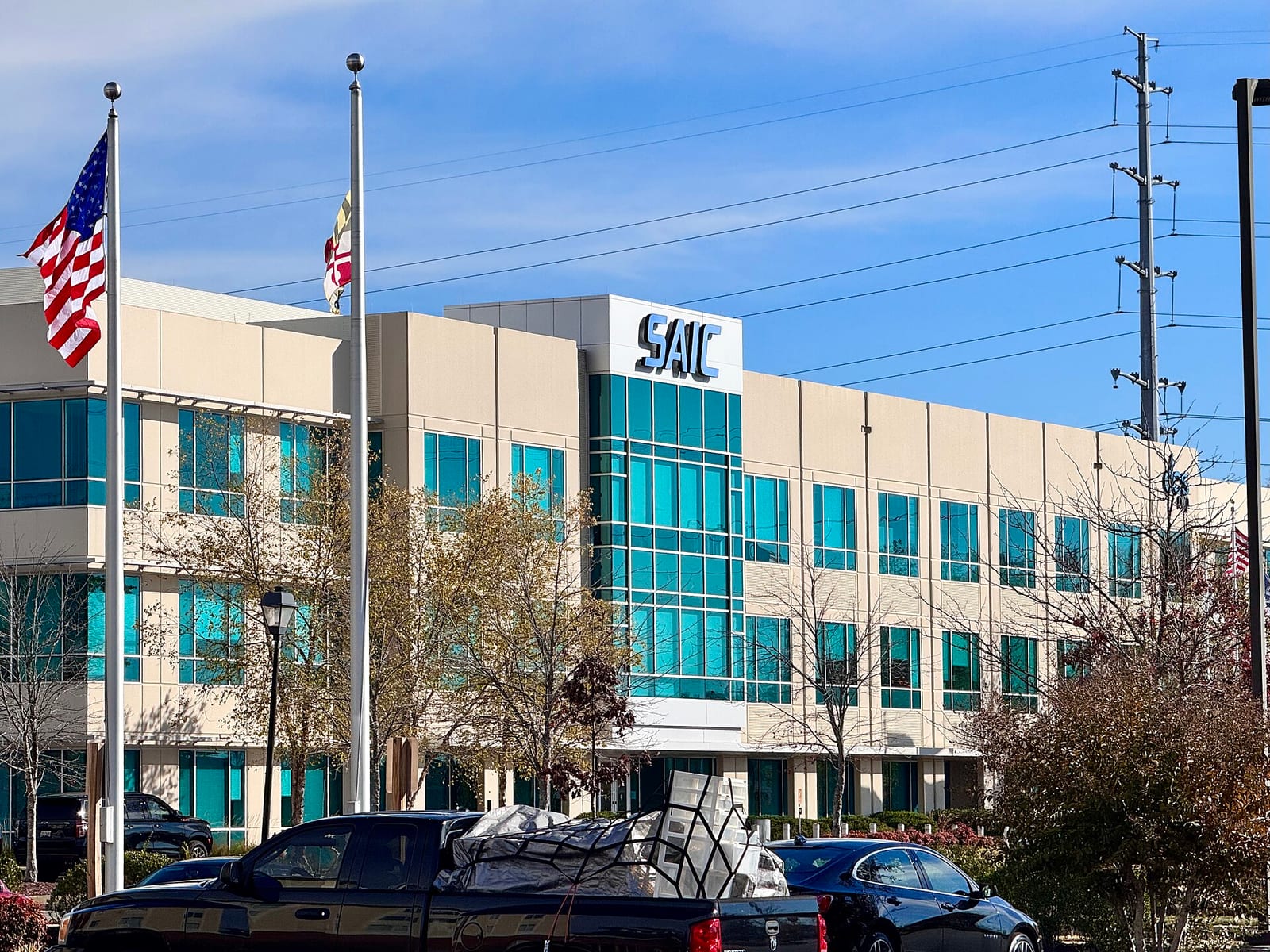
Image context: the cover is a documentary photograph of an SAIC office in California, Maryland, not a photograph of a specific contract or Q2 event. Its CC BY 4.0 source was resized without cropping.[8][9]
The beat came from converting work already won
Revenue rose 6.3% year over year to $1.88 billion. Excluding the acquired SilverEdge business, organic growth was 5.3%. Management attributed roughly one percentage point of growth to SilverEdge and another point to materials sales that it does not expect to repeat; the remaining lift came primarily from growth on existing contracts.[1][3][4]
This matters because a government-services company can post a strong quarter before its recent win rate appears in reported revenue. Existing awards support staffing, materials and other delivery inputs; those inputs become revenue as work is performed. An opportunity must clear procurement and any protest before SAIC records it. Total backlog can include funded and negotiated-unfunded awards; for indefinite-delivery, indefinite-quantity vehicles, bookings and backlog begin when task orders are awarded.[2]
The current quarter's operating conversion was credible. GAAP operating income rose 9% and operating margin increased to 8.1% from 7.9%. Adjusted EBITDA increased to $193 million, although its 10.3% margin was 20 basis points lower year over year.[1] The result was growth with solid profitability—not a fresh margin breakout.
The guide raise runs on a different clock from bookings
SAIC raised fiscal 2027 revenue guidance from $7.0–$7.2 billion to $7.2–$7.3 billion. The midpoint moved from $7.10 billion to $7.25 billion. The adjusted-EBITDA midpoint rose by $27.5 million, and the adjusted-EPS midpoint rose by $0.70. Free-cash-flow guidance stayed at more than $600 million.[1][6]
The upgrade says management has better visibility into this fiscal year's conversion and profitability. It does not settle the next year's growth question. Management expects second-half organic revenue to contract as the RITS contract rolls off, creating an estimated 350-basis-point headwind, while targeted investment takes adjusted margins into the high-9% range.[4] Current work can therefore support a raised annual guide even as the award pipeline becomes more important to the period beyond it.
That creates two clocks. The fiscal 2027 clock is governed largely by funded work, delivery and the known runoff. The fiscal 2028 clock needs delayed recompetes and new business to become bookings soon enough to convert. A raised guide answers the first clock; book-to-bill tests the second.
EPS quality is better than the year-over-year decline looks
GAAP diluted EPS fell to $2.38 from $2.71 despite higher revenue and operating income. The comparison is distorted by tax: the prior-year quarter included a $47 million benefit after an IRS audit, producing a negative 17.2% effective tax rate, versus a positive 14.2% rate this quarter.[1][2] That is why the GAAP EPS decline is a poor shorthand for operating direction.
Adjusted EPS also fell, to $3.01 from $3.63, but this measure did not remove the prior-year IRS benefit. Adjusted pretax income rose to $151 million from $145 million; adjusted net income fell as the adjusted tax line swung from a $25 million benefit to a $22 million expense. The lower weighted-average share count partly cushioned EPS, while a prior-year recovery from a patent settlement flattered the adjusted-EBITDA comparison.[1][2][4] The clean reading is narrower: revenue conversion and operating income improved, adjusted margin was broadly stable, and both GAAP and adjusted EPS growth rates are poor demand gauges this quarter.
Cash gives the quarter a mixed quality check. Operating cash flow rose 20% to $146 million, but non-GAAP free cash flow fell 13% to $131 million from $150 million. The prior-year free-cash-flow reconciliation included a positive $35 million adjustment for cash used in the receivables-purchase facility; the current quarter had no such adjustment.[1] SAIC returned $106 million through repurchases and dividends, then expanded that facility from $300 million to $400 million after quarter-end. The unchanged full-year cash guide is constructive, but it also means the earnings upgrade did not produce a higher cash target.
A 0.8x ratio is a warning, not yet a verdict
Estimated backlog ended Q2 at $22.1 billion, down from $22.9 billion at Q1, while the funded portion rose to $3.8 billion from $3.7 billion. Quarterly book-to-bill fell from 1.1x in Q1 to 0.6x in Q2; the trailing ratio moved from 1.0x to 0.8x.[1][6] Ratios below 1.0 mean recognized revenue exceeded reported net bookings over the measured period.
There is a serious timing counterweight. A $740 million Homeland Security recompete was booked two days after quarter-end. Management said including it would have brought trailing book-to-bill closer to 1.0x, and it continued to cite a recompete win rate above 90%.[1][4] In the call Q&A, management also argued that delayed recompetes can extend incumbent work even while they postpone the reported booking.[5]
Neither point makes the shortfall imaginary. The $740 million award will help the next period, but SAIC still has to replace continuing revenue conversion and the RITS runoff. Its position on a $14 billion multiple-award contract is not equivalent to $14 billion of backlog: only awarded task orders—not the vehicle ceiling—enter bookings and backlog, and those task orders may be funded or negotiated-unfunded.[1][2] Ceiling values advertise opportunity; awarded work creates coverage.
The cautious view here is falsifiable. It fails if, by the December fiscal Q3 call, delayed awards lift trailing book-to-bill decisively above 1.0x while funded backlog continues expanding from $3.8 billion. That combination would show Q2 was mainly a procurement-calendar problem. A ratio still below 1.0x with a reversal in funded backlog would instead make the raised fiscal 2027 guide look more like conversion pulled forward than the start of durable growth.
Watchlist
- December 2026 — fiscal Q3 results and strategy update: management said it expects to provide more detail on strategy and portfolio during this call. Test reported net bookings, trailing book-to-bill and funded backlog against the falsifier, and separate actual task orders from contract ceilings.[3][4]
- Fiscal Q3 booking bridge: confirm that the $740 million post-quarter Homeland Security recompete enters backlog, then ask how much additional new business is required to move the trailing ratio above 1.0x.[1][4]
- Second half through January 29, 2027: measure organic growth after the RITS runoff and the nonrecurring materials contribution, while checking whether planned investment keeps adjusted margin in management's high-9% range.[2][3][4]
- Fiscal-year cash conversion: compare more than $600 million of free cash flow with adjusted earnings, receivables-facility use and capital returns. A higher EPS guide without a higher cash guide makes the cash bridge worth preserving.[1]
Sources
- SAIC, “SAIC Announces Second Quarter Fiscal Year 2027 Results” (August 31, 2026) — Q2 revenue, margins, cash flow, bookings, backlog, post-quarter awards and revised guidance.
- SAIC, Quarterly Report on Form 10-Q for the quarter ended July 31, 2026 — GAAP results, tax-rate comparison, government-customer concentration and bookings methodology.
- SAIC, Second Quarter Fiscal Year 2027 Earnings Presentation — organic-growth bridge, leading indicators, cash targets and timing of the strategy update.
- SAIC, Second Quarter Fiscal Year 2027 Prepared Remarks — award timing, on-contract growth, RITS runoff, second-half margin expectations and book-to-bill context.
- ROIC AI, SAIC Fiscal 2027 Second-Quarter Earnings Call Transcript — management Q&A on delayed recompetes, contract extensions and fixed-price work.
- SAIC, “SAIC Announces First Quarter Fiscal Year 2027 Results” (June 1, 2026) — prior guidance, Q1 bookings, book-to-bill and backlog baseline.
- Investing.com, “SAIC Stock Rises 7% on Strong Earnings Beat and Raised Guidance” (August 31, 2026) — its reported consensus revenue and adjusted-EPS estimates.
- Harrison Keely, “SAIC Office Building in California, Maryland” (photographed November 22, 2024), Wikimedia Commons — source page for the photograph and its creator/date metadata.
- Creative Commons, “Attribution 4.0 International” — license deed governing reuse of the cover photograph.