Priced: Brown-Forman's Class B shares rose 3.9% after fiscal 2027 first-quarter results and closed September 2 at $27.38, or 17.9x fiscal 2026 reported earnings.[1][2][4] New: the same price implies a 7.1% yield on fiscal 2026 free cash flow, even though management still expects organic operating income to decline this year.[1][2] The apparent bargain is real only if last year's cash harvest proves repeatable while the company's slowest asset—whiskey aging in barrels—finds stronger end demand.
That is a narrower proposition than “premium spirits are cheap.” Brown-Forman's first quarter showed improving gross margin, fast ready-to-drink growth and better cash generation. It did not show a broad demand turn. A valuation that looks modest on earnings and unusually low on one year of cash flow therefore needs two separate proofs: that lower capital spending is structural, and that innovation can become more than an offset to softness in core whiskey and tequila.
Evidence cut-off: September 3, 2026. Valuation ratios below are author calculations using the September 2 Class B close, company-reported results and the June 9 share count. Applying the Class B price to both share classes makes the market-capitalization figures approximate. Free cash flow is operating cash flow less capital expenditure; it is not cash available without constraint. This is an analysis, not a recommendation to buy or sell the shares.[1][2][4]
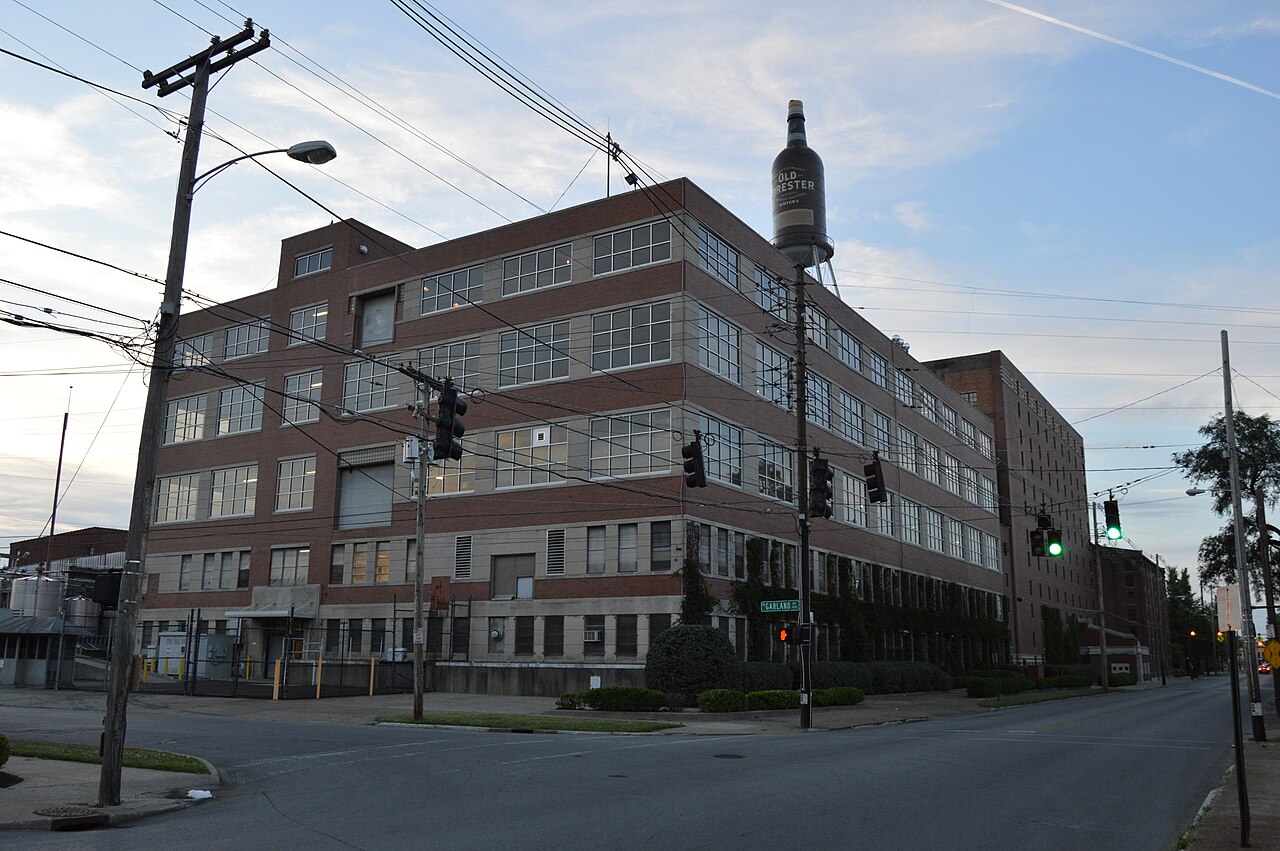
Image context: the cover shows Brown-Forman's historic Louisville bottling and warehouse complex in 2014. It makes the physical capital behind an aged-spirits balance sheet visible, but it does not document present barrel levels or plant utilization.[6]
The multiple and the cash yield tell different stories
Fiscal 2026 ended with $715 million of net income, diluted earnings per share of $1.53 and free cash flow of $893 million.[2] The September 2 close values that reported EPS at 17.9 times. Using 458.9 million shares outstanding and treating both classes at the Class B price gives an approximate equity value of $12.6 billion; against that denominator, fiscal 2026 free cash flow produces the 7.1% yield.[2][4]
The spread is too wide to ignore, but too flattering to capitalize without adjustment. Brown-Forman generated $1.0 billion of operating cash in fiscal 2026, up from $598 million, while capital expenditure fell to $107 million from $167 million. Management attributed the operating-cash improvement largely to lower working-capital requirements, including lower tax payments, even as earnings declined.[2] Cash conversion was excellent; it was not all recurring profit.
A three-year lens is less generous. Operating cash flow minus capital expenditure was $419 million in fiscal 2024, $431 million in fiscal 2025 and $893 million in fiscal 2026. Their $581 million average represents an approximate 4.6% yield at the September 2 valuation.[2][4] That is the more disciplined starting point: the latest year may understate future investment needs, while the average may understate the benefit of a genuine move into a lower-spending phase.
There is also a reason not to treat reported P/E as pure truth. Fiscal 2026 included $132 million of non-cash intangible-asset impairment, which depressed accounting income without consuming current cash.[2] The earnings multiple consequently looks a little harsher than the operating business, just as the latest cash-flow yield looks a little kinder. Brown-Forman sits between those two measures, not cleanly at either one.
A current asset with a three-year clock
At July 31, Brown-Forman carried $2.57 billion of total inventory, including $1.54 billion of barreled whiskey.[10] The annual filing classifies all barreled whiskey as current inventory even though most of it ages for three years or more. Warehousing, insurance, property taxes and other carrying charges are capitalized into its cost.[2]
That accounting convention can make a spirits balance sheet look more liquid than its economics. A barrel cannot be hurried into a mature product merely because a retailer has a good month. Equally, production cannot be cut indiscriminately when sell-through weakens: too deep a cut today can leave a shortage of correctly aged liquid years later. Inventory is both working capital and an option on future brand demand.
The important 2026 detail is that cash generation did not come from emptying the warehouses. Total inventory increased by $32 million during the fiscal year, and inventory still absorbed $22 million in the cash-flow statement.[2] In the next quarter, total inventory rose another $31 million: barreled whiskey fell $23 million, but finished goods, work in process and raw materials rose by a combined $54 million. Inventory used $39 million of cash in the quarter.[10] The earlier cash rebound instead came from other working-capital lines and lower investment. That is better than manufacturing free cash flow through liquidation, but it leaves the commercial question intact: can Brown-Forman earn an adequate return on a large asset whose conversion clock is measured in years?
The cover photograph gives that question a useful scale. Warehouse A is a real building, not a metaphor for brand value. The shares can rerate quickly; the liquid behind them cannot.[6]
The first quarter proved mix, not a turn
Fiscal 2027 Q1 net sales fell 1% on both a reported and organic basis. Organic operating income rose 4%, gross margin expanded 40 basis points to 60.2%, and free cash flow increased to $161 million from $129 million.[1] Those are credible signs of cost control. Yet $19 million of the $32 million free-cash-flow increase came from lower capital expenditure; operating cash supplied the other $13 million.[1]
The sales mix is the harder read. Whiskey was flat organically, while the Jack Daniel's family declined 1%. Ready-to-drink sales grew 11% organically and New Mix grew 36%, but tequila fell 13%. U.S. organic sales were flat and developed international markets fell 8%; emerging markets grew 9%.[1] Innovation and Mexico are doing real work, but the bridge remains narrow.
Distributor timing makes the headline less clean still. Brown-Forman estimated that changes in distributor inventories reduced U.S. net-sales growth by four percentage points relative to the prior-year period. That creates room for shipments to improve when distributors stop drawing down stock, but the company itself says depletions are the closer proxy for consumer demand.[1] A restock can repair reported sales without repairing the franchise.
The external category backdrop supports that caution. IWSR's 2026 work argues that beverage-alcohol premiumisation has lagged inflation since 2022 and that buyers are scrutinizing expensive spirits more closely. It also finds a more resilient lane in convenient formats such as RTDs.[3] Brown-Forman's quarter fits that map almost too neatly: packaged occasions are growing while established full-strength categories struggle. The question is whether RTD demand recruits consumers into the broader portfolio or simply shifts profit toward a different package and price point.
The strongest counterweight is a longer harvest phase
The cash case is not merely a one-quarter optical trick. Brown-Forman spent $274 million across fiscal 2025 and 2026 on whiskey and tequila capacity, including new barrel warehouses, then guided fiscal 2027 capital expenditure to only $60 million–$70 million.[1][2] It also repaid $343 million of euro-denominated notes in July.[1] If the capacity build is largely complete, lower spending can persist while existing stocks age into saleable products.
The brand and governance structure give management time to wait. The company has paid quarterly dividends for 82 consecutive years and raised the regular dividend for 42; the Brown family remains the anchor voting shareholder.[1][2] Those facts do not guarantee growth, but they reduce the chance that a temporary demand trough forces a short-cycle response that damages future supply.
That patience cuts both ways for outside holders. On July 26, the board said an unsolicited Sazerac acquisition proposal was “not actionable” after Wolf Pen Branch, whose Brown family members represent a majority of Class A shares, said it did not fit their vision.[7] Reuters reported that Sazerac's May proposal had offered $32 a share in cash—16.9% above the September 2 Class B close—and that a sale would require family approval.[8] The spread is evidence that a strategic buyer sees value; it is not a floor that Class B holders can force the family to accept.
Leadership is moving at the same time. Lawson Whiting announced in July that he will retire when a successor is appointed, with the board considering internal and external candidates.[9] The next CEO inherits the distribution reset, a weak developed-market tape and a rejected bid. That makes succession part of the valuation bridge rather than a footnote to it.
This is the best bull case: the market is charging an ordinary multiple for an unusually durable franchise just as capital intensity falls. Flat sales would then be tolerable for a while because restructuring, distribution changes and lower capital spending could protect cash returns until demand recovers.
The counterweight has a boundary. Management still guides fiscal 2027 organic sales to roughly flat and organic operating income to a 3%–5% decline.[1] A company harvesting past investment should eventually show more than stable gross margin and shrinking capital expenditure. It should show that the aged inventory and brand spend can produce volume, price or mix growth without leaning on distributor restocking.
Falsifier and dated watchlist
The cautious thesis is falsified if, by the fiscal Q3 report in March 2027, core Jack Daniel's depletions and organic sales in both the United States and developed international markets have turned positive while trailing free cash flow remains above $800 million without a material inventory release. That combination would show demand broadening beyond RTDs and cash conversion surviving beyond one working-capital year. A shipment-led sales bounce on its own would not clear the test.
Three checkpoints matter:
- September 9, 2026 — Barclays Global Consumer Conference: listen for a clean separation between distributor normalization and consumer depletions, plus evidence that New Mix and Tennessee Blackberry add occasions rather than cannibalize existing labels. Any boundary management sets around succession and the rejected proposal also matters.[1][5][7][9]
- October 31 quarter-end, with results on the usual December cadence: compare shipments with depletions in core whiskey, test whether developed-market weakness narrows, and identify how much of free-cash-flow growth again comes from lower capital expenditure.[1][2]
- January 31, 2027 quarter-end, with results on the usual March cadence: apply the falsifier. The full-year operating-income guide, inventory balance and trailing cash conversion should either begin agreeing with the 18x valuation or expose the 7% yield as a high-water mark.[1][2]
Brown-Forman is not expensive enough to dismiss and not yet cheap enough to value on a single cash-flow year. At $27.38, the sensible middle ground is to use the three-year cash yield as the base, treat lower capital spending as upside, and require depletion-led demand before paying for the barrel inventory as if it were already cash.
Sources
- Brown-Forman Corporation, “Brown-Forman Reports First Quarter Fiscal 2027 Results; Reaffirms Full Year Outlook” (September 2, 2026) — Q1 sales, margins, cash flow, brand and market mix, distributor-inventory estimates, debt repayment and fiscal 2027 guidance.
- Brown-Forman Corporation, Annual Report on Form 10-K for the fiscal year ended April 30, 2026 — earnings, cash-flow history, capital expenditure, inventory accounting, debt, share count and ownership structure.
- IWSR, “Premiumisation redefined: from pricing to meaningful moments” (August 20, 2026) — category context on price, inflation, consumer scrutiny and the relative resilience of ready-to-drink formats.
- Stock Analysis, “Brown-Forman (BF.B) Stock Price History” — September 2, 2026 Class B closing price and daily move used in the author calculations.
- Brown-Forman Corporation, “Brown-Forman to Participate in Barclays Global Consumer Conference” (August 31, 2026) — official notice for the September 9 management appearance.
- Nyttend, “Brown-Forman warehouse A and bottling house” (photographed June 21, 2014), Wikimedia Commons — public-domain source page and building metadata for the cover photograph.
- Brown-Forman Corporation, “Brown-Forman Board Issues Statement” (July 26, 2026) — official disclosure of the unsolicited Sazerac proposal and Wolf Pen Branch's position.
- Reuters, “Brown-Forman board says Sazerac unsolicited bid not actionable” (July 26, 2026), republished by Investing.com — reported $32-per-share terms and the family-approval boundary.
- Brown-Forman Corporation, “Brown-Forman Announces President & CEO Lawson Whiting to Retire” (July 13, 2026) — succession process and transition terms.
- Brown-Forman Corporation, Quarterly Report on Form 10-Q for the quarter ended July 31, 2026 — current inventory composition and quarterly cash-flow movements.