Priced: outdoor advertising has already escaped the lazy "billboards are dead media" bucket. U.S. out-of-home revenue reached a record $9.46 billion in 2025, digital out-of-home accounted for 36.3% of industry revenue, and digital revenue grew faster than the channel overall.[5] New: the 2026 spread is not whether screens can sell ads. It is whether Lamar, OUTFRONT, and JCDecaux can turn scarce physical locations into higher digital and programmatic yield without giving the gain back through leases, transit guarantees, capex, utilities, or weak local demand.[1][2][3][4]
That makes outdoor advertising a more interesting finance story than a media-cycle note. The asset is partly real estate, partly municipal permission, partly local sales coverage, and partly ad-tech connection. A great location can be monetized many times a day once it is digital. But the face still sits on someone else's land, a city contract, a rail platform, an airport concourse, or a regulated roadside structure. The screen may look like software. The economics are still anchored in physical rights.
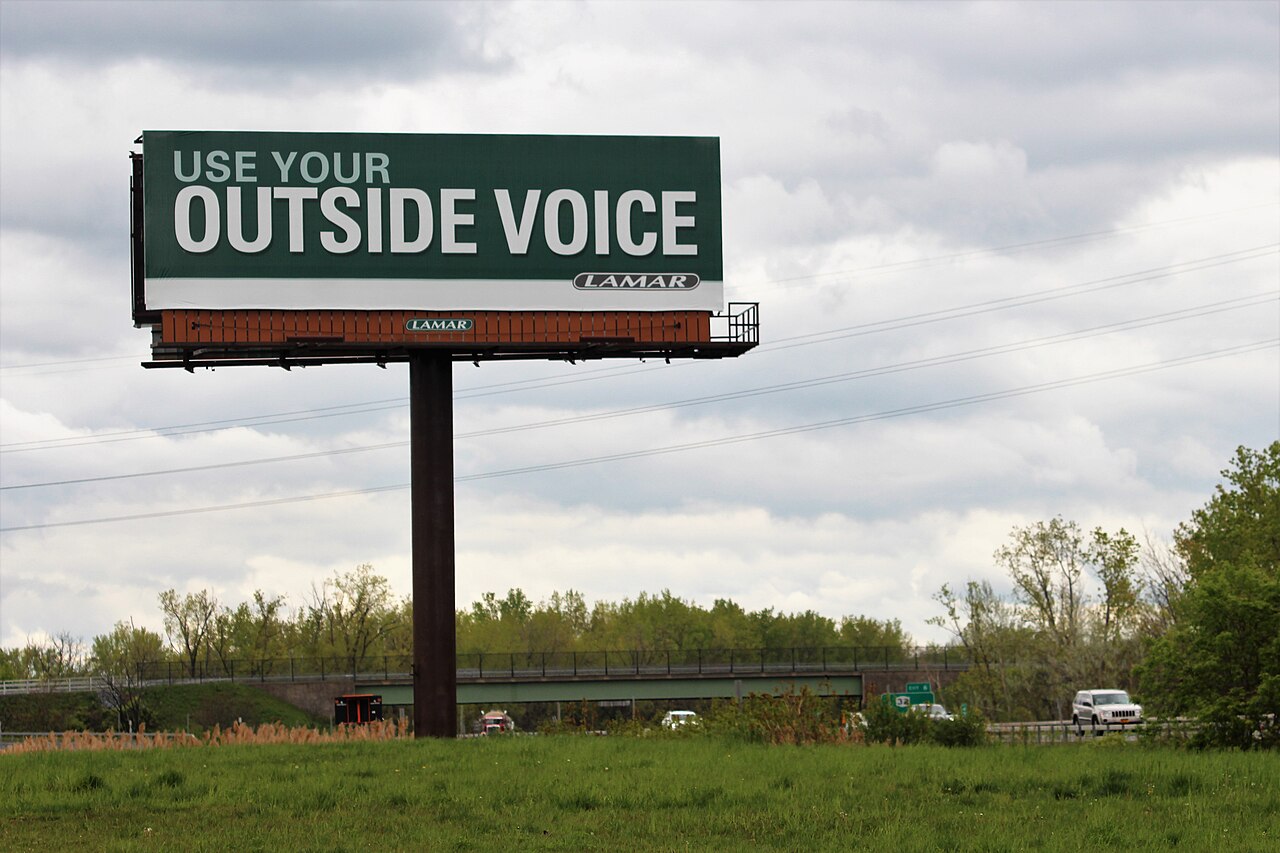
The cover photograph is intentionally plain: a Lamar billboard beside a New York road, not a Times Square spectacle or a symbolic marketing collage. The point is that the sector's premium starts in ordinary, repeatable places where commuters and local buyers actually meet.[6]
The Mechanism
The clean outdoor-advertising model has three layers. First, the operator controls a hard-to-replace location. Permitting, zoning, sightlines, traffic patterns, and local relationships all make good faces scarce. Second, the operator sells time and attention against that location. Third, digital conversion changes the revenue surface: one static poster becomes a rotation of campaigns, dayparted offers, emergency messages, programmatic buys, and shorter booking windows.
That is why the industry can grow without needing the whole advertising market to boom. OAAA's 2025 readout shows overall U.S. out-of-home revenue up 3.6%, while digital out-of-home rose 10.5% and transit was the fastest-growing format for the second straight year.[5] The useful inference is not that every billboard deserves a higher multiple. It is that the channel is still adding monetization tools to a fixed-location base.
Lamar shows the mature-billboard version of the model. For 2025, the company reported $2.27 billion of net revenue and $1.06 billion of adjusted EBITDA, with full-year adjusted EBITDA up 2.4%.[1] That is not hypergrowth, but it is high cash conversion from a deeply local network. Lamar's 2025 Form 10-K adds the relevant reinvestment line: total capital expenditures were $180.8 million, including $90.9 million spent on digital technology, and the company expected about $186 million of 2026 capital expenditures.[2] Digital yield is therefore not free. It is a capital-allocation decision inside a permitting business.
OUTFRONT shows the operating-leverage version. Its first-quarter 2026 revenue rose 10.0% to $429.6 million, while adjusted OIBDA rose 56.4% to $100.4 million.[3] The segment split matters more than the headline: billboard revenue rose 7.1%, helped by yield and programmatic platforms, while transit revenue rose 22.3% as yield improved.[3] That is the attractive branch of the thesis. When the cost base is already in place, higher-yield demand can drop through quickly.
But OUTFRONT also exposes the risk. Transit is a franchise business, not just a screen business. The same Q1 release cited higher guaranteed minimum payments to New York's MTA, inflation-linked transit franchise costs, production costs, maintenance, utilities, and site-related expenses.[3] In other words, the upside is real, but the city or transit authority still sits in the economics.
Why Digital Is Not The Whole Thesis
The easy version of the trade is to say that digital screens solve everything: more advertisers, faster creative changes, better measurement, and programmatic access. JCDecaux's 2025 results show why that story is tempting. Its digital out-of-home revenue grew 7.7% in 2025, or 10.0% organically, and digital reached 41.7% of group revenue, with programmatic revenue through VIOOH up 19.2% to EUR180.5 million.[4]
That is real progress. Programmatic turns a physical network into something media buyers can access with tools they already use. It also brings in advertisers who may never have booked a traditional outdoor campaign. The higher the fill rate and the more dynamic the creative, the more a fixed board behaves like scarce inventory rather than a static poster.
Still, digital does not eliminate location quality. It sharpens it. A weak location with a screen remains a weak location. A premium pedestrian corridor, airport, road approach, or station platform can absorb more campaigns because the audience and context are already valuable. JCDecaux's own mix points to that boundary: in 2025, street furniture and transport grew organically, while billboard declined organically.[4] The global lesson is not "digital everywhere." It is "digital where the physical concession or route quality can support it."
The Counterweight
The strongest bullish counterargument is that outdoor advertising may be unusually well positioned in a fragmented attention market. Online ads fight skipping, blocking, fraud, saturation, privacy rules, and auction opacity. A roadside board or transit screen cannot be clicked away. It is visible in the shared world, and digital conversion now lets buyers target it with more flexible timing than old poster cycles allowed.
That counterweight is why the sector should not be valued as a melting legacy channel. Lamar's local sales force and site base, OUTFRONT's transit recovery, and JCDecaux's premium street-furniture and transport concessions are not interchangeable with generic display ads.[1][3][4] The physical network is the moat. Digital and programmatic are monetization layers on top of it.
The caution is that the moat is shared with counterparties. Landlords know the site is valuable. Municipalities and transit agencies know screens can earn more. Utilities and maintenance costs rise with digital density. Political tolerance can change if brightness, clutter, safety, or public-space use becomes contentious. Outdoor operators do not own a pure software margin curve. They own negotiated rights to public attention.
Falsifier
The thesis fails if digital conversion keeps producing broad operating leverage without a cost giveback. Concretely, if Lamar converts its 2026 capex into AFFO above the top of its $8.50 to $8.70 guide, OUTFRONT sustains double-digit revenue growth while adjusted OIBDA grows faster than revenue after Q1, and JCDecaux keeps programmatic growing faster than digital overall without margin pressure, then the market should give more credit to screens as scarce, software-enabled real estate.[1][3][4]
The thesis is confirmed if revenue growth is visible but cash conversion narrows. Watch for digital capex that does not lift yield, transit revenue that comes with higher guaranteed payments, billboard revenue that depends on one-time condemnation proceeds, or programmatic growth that adds complexity without margin. In that branch, outdoor advertising is still a good channel, but not a cleaner compounder.
Watchlist
First, watch Lamar's report for the quarter ended June 30, 2026. The clean proof is not just revenue growth; it is whether digital investment and local/national demand can move AFFO per share toward or above the 2026 guide without a heavier capex burden.[1][2]
Second, watch OUTFRONT's second-quarter 2026 release for the bridge between billboard yield, transit recovery, and adjusted OIBDA. Q1 had striking leverage, but the repeat test is whether that leverage persists when franchise costs and non-recurring revenue items are separated from ordinary demand.[3]
Third, watch JCDecaux's first-half 2026 update for digital share, programmatic revenue, and the split among street furniture, transport, and billboard. If digital keeps rising while weaker billboard markets drag, the company will have to prove premium concessions can offset lower-quality faces.[4]
Fourth, watch OAAA's next 2026 industry revenue readouts. The key signal is whether digital out-of-home keeps outgrowing the total channel while transit remains healthy. If traditional formats flatten and digital carries all the growth, investors should underwrite screen scarcity more carefully, not less.[5]
The practical conclusion is narrow. Outdoor advertising deserves more respect than old-media shorthand gives it, because scarce physical locations are gaining digital yield tools. But the multiple should be earned through evidence that higher yield actually reaches cash flow. In 2026, the spread belongs to operators that can defend the location, sell the screen, and keep the counterparty from taking too much of the upgrade.
Sources
- Lamar Advertising, "Lamar Advertising Company Announces Fourth Quarter and Year Ended December 31, 2025 Operating Results" (February 20, 2026) - 2025 net revenue, adjusted EBITDA, AFFO guidance, liquidity, and operating commentary.
- Lamar Advertising, 2025 Form 10-K filing - digital-technology capital spending, total capex, 2026 expected capital expenditures, and risk/context for outdoor advertising assets.
- OUTFRONT Media, "OUTFRONT Media Reports First Quarter 2026 Results" (May 7, 2026) - Q1 revenue, adjusted OIBDA, billboard and transit segment growth, franchise costs, and capex commentary.
- JCDecaux, "Full-Year 2025 results, strong performance with operating margin rate and free cash flow already exceeding 2026 targets" (March 12, 2026) - digital out-of-home share, organic growth, programmatic revenue, and activity mix.
- Out of Home Advertising Association of America, "Out of Home Advertising Revenue Reaches Record $9.46 Billion" (March 17, 2026) - 2025 U.S. OOH revenue, digital share, digital growth, and transit growth.
- Wikimedia Commons, "File:Billboard in Menands, New York.jpg" - source page for the Tyler A. McNeil photograph of a Lamar Advertising billboard used as the article image.