U.S. naval shipbuilders are priced for order visibility. The new question is harsher: whether a larger Navy plan can turn into cash conversion before labor scarcity, supplier bottlenecks, and construction delays turn backlog into low-margin inventory.
The mechanism is simple but unforgiving. Congress can authorize ships, the Navy can issue a long-range plan, and prime contractors can report record demand. None of that creates a qualified welder, a cleared nuclear tradesperson, an available drydock, or a supplier that can deliver a no-fail component on time. In shipbuilding, demand is real only when it arrives as stable specifications, funded contracts, mature designs, trained labor, and paced production.
The Setup
The Navy's May 2026 shipbuilding plan puts the demand signal in unusually blunt terms. The department says it operates 291 battle-force ships while the legal requirement is 355, and its PB27 table shows a $65.8 billion ship-construction request for FY27, part of a five-year plan that asks for 122 ships and 63 unmanned platforms across the FYDP.[1] That is the priced part: the customer wants more hulls, more distributed manufacturing, more unmanned systems, and more industrial-base capacity.
The new part is that the customer itself admits the old process has not worked. The same plan says the shipbuilding budget has doubled over two decades while the fleet has no more ships than in 2003, and it sets a goal of moving distributed shipbuilding work from roughly 10% of the total to 50%.[1] That is not a normal growth plan. It is an admission that the bottleneck sits inside the production system.
For investors, the distinction matters. A defense stock can look cheap on backlog and expensive on execution risk at the same time. If the Navy's larger plan smooths volume through the yards, higher utilization should help labor absorption and margins. If it adds design churn, restart costs, rushed subcontracting, and schedule penalties, then the backlog is less valuable than it looks.
Six Anchors
- The Navy gap: 291 battle-force ships today versus a 355-ship statutory requirement, with a $65.8 billion FY27 ship-construction line in the plan.[1]
- The schedule gap: CBO says destroyers and submarines that once took 5 to 6 years now average 9 to 10 years, and Virginia-class attack submarines show an average delay of about four years from original contracted delivery dates.[2]
- The HII demand signal: HII reported $3.1 billion of Q1 2026 revenue, up 13.4% year over year, and $54.0 billion of total backlog as of March 31, 2026.[3]
- The HII margin gate: HII's FY26 outlook calls for $9.7 billion to $9.9 billion of shipbuilding revenue and 5.5% to 6.5% shipbuilding operating margin.[3]
- The General Dynamics yard signal: General Dynamics' Marine Systems revenue was $4.343 billion in Q1 2026, up 21.0% year over year.[4]
- The industrial-base bill: GAO says DOD spent more than $5.8 billion supporting the shipbuilding industrial base from fiscal 2014 through fiscal 2023 and planned another $12.6 billion through fiscal 2028.[6]
These anchors point in different directions. The revenue and backlog numbers argue that demand is not theoretical. The schedule and industrial-base numbers argue that demand has been running ahead of throughput. The trade is therefore not "defense spending goes up." The trade is whether volume can become earned margin.
Base Case: Backlog Converts, But Slowly
The base case is a slow improvement rather than a clean breakout. HII already showed higher Newport News volume in aircraft carriers, submarines, and naval nuclear support services, but Newport News segment margin fell to 5.3% from 6.1% a year earlier.[3] That is exactly the shape of the current setup: the yards can get busier before they get more profitable.
General Dynamics offers the better near-term operating read because Marine Systems grew sharply in Q1 and the company reported strong cash conversion at the corporate level.[4] Still, Marine Systems is not insulated from the same national constraint set. Electric Boat, Bath Iron Works, and NASSCO do not simply need more work. They need a work mix that lets learning curves compound rather than reset.
In this base case, the Navy keeps ordering, the primes keep hiring, suppliers gradually expand capacity, and margins grind higher only after rework and overtime fade. Equity upside exists, but it is earned in boring line items: absorption, labor retention, engineering stability, subcontractor quality, and cash from operations.
Upside Case: The Demand Signal Gets Cleaner
The upside case requires a better customer, not just a bigger customer. CBO's testimony is clear that recent delays are tied to incomplete designs, Navy-requested changes after construction begins, workforce challenges, and a thinner supplier base.[2] If the Navy forces more stable designs and creates a steadier sequence of ships, the yards can learn faster and suppliers can invest with less fear of a program cancellation.
This is where distributed shipbuilding could matter. The Navy wants more work performed away from a few legacy yards, and CBO notes that more than 20 companies are already involved in outsourced submarine work for Electric Boat and Newport News.[1][2] If that system is managed well, the prime yard becomes the final integration point rather than the only place where capacity has to appear. That would make backlog more valuable because it would lower the odds that every schedule slip travels through the same few gates.
In the upside scenario, HII holds the upper half of its shipbuilding margin guide, General Dynamics keeps Marine Systems growth without diluting margin, and the Navy's industrial-base spending shows up in shorter cycle times rather than just more appropriated money. The market would then be right to pay for durable demand because the delivery machine would be improving underneath it.
Downside Case: Orders Become A Working-Capital Trap
The bear case is not a collapse in Navy demand. It is the opposite: too much demand passing through too little execution capacity. CBO says the shipbuilding industry is now taking longer to build destroyers and submarines than it did in the 2000s, and GAO says the Navy keeps assuming better cost and schedule performance than the industrial base has recently delivered.[2][6] That combination can be toxic for contractors because fixed-price and incentive structures can leave them absorbing inefficiency before the government changes the plan.
The downside also has a political version. Program starts, cancellations, redesigns, and shifting priorities can damage the same workforce pipeline the Navy is trying to rebuild. A yard does not hire and train specialized labor because a speech is confident. It does so because the work sequence is credible enough to underwrite years of payroll, training, tooling, and supplier commitments.
In that branch, revenue still grows, but cash quality deteriorates. Contract assets rise, supplier disputes increase, overtime persists, and shipbuilding margins stay stuck around the lower end of guidance. The headline backlog remains impressive, but equity value fails to compound because every new hull brings another schedule and cost-risk claim on the balance sheet.
Counterweight
The strongest counterargument is that the political and strategic floor is unusually firm. The Navy's own plan, CBO testimony, GAO work, HII results, and General Dynamics results all point to the same conclusion: the United States wants more maritime capacity and has only a small set of prime shipbuilders that can deliver it.[1][2][3][4][6] That gives the incumbents negotiating leverage, visibility, and a long runway of customer relevance.
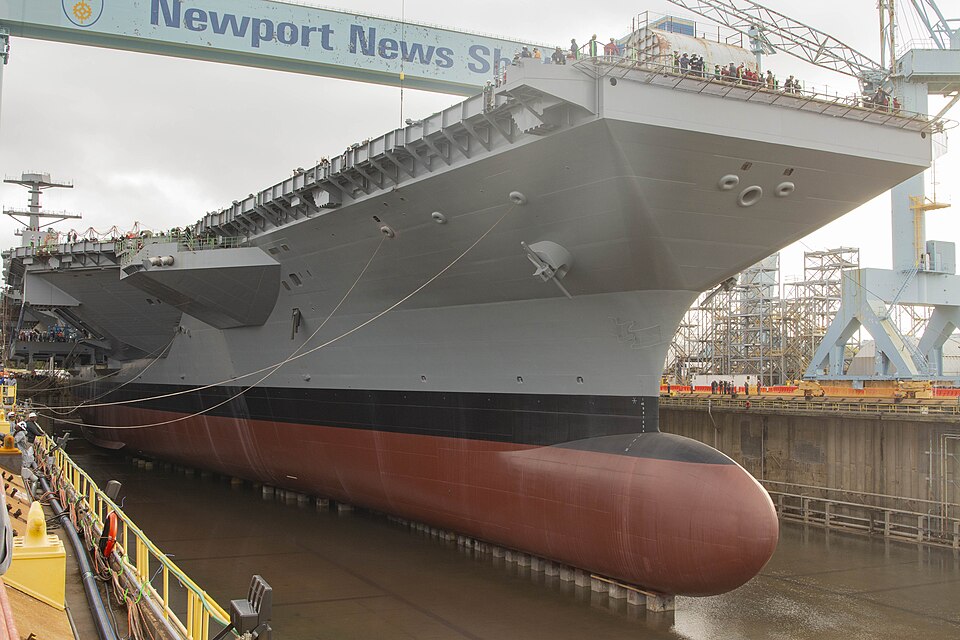
The incumbency value is real. Newport News is central to carriers and nuclear submarines; Electric Boat is central to submarines; Ingalls and Bath Iron Works are central to surface combatants; NASSCO matters for support ships.[2] These are not easily replaced suppliers. If the Navy wants a bigger fleet, it needs the existing yards to succeed.
But that is not the same as saying shareholders automatically win. Incumbency protects demand. It does not guarantee earned margin. The better conclusion is narrower: HII and General Dynamics own scarce production positions, but the value of those positions depends on whether the Navy reforms the order-to-delivery system quickly enough.
Falsifier
The bullish shipbuilding thesis fails if, over the next two to three reporting cycles, HII and General Dynamics keep growing shipbuilding revenue while delivery dates slip, shipbuilding margins stay pinned near the low end of guidance, and GAO or CBO updates show no measurable improvement in labor, supplier, or construction-cycle constraints. In that case, backlog is not a premium asset. It is a working-capital queue.
The thesis strengthens if the opposite happens: HII holds or lifts shipbuilding margin inside its guide, General Dynamics sustains Marine Systems growth without margin leakage, the Navy locks designs earlier, and industrial-base investments produce visible throughput rather than just larger appropriations.[1][3][4][6]
Watchlist
- HII shipbuilding margin: the 5.5% to 6.5% FY26 guide is the cleanest near-term proof line.[3]
- General Dynamics Marine Systems margin and cash conversion: growth is useful only if it carries operating discipline.[4]
- Navy plan stability: fewer program resets and clearer design maturity would be more bullish than a larger headline ship count.[1][2]
- GAO and CBO delay updates: the real rerating comes when independent oversight starts finding shorter cycle times, not just bigger funding lines.[2][6]
The investment read is deliberately constrained. U.S. shipbuilding is not a simple budget-up trade. It is a capacity-repair trade. The money is there, the mission is clear, and the incumbents are scarce. The unresolved question is whether the yards can turn that scarcity into timely deliveries and clean margins before the backlog itself becomes the problem.
Sources
- U.S. Navy, Shipbuilding Plan May 2026 - PB27 shipbuilding request, current fleet size, long-range inventory path, distributed shipbuilding goal, and industrial-base framing.
- Congressional Budget Office, "Testimony on Challenges Facing the Navy's and Coast Guard's Shipbuilding Programs and the Shipbuilding Industrial Base" (April 22, 2026) - construction-time, delay, workforce, supplier, and industrial-base burden analysis.
- HII, "HII Reports First Quarter 2026 Results" (May 5, 2026) - Q1 revenue, backlog, Newport News and Ingalls performance, FY26 shipbuilding revenue, and margin guidance.
- General Dynamics, "General Dynamics Reports First-Quarter 2026 Financial Results" (April 29, 2026) - Q1 revenue, Marine Systems performance, cash conversion, orders, and backlog context.
- Wikimedia Commons, "USS John F. Kennedy (CVN-79) in drydock at Newport News Shipbuilding, Virginia (USA) on 29 October 2019" - U.S. Navy photograph by MC3 Adam Ferrero.
- U.S. Government Accountability Office, "Shipbuilding and Repair: Navy Needs a Strategic Approach for Private Sector Industrial Base Investments" (GAO-25-106286, February 27, 2025) - investment scale, workforce and infrastructure constraints, drydock availability, and strategy recommendations.