An export rebound can look like a reason to pay more for domestic manufacturers. Merchanting complicates that investment story: a trader's foreign purchase first reduces recorded goods exports, and its later resale raises them, even when the cargo never enters the trader's country.[1]
The purchase has a minus sign
Merchanting has a specific meaning in international accounts. A resident business buys goods from a nonresident and resells them to another nonresident, while the goods remain outside the merchant's economy. It takes ownership; merely arranging a sale for a commission does not meet that definition. The United Nations' compilation guide also distinguishes resale from operations that transform the goods.[2]
The surprising part is where the purchase goes. Under the IMF's balance-of-payments treatment, the merchant's acquisition is a negative export, rather than an ordinary import. Resale becomes a positive export. Subtracting acquisitions from sales produces the item called net exports of goods under merchanting. The original supplier and final buyer record their own transactions under general merchandise.[1]
Consider an invented transaction. A merchant resident in Ireland buys a shipment of grain abroad for €100 million and resells it, unchanged, to a foreign customer for €110 million. The cargo travels between foreign ports. Assume both ownership transfers occur in the same reporting quarter, with no other transactions or costs in the example.
The Irish merchanting entries are minus €100 million and plus €110 million. Together they add €10 million to goods exports. Counting the full resale price as the quarter's net export contribution would overlook the acquisition. Calling the purchase an Irish customs import would invent a border crossing that never happened. These are illustrative calculations applying the recording rule, not reported company results.[1][2]
A quarter-end can change the apparent story
Now move only the resale into the following quarter. The acquisition quarter records negative merchanting exports of €100 million. The resale quarter records positive merchanting exports of €110 million, assuming the merchant makes no new purchases then. Across both quarters, the result remains €10 million.
The second quarter looks spectacular in isolation. Yet the merchant has not suddenly earned the entire selling price: it acquired the grain earlier. Likewise, the first quarter's negative entry does not establish that the business lost money. It may be accumulating goods for future sale. The UN guide explicitly warns that changes in inventories can make the net merchanting item negative.[2]
This is a timing problem for an analyst trying to infer momentum. A batch of completed resales can lift the current period while the related purchases sit in an earlier one. Before extrapolating that lift, ask whether the trader is replenishing its stock or running it down. The completed transaction and the reporting period answer different questions.
The ECB's methodology adds another boundary: the net figure includes holding gains and losses as well as trading margins and inventory changes. It is therefore unsuitable as a direct measure of recurring operating profit. Nor should a negative trade entry alone be read as an equal loss of domestic production; a GDP assessment also needs the treatment of inventories and trading output.[2][3]
The adjustment is large enough to matter
Ireland's Central Statistics Office provides a useful historical check. Its published reconciliation for 2016 added €5.332 billion of net merchanting exports when moving from border-based trade statistics to ownership-based merchandise exports. That was a separately identified adjustment, alongside goods for processing and other differences. It was not evidence that customs officers had missed a corresponding stream of departing containers.[5]
The distinction remains relevant to current releases. On September 22, 2026, the Swiss National Bank reported a second-quarter current-account surplus of CHF 24 billion, an increase of CHF 13 billion from a year earlier. It attributed the improvement mainly to goods trade, highlighting a stronger merchanting balance and a less negative balance in nonmonetary gold. It also noted that the comparison quarter had been unusually weak.[4]
That release supports a narrower conclusion than “Swiss factories enjoyed an export boom.” Merchanting helped improve the external balance. The headline does not tell us how much came from wider margins, transaction timing or more physical volume. Nor does it attribute the entire improvement to merchanting.[4]
The Irish example demonstrates how the statistical bridge works; the Swiss release demonstrates why reading that bridge matters. Neither establishes a current trading signal for a particular stock or currency.
Real activity, different beneficiaries
The strongest counterweight is that merchanting is economically substantive. An owner can organize distribution, bear inventory risk and earn a return even when the goods stay abroad. Dismissing the entry because the home country's docks are quiet would miss the business being measured. The ECB gives crude oil bought and resold in transit, without transformation, as a typical example.[3]
The investment question is which earnings the release supports. A merchant's improved terms can benefit that merchant without implying higher output at a local factory. Conversely, a domestic producer can be expanding while merchanting purchases temporarily depress aggregate exports. The two activities need separate evidence.
My interpretation is that a merchanting-led improvement is insufficient grounds for raising a forecast of domestic manufacturing demand. The falsifier would be a detailed release showing that the improvement instead comes predominantly from higher volumes of domestically produced exports, corroborated by production and orders. That would support the factory-led reading for that episode.
Three events can sharpen the assessment:
- The SNB's scheduled December 22, 2026 release of third-quarter external accounts: check whether the merchanting improvement persists and whether revisions change the weak comparison period.[4][6]
- The next Irish quarterly balance-of-payments release: inspect the reconciliation with cross-border goods trade, separating merchanting from processing and other adjustments before attributing a change to domestic shipments.[5]
- The merchant's next reporting close: where disclosures permit, compare sales with purchases and inventory movements. A resale surge followed by replenishment has a different trajectory from continuing growth in completed trading margins.[3]
Sources
- International Monetary Fund, Balance of Payments and International Investment Position Manual, sixth edition, paragraphs 10.41–10.46 — merchanting, negative acquisition entries, positive resales and counterpart treatment.
- United Nations Statistics Division, “Net exports of goods under merchanting,” MSITS 2010 Compilers Guide, paragraphs 14.65–14.70 — definition, inventory timing, holding gains and compilation boundaries.
- European Central Bank, EU Balance of Payments and International Investment Position Statistical Sources and Methods, October 2023, section 1.1 — merchanting components and the example of crude oil traded in transit.
- Swiss National Bank, “Swiss balance of payments and international investment position: Q2 2026,” September 22, 2026 — current-account change, merchanting and gold contributions, and comparison-period qualification.
- Central Statistics Office, Ireland, “Explaining Goods Exports and Imports 2012–2016,” Table 1 and accompanying definitions — reconciliation of cross-border and ownership-based trade.
- Swiss National Bank, “Time schedule and past appearances by Governing Board members” — December 22, 2026 publication date for third-quarter external accounts; checked November 16, 2026.
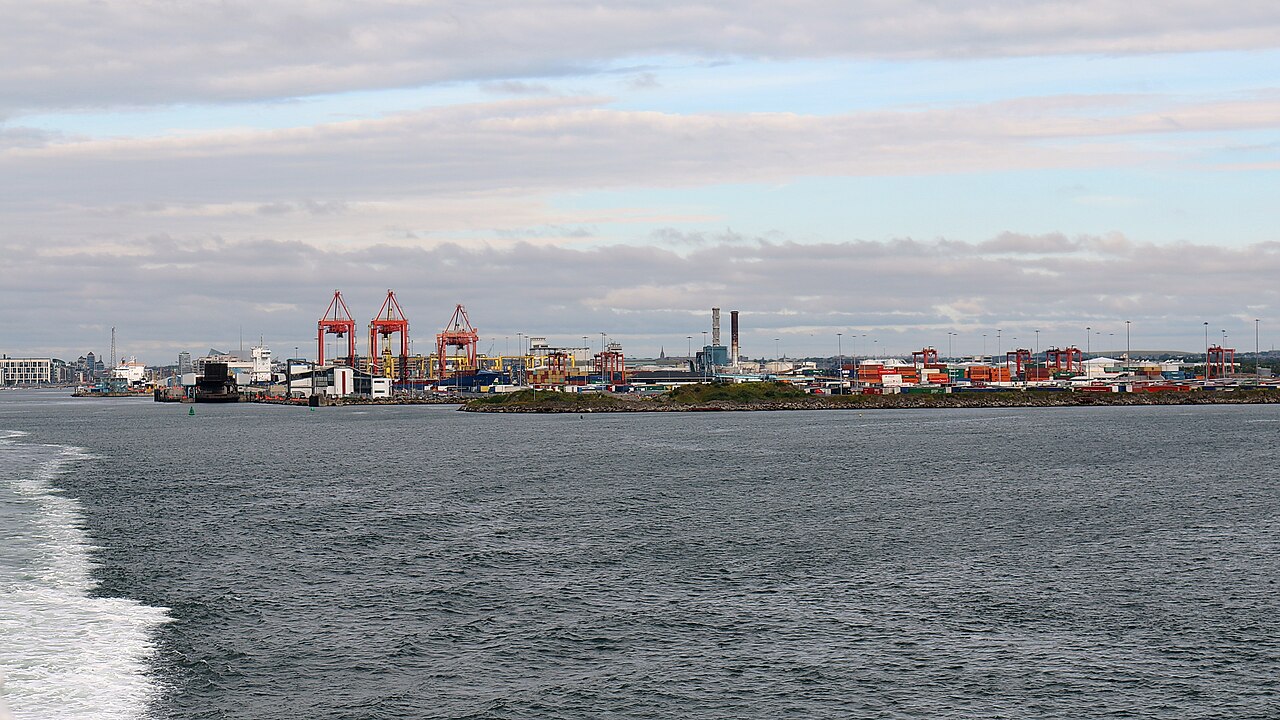
- Robert Linsdell, “Dublin Port, Co. Dublin (507227),” June 13, 2015, via Wikimedia Commons — photograph and provenance.