As of 2026-05-10 UTC, the market already knows the obvious parts of the May rates story. The Federal Reserve left the federal funds target range at 3.50% to 3.75% on April 29.[1] Treasury then raised its April-June 2026 net marketable borrowing estimate to $189 billion from the far calmer February baseline, but the May 6 refunding package still left benchmark nominal coupon and FRN sizes essentially unchanged while leaning on bigger bills and a late-May cash-management bill instead.[2][3][4] By the end of the week, April payrolls had slowed to 115,000 with the unemployment rate unchanged at 4.3%.[5]
That combination matters because it strips away one popular excuse for the long end. Priced is that the Fed is not rushing to cut and Treasury is not springing a fresh coupon-supply shock. New is that next week's inflation and spending data now carry more incremental power for rates than the refunding calendar does. If the curve moves from here, the cleaner trigger is likely to be CPI on May 12 and retail sales on May 14, not a surprise burst of May duration supply.[1][3][6][8]
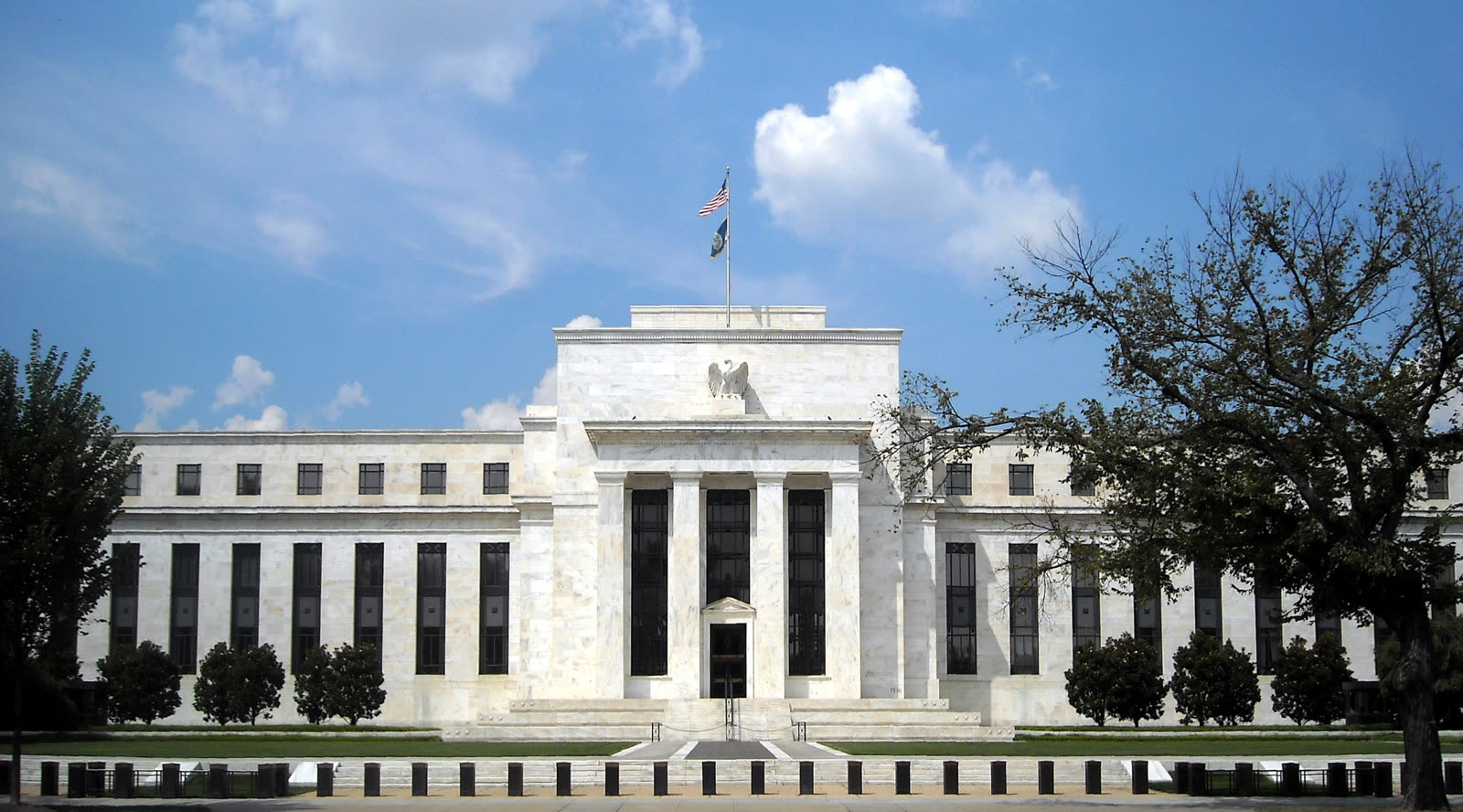
Image context: the cover uses a real Wikimedia Commons photograph of the Marriner S. Eccles Federal Reserve Board Building in Washington, D.C.[9] It fits this article because the week's core story is institutional sequencing. Policy has already been stated, debt-management plans have already been sketched, and the market is waiting for the next batch of macro facts.
What the market actually learned this week
The Fed part was narrower than a headline reader might think. The April 29 statement kept the target range at 3.50% to 3.75%, said inflation remained elevated, and noted that global energy prices were part of the problem.[1] It also exposed a live internal split: Stephen Miran preferred a 25-basis-point cut, while Beth Hammack, Neel Kashkari, and Lorie Logan supported holding rates but did not support retaining an easing bias in the statement.[1] That is not a central bank about to declare victory. It is a central bank deliberately buying time.
Treasury's message was similarly more measured than the word "refunding" tends to imply. On May 4, the department said it now expected to borrow $189 billion in privately held net marketable debt during the April-June quarter while assuming an end-of-June cash balance of $900 billion; for July-September, it projected $671 billion with an end-of-September cash balance of $950 billion.[2] Two days later, the refunding statement said Treasury would maintain nominal coupon and FRN auction sizes at current levels over the next several quarters, while planning to increase shorter-dated benchmark bill sizes over the coming weeks and to issue a short-dated CMB in late May to meet a temporary liquidity bulge from maturing coupon securities.[3]
The accompanying TBAC financing table made the point even clearer. The recommended May 2026 schedule still showed a $42 billion 10-year reopening, a $25 billion 30-year reopening, and a $28 billion 2-year FRN, with June and July stepping back into the same familiar pattern markets were already carrying.[4] This was not a May duration ambush.
Rates levels themselves reflect that relative calm. Treasury's own daily yield-curve table put the 2-year at 3.95%, the 10-year at 4.45%, and the 30-year at 5.02% on May 4, the day Treasury published the revised borrowing estimate.[6] Those are elevated nominal yields, but they are not the signature of a market suddenly discovering a new coupon-supply hole.
Why payroll made next week's data more important than refunding week
The April employment report narrowed the debate rather than ending it. Payrolls rose 115,000 in April, below the faster prints that typically force an immediate hawkish re-read, yet unemployment held at 4.3%.[5] Average hourly earnings rose 0.2% over the month and 3.6% over the year, while the average workweek edged up to 34.3 hours.[5] That is softer labor momentum, but it is not labor-market failure.
This matters because payroll landed after the Fed had already chosen patience and after Treasury had already removed the most obvious supply scare. Once those two decisions were on the table, labor data became the bridge to the next genuine repricing window. A hot jobs number could have turned next week into a debate about whether the Fed's hold was too dovish. Instead, the report was cool enough to keep the easing conversation alive, but not weak enough to settle it.[1][5]
That leaves inflation and spending with a cleaner job. BLS says the April 2026 CPI release arrives on Tuesday, May 12, at 8:30 a.m. ET, and the broader release calendar puts April 2026 PPI on Wednesday, May 13, at 8:30 a.m. ET.[7] Census says March 2026 advance retail and food-services sales were $752.1 billion, up 1.7% from February and 4.0% from a year earlier, and that the April 2026 retail-sales report is scheduled for May 14 at 8:30 a.m. ET.[8] In other words, the next rate impulse is lined up in a tight three-day sequence and will tell the market whether softer labor can coexist with sticky prices and still-healthy consumption.
Strongest counterweight
The strongest pushback is that supply is not gone; it is merely deferred. Treasury did increase its current-quarter borrowing estimate by $79 billion versus what it announced in February, and the $671 billion July-September estimate is a meaningful reminder that summer financing needs can reassert themselves fast.[2] The refunding statement also explicitly pointed to larger bills in coming weeks and a late-May cash-management bill.[3] If inflation re-accelerates at the same time that cash rebuilding absorbs more front-end balance-sheet capacity, rates can still cheapen without needing a dramatic coupon-size change.
The Fed's own language reinforces that risk. The April 29 statement said inflation is elevated and tied part of that pressure to higher global energy prices.[1] So the calm reading here is not "supply no longer matters." It is narrower: this May week did not deliver a new duration shock large enough to dominate the next macro prints.
Falsifier
This wrap is wrong if May funding mechanics reassert themselves before the data do. Concretely, if the late-May CMB, larger bill sizes, or upcoming coupon auctions start producing visibly worse digestion and force the long end higher even without a hot CPI or strong retail-sales print, then the claim that "next week belongs to macro data" is too neat.[3][4]
Watchlist
- 2026-05-12, 8:30 a.m. ET — CPI for April 2026. This is the first real test of whether softer payroll growth is being matched by cleaner disinflation.[7]
- 2026-05-13, 8:30 a.m. ET — PPI for April 2026. Pipeline price pressure matters because the Fed has already flagged inflation as still elevated.[1][7]
- 2026-05-14, 8:30 a.m. ET — advance retail sales for April 2026. If spending stays firm after a softer payroll print, the market loses an easy recession shortcut.[8]
- 2026-06-05, 8:30 a.m. ET — Employment Situation for May 2026. BLS has already posted the next payroll release date, which is where this softer-labor story either extends or gets revised away.[5]
Takeaway
This was a clarifying week rather than a dramatic one. The Fed stayed put, Treasury kept coupons dull, and payroll cooled without cracking. That leaves the rates market with fewer narrative props. The next real move has to come from inflation, producer prices, or consumer demand. For now, the long end can still sell off, but it has less room to blame May refunding theater for it.[1][2][3][5][7][8]
Sources
- Federal Reserve Board, "Federal Reserve issues FOMC statement" (April 29, 2026) - target range held at 3.50%-3.75%, inflation language, and dissent details.
- U.S. Department of the Treasury, "Treasury Announces Marketable Borrowing Estimates" (May 4, 2026) - updated April-June and July-September net marketable borrowing estimates and cash-balance assumptions.
- U.S. Department of the Treasury, "Quarterly Refunding Statement of Deputy Assistant Secretary for Federal Finance Brian Smith" (May 6, 2026) - stable nominal coupon and FRN sizes, larger bills, and a late-May cash-management bill.
- Treasury Borrowing Advisory Committee, "TBAC Recommended U.S. Treasury Financing Schedule for May 2026-July 2026 Quarter" (May 6, 2026) - recommended 10-year, 30-year, and FRN auction sizes for the refunding quarter.
- U.S. Bureau of Labor Statistics, "The Employment Situation -- April 2026" (released May 8, 2026) - payrolls, unemployment, hourly earnings, workweek, and next payroll release date.
- U.S. Department of the Treasury, "Daily Treasury Par Yield Curve Rates" (2026 table) - Treasury's daily 2-year, 10-year, and 30-year constant-maturity yields, including May 4, 2026.
- U.S. Bureau of Labor Statistics, "Schedule of Selected Releases 2026" - dates and times for CPI and PPI releases in May 2026.
- U.S. Census Bureau, "Advance Monthly Sales for Retail and Food Services, March 2026" (April 21, 2026) - March retail-sales level and the scheduled May 14, 2026 release date for April retail sales.
- Wikimedia Commons, "File:Marriner S. Eccles Federal Reserve Board Building.jpg" - source page for the lead image used in this article.