The market can price the new enhanced supplementary leverage ratio rule as a simple bank-capital easing. That is too broad. The cleaner read is narrower: the rule is a Treasury-market capacity trade, meant to make the leverage ratio less likely to discourage the largest banks from holding low-risk balance sheet while the Treasury market and reserve system keep expanding.[1][2]
The difference matters for investors. If this were broad stimulus, the obvious playbook would be "less capital, more lending, more buybacks." The official rationale is not that. The agencies framed the final rule around lower-risk activities such as U.S. Treasury intermediation, with the final standard taking effect on April 1, 2026 and reducing aggregate tier 1 capital requirements at affected holding companies by less than 2%.[1] The investable question is therefore not whether banks received relief. They did. The question is whether that relief turns into dealer capacity where the Treasury market actually tightens: positions, repo financing, client balance-sheet demand, and stress-time risk limits.
What Changed
The eSLR sits on top of the supplementary leverage ratio for the largest and most systemically important U.S. banking organizations. Unlike risk-based capital rules, leverage ratios do not give much credit for whether an asset is risky or safe. That makes them useful as a backstop, but it also means reserves at the Fed and Treasury securities can consume leverage exposure even though they are central to market plumbing.[2][3]
That was the policy tension behind the final rule. The Fed's June 2025 proposal said conditions had changed since the post-crisis calibration: bank reserves had increased substantially, Treasury holdings in the banking system had climbed, and the leverage ratio had become more binding than originally expected.[2] The November 2025 final rule kept that basic direction. It modified leverage capital standards for GSIBs and their bank subsidiaries, capped the bank-subsidiary eSLR add-on at 1 percentage point, and made the overall requirement for those depository institutions no more than 4%.[1]
The priced-vs-new gap is that bank investors tend to focus on released capital, while rates investors should focus on balance-sheet elasticity. A rule can make space cheaper without forcing a dealer to use that space for Treasuries. The value appears only if the largest bank-affiliated dealers are willing to warehouse Treasury inventory or finance client positions when market demand for immediacy rises.
The Mechanism
The Treasury-market case is not imaginary. A 2023 Fed note estimated that Treasuries held at dealer subsidiaries accounted for less than 2% of total leverage exposure at the big six U.S. bank holding companies, while Treasury secured financing transactions accounted for about 6%.[3] Those shares sound modest, but the constraint can still bite at the margin because dealers do not wait until the rule is literally binding. They manage buffers, internal limits, and balance-sheet usage before they hit a regulatory wall.
That is why the growth numbers matter. A 2024 Fed assessment showed Treasury securities outstanding to the public, excluding SOMA, rising from about $8.3 trillion in 2012 to $22.9 trillion in July 2024, a 176% increase. Over the same period, primary dealers' gross Treasury positions rose 80%, and secured financing provided to clients rose 43%.[4] The market to be intermediated grew much faster than the visible dealer balance sheet. SLR relief is an attempt to make that mismatch less brittle.
The reserve backdrop adds a second layer. The New York Fed's 2026 SOMA discussion says the Fed reduced securities holdings by more than $2 trillion from 2022 until December 2025, then ended runoff when reserves reached an ample range.[5] During the final months of 2025, the effective fed funds rate moved from about 7 basis points below IORB to just 1 basis point below IORB, a signal that reserves were no longer abundant in the old sense.[5] That does not make the SLR rule a liquidity injection. It means the system is trying to operate with ample reserves, ongoing reserve-management purchases, and a Treasury market large enough that dealer balance-sheet frictions can show up quickly.
Treasury's own advisers were talking about the same capacity issue in practical terms. In February 2026, TBAC minutes noted dealer feedback that a different 7-year note issuance pattern could unlock "billions of dollars" of balance-sheet space for intermediation, while also discussing how Fed bill purchases and SOMA holdings affect the consolidated maturity profile of government debt.[7] That is the live policy environment: not one lever, but several small adjustments aimed at preventing the market's size from outrunning its shock absorbers.
Strongest Counterweight
The best objection is that leverage-ratio relief may not buy much Treasury resilience. Governor Michael Barr dissented from the final rule and argued that it would reduce bank-level capital requirements by $219 billion for GSIBs, including a 28% decline in tier 1 capital requirements at GSIB depository institution subsidiaries.[6] He also argued that Treasury intermediation happens primarily at broker-dealers, while much of the capital reduction happens at banks, and that firms may prefer higher-return uses of capacity over low-margin Treasury market making.[6]
That critique should not be dismissed. Dealer capacity is constrained by more than capital: VaR limits, volatility, funding cost, client demand, quarter-end balance-sheet targets, and management appetite all matter.[4][6] In a stress event, the binding limit may be an internal risk limit rather than the eSLR. That is why the rule should be valued as an option on capacity, not as a guarantee that Treasury liquidity will be smooth in the next shock.
The bullish version is not "banks lend more." It is "dealers step in a little more before Treasury-market liquidity gaps widen." The bearish version is not "nothing changed." It is "the released headroom migrates to shareholder returns or higher-return balance-sheet uses, while Treasury intermediation remains constrained when volatility jumps." Both are plausible enough that the watchlist matters more than the headline.
Falsifier
The thesis fails if Treasury-market liquidity does not improve during heavy issuance or volatility even after the rule is live, especially if affected GSIBs show no meaningful increase in Treasury inventory, repo financing, or client intermediation capacity. It also fails if capital distributions rise while market-function indicators remain fragile. In that case, the rule would look less like infrastructure support and more like ordinary capital relief dressed in market-resilience language.
Watchlist
- Primary dealer balance-sheet use: watch whether Treasury positions and secured financing expand around refunding weeks and auction tails, not just in quiet periods.[3][4]
- Money-market pressure: the EFFR-IORB spread, standing repo usage, and repo rates relative to fed funds matter because the Fed is now maintaining ample reserves rather than draining from abundant reserves.[5]
- Capital allocation at GSIBs: buybacks, dividends, and subsidiary-level capital movement will show whether the relief is staying close to market intermediation or drifting toward shareholder return.[1][6]
- Treasury issuance design: TBAC discussions about auction calendars, reopening patterns, and Fed bill purchases are early signals of whether policymakers still see dealer balance sheet as a binding market-structure constraint.[7]
Takeaway
SLR relief is easiest to misunderstand when it is filed under "bank deregulation" or "liquidity injection." The better frame is more mechanical. The Treasury market has grown, reserves are no longer in the old abundant regime, and dealer balance sheets are being asked to intermediate more public debt with finite capital and risk appetite. The final eSLR rule may help at the margin. It will only matter for markets if the margin shows up where stress actually clears.
Sources
- Board of Governors of the Federal Reserve System, FDIC, and OCC, "Agencies issue final rule to modify certain regulatory capital standards" (November 25, 2025), covering the final eSLR rule, affected institutions, estimated capital impact, and April 1, 2026 effective date.
- Jerome H. Powell, "Statement on Enhanced Supplementary Leverage Ratio Proposal" (Federal Reserve, June 25, 2025), explaining the proposal's rationale around reserves, Treasury holdings, and leverage-ratio bindingness.
- Paul Cochran, Sebastian Infante, Lubomir Petrasek, Zack Saravay, and Mary Tian, "Dealers' Treasury Market Intermediation and the Supplementary Leverage Ratio" (FEDS Notes, August 3, 2023).
- Board of Governors of the Federal Reserve System, "Assessment of Dealer Capacity to Intermediate in Treasury and Agency MBS Markets" (FEDS Notes, October 22, 2024).
- Federal Reserve Bank of New York, "The Federal Reserve's Transition to Ample Reserves: A View from the SOMA Annual Report" (April 13, 2026).
- Michael S. Barr, "Statement on Enhanced Supplementary Leverage Ratio Final Rule" (Federal Reserve, November 25, 2025), dissenting statement and capital-impact critique.
- U.S. Department of the Treasury, "Minutes of the Meeting of the Treasury Borrowing Advisory Committee February 3, 2026," including dealer feedback on 7-year note reopening structure and balance-sheet capacity.
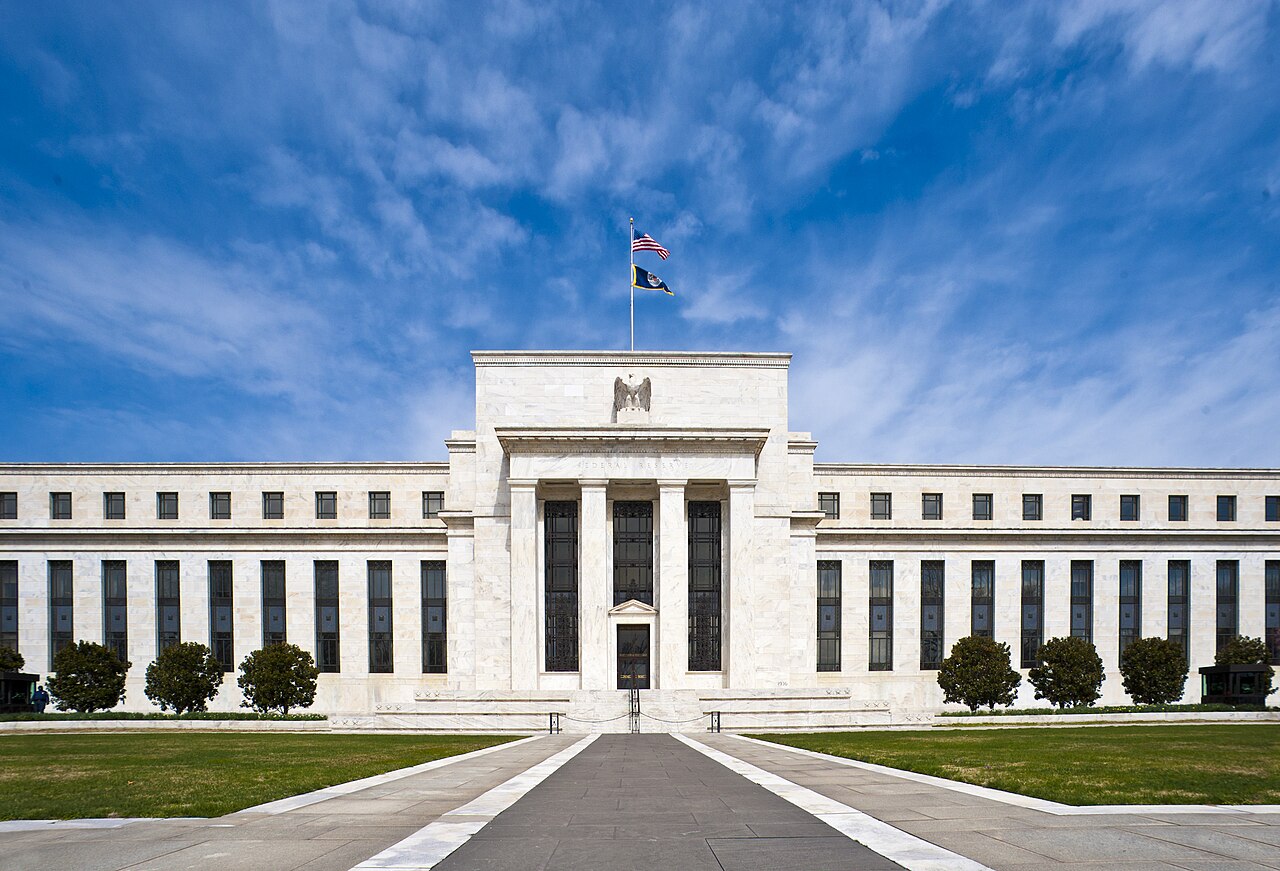
- Wikimedia Commons, "File:Ec 8 (26088200676).jpg," photograph of the Eccles Building, originally posted by the Board of Governors of the Federal Reserve System on Flickr.