As of 2026-05-03 UTC, the Q1 GDP print looks like a slowdown story only if you stop at the headline. Real GDP rose at a 2.0% annualized rate, which is better than the prior quarter's 0.5%, but the more useful finance read sits one layer lower: real final sales to private domestic purchasers still grew 2.5%, even as imports turned up and inventories did more of the visible headline work.[1] Priced is that Q1 was not a recession quarter. New is that the soft-landing case now depends less on retroactive GDP parsing and more on whether labor, retail sales, and inflation data can keep domestic demand firm after a quarter in which imported goods and inventory accumulation distorted the surface picture.[1][2][7][8]
March personal income and spending then tightened the argument. Personal income rose 0.6%, disposable personal income rose 0.6%, and personal consumption expenditures rose 0.9%; yet real DPI slipped 0.1%, real PCE rose only 0.2%, and the personal saving rate fell to 3.6%.[2] That combination does not describe a collapsing consumer. It describes a consumer still spending, but one doing so with less real-income cushion than the headline nominal data imply.
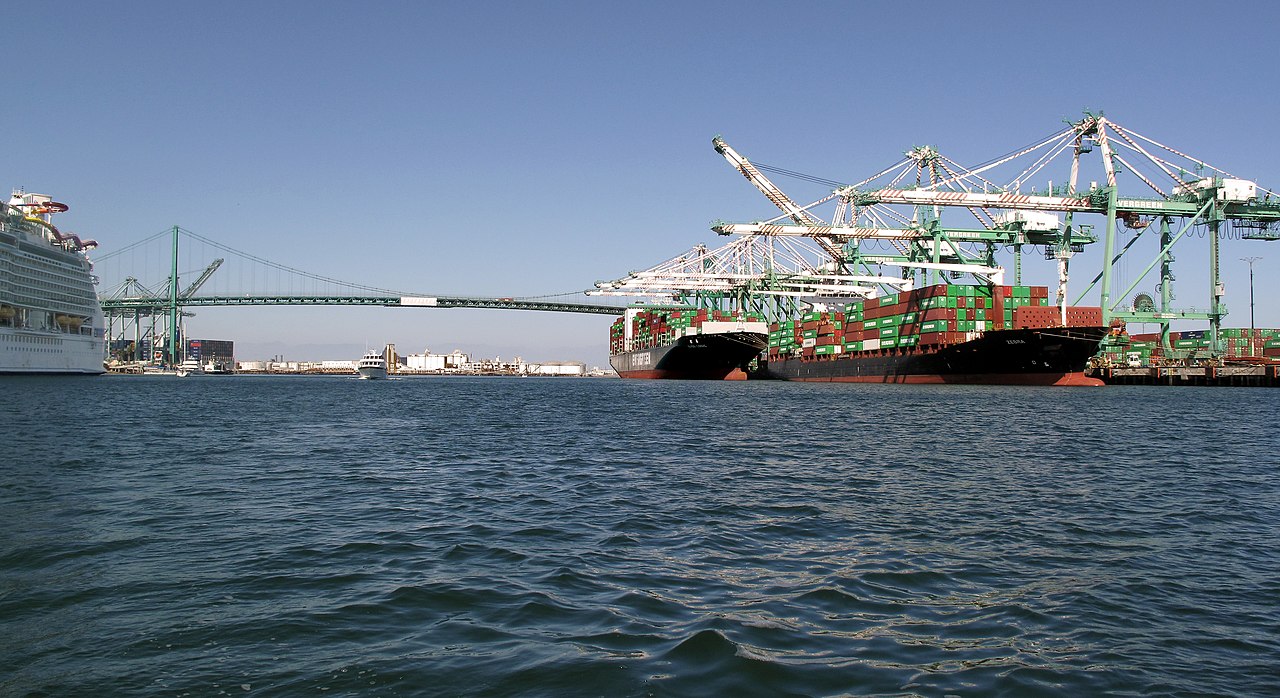
Image context: the cover uses a real photograph of the Port of Los Angeles from Wikimedia Commons. It belongs here because the article's main claim is mechanical, not metaphorical: imports turned up, inventories rose, and the GDP headline therefore looked softer than the domestic-demand core.[9]
Why the headline looked softer than the domestic core
The BEA release gives the cleanest version of the mechanism. In the first quarter, the contributors to higher real GDP were investment, exports, consumer spending, and government spending. Imports also increased, and because imports are a subtraction in GDP accounting, that turn-up worked against the headline number.[1] The same release says the quarter's acceleration versus late 2025 reflected upturns in government spending and exports plus faster investment, partly offset by a deceleration in consumer spending; imports turned up at the same time.[1]
That is why 2.0% real GDP and 2.5% real final sales to private domestic purchasers can coexist without contradiction.[1] The first number is the headline everyone sees. The second isolates consumer spending plus gross private fixed investment and is often the better way to judge whether the private domestic core is actually breaking.[1] In this case it did not break. It stayed firmer than the top-line GDP print suggested.
Inventories matter here too. BEA's technical note says the increase in investment reflected gains in equipment, intellectual property products, and private inventory investment, with inventory gains led by retail and wholesale trade.[1] Put differently, Q1 growth was not telling one simple story. Some of the apparent resilience came from stock being built or restocked, while some of the apparent softness came from imports coming in faster. That is a very different setup from a quarter in which the consumer simply disappears.
What March PCE changed
The March personal income and outlays release makes the next question narrower. Households were still bringing in more nominal income and still spending more nominal dollars. Personal income increased by $149.2 billion, DPI increased by $142.5 billion, and PCE increased by $195.4 billion in March.[2] The goods side did most of the monthly spending lift: $132.6 billion of the increase came from goods and $62.9 billion from services.[2]
But the inflation-adjusted picture was less generous. Real DPI fell 0.1% in March even as real PCE rose 0.2%.[2] The PCE price index rose 0.7% month over month and 3.5% year over year, while core PCE rose 0.3% month over month and 3.2% year over year.[2] That leaves two simultaneous truths in place. The consumer still moved. The consumer also did not receive much real-income relief while doing it.
That matters because the saving buffer is no longer especially fat. Personal saving was $857.3 billion in March and the saving rate was 3.6%.[2] A low saving rate is not immediate evidence of distress, but it does reduce the room for growth to keep surprising on the upside if labor income cools or goods spending normalizes after an import-heavy quarter.
Six numeric anchors
- Real GDP: 2.0% annualized in Q1 2026, after 0.5% in Q4 2025.[1]
- Real final sales to private domestic purchasers: 2.5% in Q1 2026.[1]
- Quarterly inflation inside GDP: 4.5% for the PCE price index and 4.3% for core PCE in Q1.[1]
- March household flow: personal income +0.6%, DPI +0.6%, and PCE +0.9%.[2]
- March real cushion: real DPI -0.1%, real PCE +0.2%, saving rate 3.6%.[2]
- Markets still calm: on 2026-04-30, the 2-year Treasury yield was 3.88%, the 10-year was 4.40%, high-yield OAS was 2.83%, and BBB OAS was 1.02%.[3][4][5][6]
Those numbers do not describe a market pricing immediate recession. They describe a market that still believes domestic demand can hold up, but one that has much less tolerance for another inflation surprise if real income does not improve.
Strongest counterweight
The strongest counterweight to a cautious reading is that the data still support a durable soft landing. A 2.5% gain in real final private domestic sales is respectable, not fragile.[1] March spending still rose in real terms.[2] Credit spreads remain tight enough that neither refinancing stress nor broad earnings panic is being priced into corporate risk premia.[5][6] From that angle, the GDP headline did exactly what a healthy mid-cycle quarter can do: absorb noisier trade and inventory swings without breaking the private domestic core.
That pushback is credible. It is also incomplete. Tight spreads and a positive domestic-demand print tell you the system has not cracked. They do not guarantee that household demand can keep leaning on nominal income growth if real-income gains remain thin and inflation stops easing.[2][5][6]
Falsifier
This article's caution is wrong if the next month of data restores real-income breathing room without damaging activity. Concretely, if May 8 payrolls show labor still expanding at a healthy pace, May 12 CPI cools enough to validate the softer core-PCE trend, and May 14 retail sales confirm that April demand held up without another saving-rate squeeze, then Q1's imports-and-inventories distortion will have mattered more than the underlying slowdown risk.[2][7][8]
Watchlist
- 2026-05-08 Employment Situation for April 2026: the cleanest near-term test of whether labor income can keep supporting demand.[7]
- 2026-05-12 Consumer Price Index for April 2026: the next read on whether March's hotter monthly inflation pulse broadens or fades.[7]
- 2026-05-14 Advance Monthly Sales for Retail and Food Services for April 2026: the quickest check on whether spending held after the import-heavy Q1 setup.[8]
- 2026-05-28 Q1 GDP second estimate and April Personal Income and Outlays: the revision window that can confirm or weaken the current domestic-demand interpretation.[1][2]
Takeaway
Q1 GDP was softer in appearance than in domestic substance. The quarter's 2.0% headline did not come from a dead consumer or a broad private-sector retreat; it came from a mix in which imports turned up, inventories helped, and the private domestic core still managed 2.5% growth.[1] March PCE then kept the soft-landing case alive while narrowing its margin for error: spending continued, but real income stayed thin and the saving rate stayed low.[2] That leaves the next market move where it belongs, in fresh labor, inflation, and retail data rather than in headline GDP alone.
Sources
- U.S. Bureau of Economic Analysis, "GDP (Advance Estimate), 1st Quarter 2026" — Q1 real GDP, real final sales to private domestic purchasers, price indexes, and the technical note on imports and inventories.
- U.S. Bureau of Economic Analysis, "Personal Income and Outlays, March 2026" — March income, DPI, PCE, real PCE, real DPI, saving rate, and PCE inflation figures.
- Federal Reserve Bank of St. Louis FRED, "2-Year Treasury Constant Maturity Rate" (DGS2) — April 30, 2026 yield used in the rates anchor.
- Federal Reserve Bank of St. Louis FRED, "10-Year Treasury Constant Maturity Rate" (DGS10) — April 30, 2026 yield used in the rates anchor.
- Federal Reserve Bank of St. Louis FRED, "ICE BofA US High Yield Index Option-Adjusted Spread" (BAMLH0A0HYM2) — April 30, 2026 spread used in the credit anchor.
- Federal Reserve Bank of St. Louis FRED, "ICE BofA BBB US Corporate Index Option-Adjusted Spread" (BAMLC0A4CBBB) — April 30, 2026 spread used in the credit anchor.
- U.S. Bureau of Labor Statistics, "Schedule of Selected Releases for May 2026" — May 8 Employment Situation and May 12 Consumer Price Index release dates.
- U.S. Census Bureau, "Monthly Retail Trade - Release Schedule" — May 14, 2026 advance retail sales release date for April 2026.
- Wikimedia Commons, "File:View of Port of Los Angeles with container ships.jpg" — source page for the port photograph used as the article image.