Priced: five Liberty and Victory loan drives drew $24.07 billion of orders, from which Treasury allotted $21.44 billion to the United States' World War I financing effort. New: the more durable asset was distribution. Treasury, the young Federal Reserve, banks, employers, churches, clubs, movie theaters, and volunteer speakers built a temporary national sales network; its largest drive alone recorded 22.8 million subscribers and showed private finance that household savings could be reached at scale.[2][3][5]
This was not a triumph of patriotic feeling over price. The bonds were designed to clear near market terms, supported by tax privileges and Federal Reserve credit, then wrapped in the most pervasive public campaign the country had attempted. The mechanism matters more than the mythology: competitive paper, easier payment, trusted local channels, relentless repetition. That combination financed the war and changed who Wall Street imagined as an investor.
The funding problem was also a consumption problem
After the United States entered the war in April 1917, Treasury Secretary William Gibbs McAdoo rejected money creation as the primary answer and settled on a mix of taxes and borrowing. The eventual target was approximately one-third tax finance and two-thirds bond finance.[1] Borrowing had a second purpose beyond filling the Treasury: if households bought bonds from current income and reduced consumption, labor and materials could shift toward war production without the same inflationary pressure.
That logic imposed a demanding test. Moving money from an existing bank deposit or municipal bond into a Liberty Bond would rearrange a portfolio, but it would not necessarily create new saving. Borrowing from a bank to subscribe could even expand purchasing power. The program therefore needed millions of households to defer spending, not merely millions of forms with signatures.
Treasury turned that macroeconomic problem into a retail-funnel problem. The security had to look credible beside familiar savings products; the payment schedule had to fit a wage; and the sale had to arrive through an institution or person the buyer already encountered.
First make the bond investable
The first offering sought $2 billion at a 3.5% coupon. Its $50 minimum denomination was substantial—about two weeks of a manufacturing production worker's compensation—but the rate was not a charitable concession to government. Federal Reserve History places contemporary savings-bank rates around 3.5% to 4% and high-grade municipal yields around 3.9% to 4.2%. Later Liberty coupons rose to 4% and then 4.25% as competing yields moved higher.[1]
Tax treatment and convertibility strengthened the package. Owners of the first issue could exchange into later, higher-coupon bonds, while member banks could use government securities as collateral for Federal Reserve loans. Research by Sung Won Kang and Hugh Rockoff argues that tax exemption and direct or indirect Fed support did more to hold yields down than patriotic sacrifice did; the coupons sat close to comparable market returns from the start.[4]
Then Treasury attacked the cash-flow obstacle. A household could reserve a $50 bond with $4 and make twenty-three weekly payments of $2. Twenty-five-cent thrift stamps offered an even smaller first step, while employers used payroll deductions and banks handled subscription payments, custody, and sometimes credit against the bonds.[1][2] The instrument did not become smaller, but the on-ramp did.
That distinction is still recognizable in financial products. A minimum ticket describes the asset. An installment, sweep, or payroll mechanism describes the distribution. Liberty Bonds scaled because their designers worked on both.
Then put an underwriter in every town
McAdoo did not hire a conventional commission salesforce. The Federal Reserve Banks organized district committees, which branched into state and local committees; member banks took subscriptions. Civic and religious groups supplied trust and reach. Women's organizations, the Boy Scouts, labor groups, retailers, newspapers, and employers became parts of the placement network.[1][2]
The campaign converted ordinary gathering places into investor-education channels. Four Minute Men delivered short talks during film-reel changes and later spoke in churches, lodges, and union halls. Across their wider wartime work, the network counted about 75,000 speakers in more than 5,000 communities and delivered more than seven million speeches—not all of them bond pitches. Local bank quotas were published, towns competed, buyers wore buttons, and public rallies made subscription visible.[2]
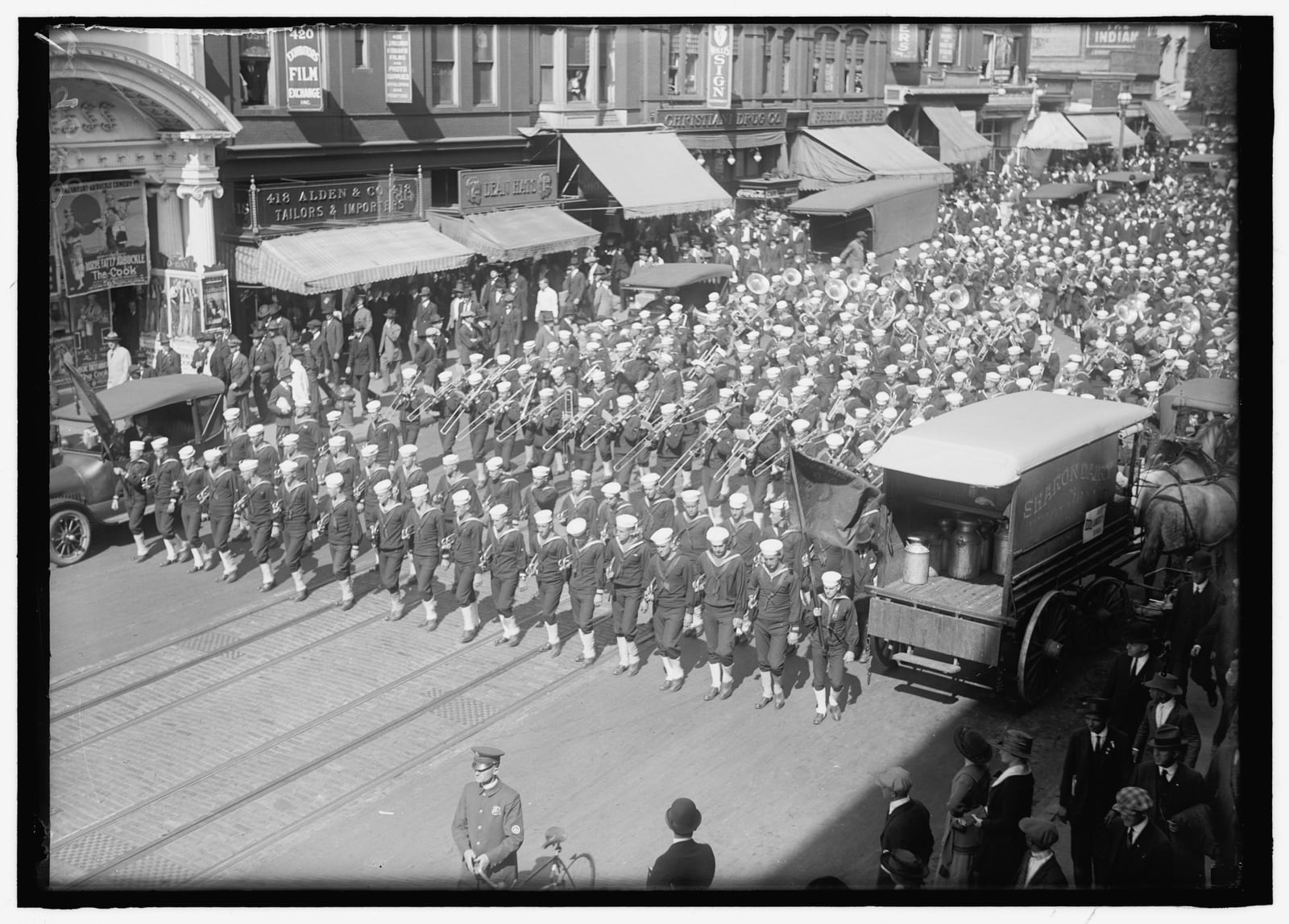
The cover photograph catches the model in one frame. John Philip Sousa's band is playing near the Treasury at a Fourth Liberty Loan ceremony in September 1918. This is not an image of a bond certificate or a trading room. It is the underwriting process staged outdoors: music, flags, public authority, social proof, and a crowd gathered around a financial ask.[7]
The intensity was not incidental decoration. Before the war, most households had little experience buying securities. A bank clerk could explain the form, an employer could collect installments, a local committee could repeat the pitch, and a rally could make participation feel normal. Distribution reduced unfamiliarity one contact at a time.
Scale came from the channel, not a giveaway coupon
The first drive accepted about 4 million subscribers and was 50% oversubscribed; small applications received priority. By the Fourth Liberty Loan in 1918, the accepted issue reached nearly $7 billion from 22.8 million subscriptions. The subscriber totals cannot be added into a unique-owner count because people could participate in more than one drive, but the progression still shows a machine learning to reach far beyond traditional bond buyers.[1][2][5]
The five-drive table compiled by Eric Hilt and Wendy Rahn also reveals a striking fall in average subscription size: $759 in the first drive, $491 in the second, and $227 in the third before it rose in the final two. The program was not simply finding more dollars. It was processing more, smaller orders.[2]
The priced-versus-new gap is therefore clear. The coupon and credit support helped the paper clear; the novelty was the ability to originate household demand. A bond sold on market-aware terms can still transform finance if the selling system reaches customers that the market had ignored.
The afterlife moved from deposits to securities
The deepest claim is not that every Liberty Bond buyer became a stock investor. It is that the drives changed both sides of the retail market: households acquired experience with securities, and intermediaries acquired experience selling to households.
Using county-level differences in subscription intensity, Hilt, Matthew Jaremski, and Rahn find that stronger Liberty Bond participation was followed in the 1920s by more investment banks, slower growth in commercial-bank assets, and greater later ownership of stocks or bonds. Their design does not turn every rally into a clean experiment, but it supports a channel broader than wartime fundraising: the campaign helped redirect intermediation from deposits and loans toward marketed securities.[3]
Later work sharpens the persistence boundary. Gillian Brunet, Hilt, and Jaremski find that households in high-participation counties reported more stock and bond ownership decades later, but only among cohorts old enough to have been exposed to the drives. Their estimates imply that late-1960s household stock ownership would have been about 21% lower without the campaigns.[6] The cohort result matters because it looks more like learned financial behavior than a permanently different county trait.
The private sector carried the lesson forward. Investment banks opened retail offices and used print advertising and sponsored radio programming in the 1920s. Government had demonstrated that middle-income savings were not too fragmented to pursue; they were a market waiting for a channel.[3]
The strongest counterweight: participation was neither free nor purely voluntary
Calling this democratization without qualification would turn distribution success into moral approval. The same local density that made the campaign effective also made refusal visible. Committees published bank-level quotas. German Americans could face harassment if they failed to display loyalty through purchases. Kang and Rockoff recount a bank charter being revoked after its six applicants bought only $200 of bonds.[2][4]
Headcount also overstates the democratization of dollars. In the Fourth Loan, $50 and $100 orders made up 84.8% of public subscription accounts but only 18.1% of their value. Orders of $10,000 or more were just 0.38% of accounts yet supplied 48.2% of public subscription dollars. Small tickets made ownership visible and widespread; larger accounts financed much more of the issue.[8]
Nor did patriotism repeal bond math. The first issue slipped below par soon after sale as general rates rose, and the government leaned on tax advantages, bank finance, and Fed balance-sheet support. Kang and Rockoff's market-price evidence finds little room for the romantic claim that marginal investors routinely accepted a large return sacrifice for the cause.[4]
That is the essential counterweight. The drives widened access and financial familiarity, but they mixed education with propaganda, convenience with surveillance, and voluntary saving with institutional pressure. Subscriber count is evidence of reach. It is not, by itself, evidence of informed consent, fair allocation, or a good realized return.
Falsifier
The retail-distribution thesis fails if broad subscriptions were only a wartime publicity layer: local campaign intensity would leave no later imprint on financial intermediation, and exposed households would show no persistent difference in securities ownership. The evidence so far does not trip that falsifier—small orders establish reach but not dollar dominance, county exposure predicts later market structure, and the long-run ownership effect is concentrated in cohorts that actually encountered the drives.[2][3][6][8] The studies support a durable distribution effect, not the claim that every subscription created wealth or financial sophistication.
Watchlist: four dated tests in the record
- May 14–June 15, 1917 — the First Liberty Loan: watch the allocation, not only the oversubscription headline. Priority for small applications and roughly four million accepted subscribers show whether the first funnel genuinely widened ownership.[1][5]
- October 1, 1917 — the Second Loan opens: the higher 4% coupon and conversion privilege test whether Treasury respected competing yields. If patriotism alone carried demand, repricing the product would have been unnecessary.[1][5]
- September 28–October 19, 1918 — the Fourth Loan: a $6 billion target, influenza-era disruption, and the largest subscriber count make this the network's stress test. The question is whether local institutions could replace mass gatherings when public meetings were curtailed.[2][5]
- April 21–May 10, 1919 — the Victory Loan: after the armistice and the shutdown of the Committee on Public Information, the final drive separates reusable financial distribution from emergency propaganda.[4][5]
Liberty Bonds did what their name promised only in the narrow sense: they lent money to a government at war. Their more consequential financial work was mundane. They created a product ladder, a payment rail, a local service layer, and a repeated sales motion. The campaign's methods deserve scrutiny; its market lesson is harder to dismiss. A security can be priced correctly and still go nowhere until someone builds the road to the buyer.
Sources
- Federal Reserve History, “Liberty Bonds” — financing mix, bond terms, installment access, campaign scale, and the Federal Reserve's distribution role.
- Eric Hilt and Wendy M. Rahn, “Turning Citizens into Investors: Promoting Savings with Liberty Bonds During World War I,” RSF: The Russell Sage Foundation Journal of the Social Sciences 2, no. 6 (2016) — subscriptions, payment plans, civic networks, banks, and coercive pressure.
- Eric Hilt, Matthew S. Jaremski, and Wendy Rahn, “When Uncle Sam Introduced Main Street to Wall Street: Liberty Bonds and the Transformation of American Finance,” NBER Working Paper 27703 (2020; later published in the Journal of Financial Economics) — county-level evidence on investment banks, commercial banks, and later securities ownership.
- Sung Won Kang and Hugh Rockoff, “Capitalizing Patriotism: The Liberty Loans of World War I,” NBER Working Paper 11919 (2006) — pricing, tax treatment, Federal Reserve support, social pressure, and post-issue market evidence.
- Federal Reserve Bank of St. Louis FRASER, The Story of the Liberty Loans — contemporary campaign history, opening and closing dates, issue terms, and the Fourth Loan's influenza disruption.
- Gillian Brunet, Eric Hilt, and Matthew Jaremski, “‘Invest!’: Liberty Bonds and Stock Ownership over the Twentieth Century,” Journal of Financial Intermediation 64 (2025) — cohort-specific long-run household ownership evidence.
- Library of Congress, Harris & Ewing Collection, “Liberty Loans. Sousa's Band Playing for 4th Liberty Loan Drive” (September 21, 1918) — archival glass-negative photograph and cover-image provenance.
- U.S. Department of the Treasury, Annual Report of the Secretary of the Treasury on the State of the Finances for the Fiscal Year Ended June 30, 1919 — primary Fourth Liberty Loan subscription counts and dollar classification.