Priced: Indonesia's $8.5 billion of net portfolio inflows in the second quarter and a 5.75% Bank Indonesia policy rate have rebuilt the carry case.[1] New: Bank Indonesia's JISDOR reference rate was Rp17,836 per U.S. dollar on August 14—modestly firmer than at the end of June, but not yet a decisive appreciation trend.[1][7]
That distinction is the market. A stable rupiah after a difficult external shock is a policy achievement; it is not the same thing as a self-sustaining appreciation cycle. The July policy review's dated flow split shows why: the large second-quarter intake, led by government securities and Bank Indonesia Rupiah Securities, or SRBI, was followed by only $0.1 billion of net inflows through its July 20 cutoff, primarily into government bonds.[1]
This is a market-mechanism analysis, not individualized investment advice. Returns on rupiah assets depend on security price, income, taxes, hedging cost, and the exchange rate at exit.
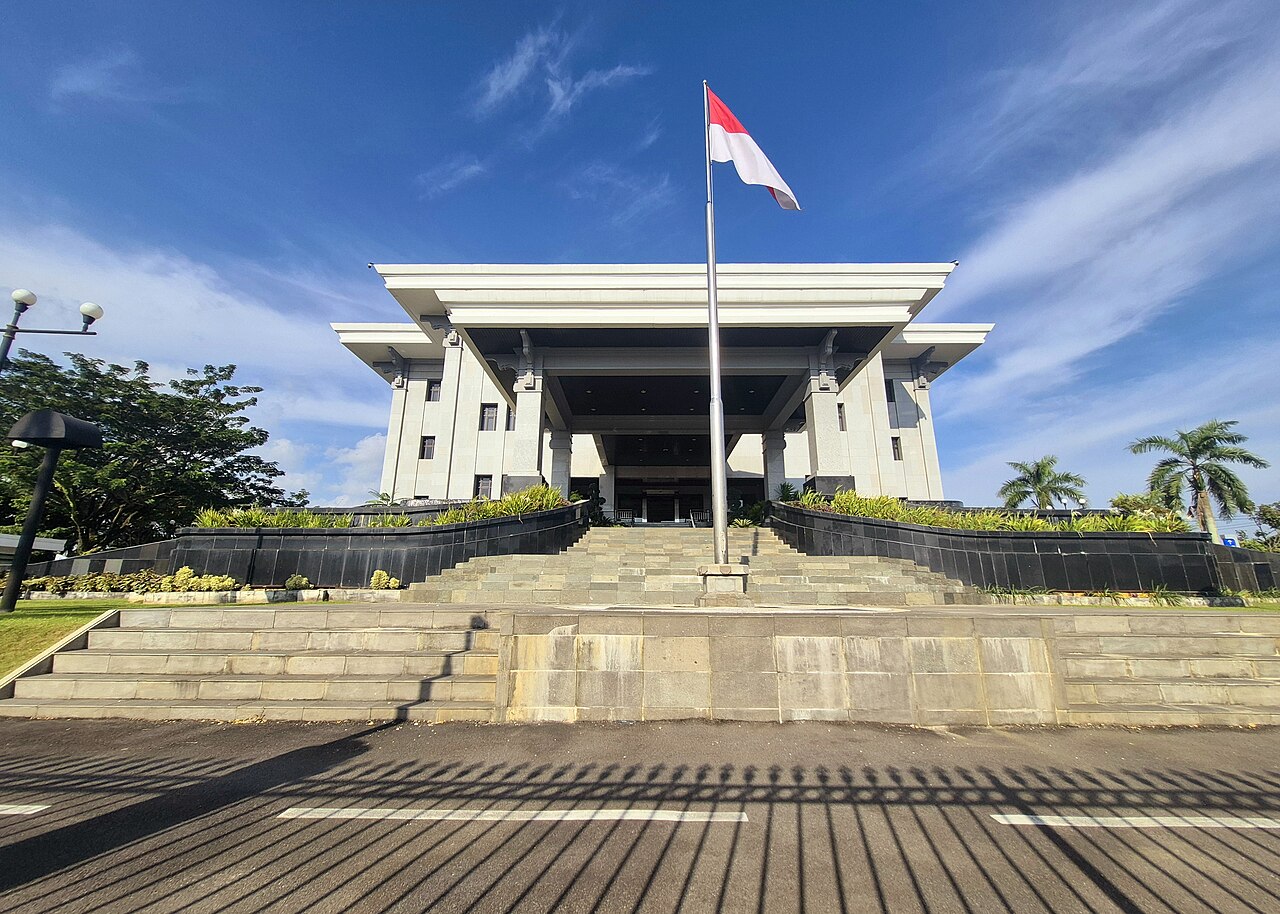
Image context: the cover shows Bank Indonesia's West Kalimantan representative office in Pontianak in January 2026. The photograph is useful precisely because currency defense is not an abstract ticker exercise: one national policy is implemented through an institution with regional reach, operating across money markets, banks, payment systems, and the real economy.[6]
A defense assembled in layers
Bank Indonesia has not tried to support the rupiah with the policy rate alone. Its June policy review paired tighter rates with a higher-yield structure for SRBI, more intensive intervention in offshore non-deliverable forwards and in domestic spot and forward markets, cheaper hedging for foreign investors, and repo liquidity for banks.[2] The July decision kept the policy rate unchanged but expanded the same architecture: attract portfolio cash, reduce the cost of protecting that cash, and prevent the currency defense from draining liquidity out of the domestic banking system.[1]
The causal chain is short. A foreign investor buying SRBI first needs rupiah, which creates demand for the currency. A more attractive local yield raises the income available to absorb currency risk. A hedging incentive lowers one cost of owning the position. If dollar demand becomes disorderly, Bank Indonesia can intervene across several markets rather than relying on the spot market alone.[1][2]
Each link helps stability. None turns portfolio money into permanent capital. The investor can let the security mature, close the hedge, and leave. That is why the right question is not whether inflows occurred. It is whether they broaden, persist, and remain when the yield gap or global risk mood becomes less favorable.
The flow split is the tell
The second-quarter headline is strong. At the July 20 cutoff, the early-third-quarter follow-through was thin. That contrast matters more than treating every incoming dollar as the same vote of confidence.
Bank Indonesia says the second-quarter inflow was driven mainly by government bonds and SRBI. By July 20, nonresident SRBI holdings had reached Rp288.65 trillion.[1] This is evidence that the transmission mechanism works: Bank Indonesia made local money-market paper attractive, and overseas buyers responded.
It is also a concentration signal. Both government bonds and SRBI are yield-sensitive portfolio instruments; SRBI in particular is central-bank paper designed for monetary operations, not a factory, toll road, or long-lived equity commitment. Demand for that fixed-income pair can be deep and rational while the carry is compelling. It can also reverse more quickly than direct investment when U.S. yields rise, the dollar strengthens, or investors reassess the cost of the hedge.
The sourced fact is therefore encouraging but bounded: foreign demand is present in both sovereign and central-bank paper. The interpretation is narrower than a bullish slogan: much of that demand is being paid to occupy the carry-sensitive part of the rupiah market.
Why a flat currency can still be a win
Indonesia reached this position against a hostile backdrop. The Asian Development Bank's July outlook described tighter global conditions, higher energy and food costs, and exchange-rate pressure across developing Asia, even while leaving Indonesia's growth outlook comparatively resilient.[3] The World Bank likewise found domestic demand holding up but stressed that external pressure, fiscal credibility, and productivity reform still govern the durability of growth.[4]
In that setting, flat is not nothing. If global dollar demand and imported-energy risk are pushing one way while local yields, securities demand, hedging support, and intervention push the other, an unchanged exchange rate can mean the defense absorbed a real shock.
But a market wrap has to distinguish outcome from counterfactual. We can observe the stability; we cannot observe precisely where the rupiah would have traded without the policy package. Nor does stability alone reveal which tool did the most work. The rate, SRBI yield, hedge subsidy, intervention, and reserve buffer operate together, which makes the package stronger operationally and harder to decompose analytically.
The price signal remains plain: capital arrived, yet the currency did not establish a rising trend. The cleanest reading is that investors are being compensated to rent rupiah carry while the external risk premium remains elevated.
Strongest counterweight: the buffer is real
The bearish version can go too far. Bank Indonesia reported $145.3 billion of reserve assets at the end of July, only slightly below June and still considered adequate for external resilience.[8] That is a meaningful capacity to smooth disorderly markets, and it sits beside resilient domestic demand rather than an economy already in contraction. The World Bank and ADB both describe Indonesia as comparatively steady even while flagging the global and structural risks.[3][4]
If global yields ease, energy pressure fades, and Indonesia's external balance improves, today's defense could become tomorrow's appreciation. In that branch, the existing carry would no longer have to offset such a large external drag. Buying could persist across both SRBI and government bonds for multiple policy intervals, expand rather than rotate between them, and eventually reach private assets. That would make the second-quarter inflow look like the start of a reallocation rather than a temporary shelter.
Reserves are not proof that this branch has begun, however. A reserve stock is a buffer, not a recurring inflow. Intervention can reduce volatility but cannot manufacture a favorable global rate differential indefinitely. Higher local yields support the currency while also raising the hurdle for borrowers and asset valuations. The policy mix has bought room; the next flows must show what that room is worth.
Falsifier
Discard the “stability, not a turn” view if the rupiah appreciates for a full policy interval while nonresident demand expands across both SRBI and government bonds—instead of merely rotating between them—and reserves remain stable without another rate increase or richer hedging support. That combination would show that demand is becoming durable enough to do more than offset pressure.
The opposite combination would reinforce the thesis: a flat or weaker currency while inflows fade or merely rotate between government bonds and SRBI, especially if reserves decline or Bank Indonesia has to make the carry package more generous.
Watchlist
- August 18–19 — first scheduled policy meeting since Destry Damayanti became acting governor: watch the policy-rate decision, the updated third-quarter flow total, and whether communication reinforces policy continuity or emphasizes fresh defense measures.[5][9]
- September 1 — revised macroprudential liquidity incentives take effect: the test is whether easier bank liquidity can support domestic credit without weakening rupiah demand or forcing SRBI to carry even more of the stabilization burden.[1]
- September 22–23 — next scheduled policy meeting: by then the market will have supplied a full interval of evidence. Expanding demand across both government bonds and SRBI, alongside currency appreciation, would challenge this view; another flat interval with total inflows fading or merely rotating between the two would confirm that stability is still being rented.[5]
Sources
- Bank Indonesia, “BI-Rate Held at 5.75%: Strengthening Stability, Supporting Economic Growth” (July 22, 2026) — policy settings, intervention and hedging measures, exchange rate, portfolio flows, SRBI holdings, and reserve assets.
- Bank Indonesia, Monetary Policy Review — June 2026 — the June tightening, SRBI rate structure, foreign-investor hedge incentive, foreign-exchange intervention, and domestic repo-liquidity design.
- Asian Development Bank, Asian Development Outlook, July 2026 — Indonesia's resilient outlook within a region facing tighter global conditions, commodity shocks, and exchange-rate pressure.
- World Bank, Indonesia Economic Prospects: Managing Risks, Unlocking Productivity (June 2026) — domestic-demand resilience and the external, fiscal, and productivity conditions around the outlook.
- Bank Indonesia, 2026 publication calendar — the August and September Board of Governors policy-meeting dates.
- Wikimedia Commons, “Gedung Bank Indonesia di Pontianak (2026) 02” — January 2026 photograph by Medelam of Bank Indonesia's West Kalimantan representative office.
- Bank Indonesia, JISDOR daily reference-rate table — the August 14, 2026 USD/IDR reference rate.
- Bank Indonesia, “Official Reserve Assets Remained Maintained in July 2026” (August 7, 2026) — the end-July reserve position and adequacy assessment.
- Bank Indonesia, “Appointment of the Senior Deputy Governor as Acting Governor of Bank Indonesia” (July 27, 2026) — Destry Damayanti's appointment and the institution's continuity statement.