Priced: CoreWeave shares jumped 19% after Q2 as revenue reached $2.575 billion and company-defined revenue backlog reached $104.2 billion.[1][5] New: the harder operating proof was nearly 500 MW of active power added in one quarter, lifting live capacity to 1.5 GW, while adjusted operating margin rose from 1% in Q1 to 5%. That makes the conversion from contract to working cloud visible. It also leaves contracted power at 3.7 GW—2.2 GW ahead of the active estate—so delivery and funding, rather than sales appetite, are now the tighter constraints.[1]
The quarter split neatly. CoreWeave landed revenue near the top of its May range, beat its adjusted operating-income range, and kept interest expense just below guidance. It also deployed more capital than planned. Demand was never the difficult part of this earnings story; Q2 supplied evidence that the machinery can switch on at speed, but not yet that the resulting margin can outrun the capital stack.[1][3][4]
Evidence cut-off: August 16, 2026. “Revenue backlog,” “capital expenditures,” and adjusted operating income use CoreWeave's definitions; GAAP remaining performance obligations and cash purchases of property and equipment are identified separately. This is an earnings analysis, not a recommendation to buy or sell the shares.[1][2]
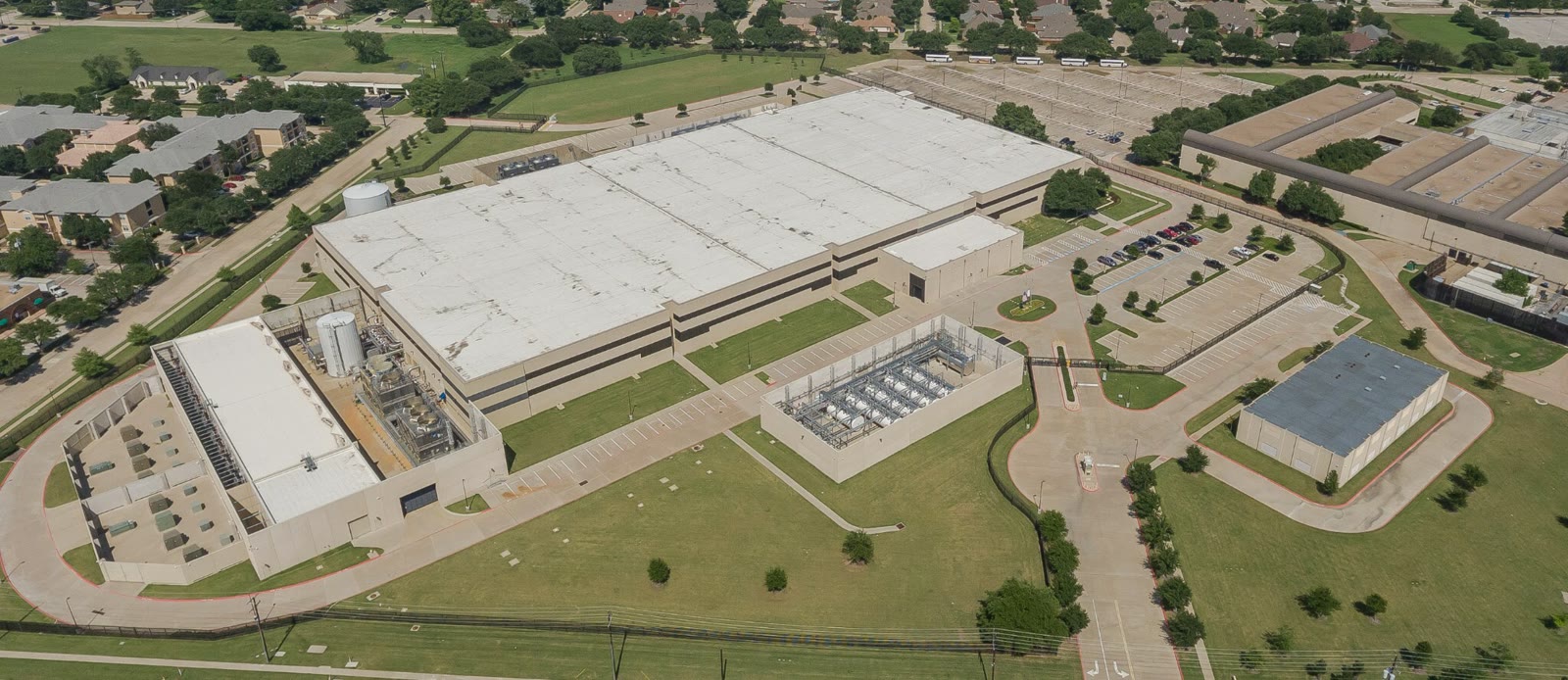
Image context: the cover is CoreWeave's official aerial photograph of its Plano facility, published with the company's July 2023 announcement that the site was due to become fully operational by year-end. It does not depict Q2 2026 activity. It is relevant because the earnings mechanism runs through a real sequence of land, grid connection, cooling, servers, networking, and software—not through an abstract AI-demand chart.[7]
The real beat was measured in megawatts
The May guidance and the Q2 result expose both sides of the print.[1][4]
| Metric | May Q2 guidance | Q2 actual | Read-through |
|---|---|---|---|
| Revenue | $2.45B–$2.60B | $2.575B | Near the top |
| Adjusted operating income | $30M–$90M | $128M | Above the range |
| Net interest expense | $650M–$730M | $640M | Just below the range |
| Capital expenditures | $7B–$9B | $9.4B | Above the range |
The operating-income beat matters more than the small revenue beat. CoreWeave had already explained the commissioning drag: after receiving a powered shell, it typically incurs lease, power, equipment-depreciation, and fit-out costs for one to two months before recognizing revenue; management says contribution margin normally settles into the mid-20s by the third month.[4] That is a management model, not an audited promise, but Q2 behaved in the direction it predicts. Adjusted operating income climbed from $21 million in Q1 to $128 million as the active base expanded.[1]
Timing also gives Q3 an unusually clean test. More than 300 MW of Q2's increase arrived in June alone, according to management—more active power than CoreWeave had ever added in a full quarter.[3] Much of that capacity therefore contributed ramp cost for part of Q2 but could carry a fuller revenue load in Q3. If margin does not continue improving, “late-quarter activation” will stop being an explanation and become a question about unit economics.
Backlog and power run on different clocks
The $104.2 billion headline needs one layer of unpacking. CoreWeave's presentation reconciles it to $103.7 billion of filed remaining performance obligations, plus $0.5 billion of other estimated future revenue under committed contracts.[1] The 10-Q says 41% of RPO is expected to be recognized by June 30, 2028, another 39% in months 25 through 48, and the balance later.[2] These are estimates subject to delivery, service availability, credits, delays, and other variable consideration—not a pile of revenue already earned.
Power is a separate ledger. At quarter-end, 1.5 GW was active against 3.7 GW contracted. The resulting 2.2 GW gap is not a direct backlog-coverage ratio: customer consideration is measured in dollars, while contracted power is a site-and-supply input measured in watts. It is still the best physical map of the work remaining. Power has to be available; a shell has to be fitted; GPUs, networking, storage, and cooling have to be commissioned; only then can a customer workload begin producing service revenue.
There is genuine progress inside that gap. Management said more than half of Q2 backlog was tied to contracts where customer delivery had begun, and it expects that share to exceed two-thirds by year-end.[3] The quarter also ended before more than $25 billion of early-Q3 commitments that the company excluded from its reported backlog.[1] In other words, the delivery numerator is rising, but the demand denominator is still moving away.
Operating leverage has appeared above the interest line
CoreWeave reported a $49 million GAAP operating loss and $128 million of adjusted operating income after excluding stock compensation, acquisition costs, and acquired-intangible amortization. Below that line sat $640 million of net interest expense, producing a $626 million net loss.[1][2] The company has demonstrated operating leverage; it has not yet demonstrated earnings after financing.
Q3 guidance sharpens the issue. At the midpoints, CoreWeave expects roughly $3.525 billion of revenue, $230 million of adjusted operating income, $900 million of interest expense, and $12.5 billion of capital expenditures.[3] Interest would still be almost four times adjusted operating income. Capex would be roughly three and a half times quarterly revenue.
Those comparisons are intentionally not profit-margin calculations. Capex creates assets intended to earn over several years, and interest is reported below operating income. They show the timing burden: cash and financing arrive before the cluster has delivered its contracted revenue. CoreWeave's capex measure also is not the same as cash spending; the company defines it as property-and-equipment additions, including finance-lease assets, less the change in construction in progress.[1] Its 10-Q shows $14.1 billion of cash purchases of property and equipment in the first half, versus $3.7 billion of operating cash flow—a roughly $10.5 billion gap before other investing activity, filled principally through financing.[2]
The strongest counterweight is real contracts—and real concentration
This is not a speculative shell waiting for its first tenant. Committed contracts generated 98% of Q2 revenue, deferred revenue stood at $9.7 billion, and more than half of backlog had already entered delivery.[2][3] CoreWeave also structures much of its term borrowing as delayed-draw, contract-backed financing, so funds are drawn alongside the operationalization of specific capacity rather than sitting idle from day one.[4] Customer prepayments and matched financing do not eliminate the funding gap, but they make it more underwritten than the headline net loss suggests.
The protection has a boundary. CoreWeave's two largest customers supplied 36% and 26% of Q2 revenue. The 10-Q warns that customer non-performance could leave the company with excess capacity while it remains responsible for equipment, data-center leases, build-outs, and related financing.[2] A concentrated, contracted model can be both more visible and more brittle: the same agreements that support the debt make counterparty performance unusually important.
What would break this read
The thesis is that Q2 marked a repeatable conversion from active power into operating leverage, even while financing remains the limiting layer. Discard that view if CoreWeave reaches at least 1.85 GW of active power at year-end but Q4 adjusted operating margin remains below 10%. Management expects a low-teens Q4 margin; falling short after the late-June capacity ramp would show that scale is not absorbing commissioning and platform costs as claimed.[3]
Watchlist
- September 29–October 1 — Fully Connected 2026: listen for customer-level evidence on managed inference, utilization across older and newer GPUs, and the operational steps between a contracted site and billable capacity. Product announcements matter less here than disclosed adoption and margin mechanics.[6]
- Q3 2026 results: test the $3.45 billion–$3.60 billion revenue range and $200 million–$260 million adjusted operating-income range against $860 million–$940 million of interest and $11.5 billion–$13.5 billion of capex. The more than 300 MW added in June should now have a fuller quarter to contribute.[3]
- December 31 — the conversion checkpoint: compare active power with the greater-than-1.85 GW target, check whether more than two-thirds of Q2 backlog has entered delivery, and apply the 10% margin falsifier rather than relying on the exit revenue run rate alone.[3]
CoreWeave's Q2 deserves more than either a demand victory lap or a debt warning. The company activated nearly 500 MW, beat its adjusted operating-income guide, and showed that a larger live estate can lift margin. The next proof is narrower and harder: keep commissioning the power already contracted, let the late-June capacity earn for a full quarter, and make operating income climb faster than the interest bill. The bookings are ahead. The investment case now travels on the power curve.
Sources
- CoreWeave, Q2 2026 Earnings Presentation (August 11, 2026) — revenue, company-defined backlog and its RPO reconciliation, active and contracted power, capex definition, operating metrics, and quarter-to-quarter margin.
- CoreWeave, Quarterly Report on Form 10-Q for the quarter ended June 30, 2026 — RPO timing and conditions, customer concentration, deferred revenue, debt, operating cash flow, and cash purchases of property and equipment.
- CoreWeave, Corrected Transcript: Q2 2026 Earnings Call (August 11, 2026) — commissioning timing, late-June power additions, backlog under delivery, Q3 and full-year guidance, and year-end operating targets.
- CoreWeave, Corrected Transcript: Q1 2026 Earnings Call (May 7, 2026) — prior Q2 guidance, one-to-two-month fit-out economics, delayed-draw financing structure, and the earlier active-power baseline.
- Stan Choe, “Wall Street rises near a record as AI stocks climb and worries about inflation ease a bit.” Associated Press, August 12, 2026 — CoreWeave's 19.3% post-earnings share-price move and the broader market context.
- CoreWeave, “Fully Connected 2026” — official September 29–October 1 conference dates and program scope.
- CoreWeave, “CoreWeave Opens New Texas Data Center to Expand Access to High-Performance GPUs,” July 25, 2023 — official Plano facility photograph and announcement context.