The easy grid-battery trade is already priced: storage is scaling fast, interconnection queues are full, and every solar-heavy market now understands the value of moving cheap midday power into the evening peak. The new question is narrower and more investable: can batteries earn enough durable revenue after the first wave of ancillary-service scarcity gets competed away?
That is the shift for 2026. EIA says U.S. developers plan to add a record 86 GW of utility-scale generating capacity this year, with battery storage contributing 24 GW, or 28% of the planned total.[1] Battery storage additions would follow a record 15 GW added in 2025, and EIA notes that more than 40 GW has been added over the last five years.[1] That is no longer a novelty premium. It is a scale industry.
The Mechanism
Battery storage earns money from time and optionality. A battery can charge when power is cheap, discharge when power is dear, sell ancillary services that help balance the grid, and, in some markets, receive capacity payments for being available during reliability-critical hours. Those are different revenue streams with different durability.
Early battery economics often benefited from scarcity. When a market has only a small storage fleet, a battery can collect high ancillary-service prices or catch wide energy spreads during hot, tight intervals. But the same fast buildout that validates the technology also compresses the easy margins. As more batteries chase the same frequency-response products and the same evening ramp, the marginal battery needs better siting, longer duration, stronger software, or a contract that pays for reliability value instead of only merchant volatility.
California shows the operating logic. CAISO says storage can participate through several market models, including non-generator resources that can behave as both load and generation, and participation requires scheduling coordinators, revenue-quality metering, and, for ancillary services, certification and direct telemetry.[3] In other words, this is not simply a box of cells next to a transformer. It is a market resource with obligations, metering, bidding, and dispatch behavior.
CAISO's 2024 battery-storage report makes the finance distinction sharper. California's resource-adequacy program pays batteries for capacity when they contract with load-serving entities, but those resources also take on market obligations, including must-offer rules for flexible resource-adequacy capacity.[4] The same report says batteries receive net qualifying capacity based on sustained four-hour output testing, and that longer-duration batteries do not automatically receive more resource-adequacy credit than four-hour assets under that framework.[4] That is a valuation boundary: adding duration can help in merchant dispatch, but capacity-market rules decide how much of that engineering choice becomes contracted revenue.
What Is Actually New
The buildout is concentrated. EIA expects about 80% of 2026 battery additions to come from three states: 12.9 GW in Texas, 3.4 GW in California, and 3.2 GW in Arizona.[1] That concentration matters because battery returns are not national averages. They are nodal, congested, weather-sensitive, and rule-specific.
Texas is the cleanest warning that growth and returns can move in opposite directions. Modo Energy estimates ERCOT battery revenues fell to roughly $29.4/kW in 2025, about half of 2024's $56/kW and about one-sixth of 2023's $193/kW.[5] Its explanation is exactly what investors should expect in a maturing storage market: fewer extreme weather intervals plus rapid capacity growth that saturated ancillary services and compressed energy-arbitrage spreads.[5]
That does not make the buildout irrational. It changes the underwriting question. A battery financed on 2023-style scarcity pricing is fragile. A battery financed on tighter spreads, conservative capacity assumptions, stronger dispatch optimization, and a more realistic degradation profile can still be valuable. The spread between those two cases is where the equity risk sits.
Modo's ERCOT buildout data reinforces the point. Texas began 2026 with 13.9 GW and 22.9 GWh of operational grid-scale battery capacity, after 6 GW came online in 2025 alone.[6] Two-hour systems dominated the 2025 additions, and average duration rose only to 1.65 hours.[6] That is enough to harvest short evening spreads and ancillary products, but not necessarily enough to turn a battery into a deep reliability substitute during a prolonged scarcity event.
Five Numeric Anchors
- 86 GW: planned U.S. utility-scale capacity additions in 2026, according to EIA.[1]
- 24 GW: planned U.S. utility-scale battery additions in 2026.[1]
- 80%: approximate share of planned 2026 battery additions concentrated in Texas, California, and Arizona.[1]
- $29.4/kW: Modo Energy's expected full-year 2025 ERCOT BESS revenue level, down from $193/kW in 2023.[5]
- 13.9 GW / 22.9 GWh: ERCOT's operational grid-scale BESS footprint entering 2026, per Modo Energy's buildout report.[6]
Those anchors frame the thesis: storage demand is real, but the marginal battery is being funded into a more competitive market than the first wave enjoyed.
The Counterweight
The strongest bullish counterweight is cost. Lazard's 2025 LCOE+ release says battery-storage costs declined sharply across hybrid and standalone projects, offsetting the 2021-2024 increase cycle and bringing storage economics back toward 2020 levels.[2] Lower cell prices, higher energy density, and cheaper project costs can absorb some revenue compression.
There is also a grid-value argument that pure merchant revenue misses. Batteries reduce curtailment, smooth ramps, support reliability during net-load peaks, and can defer some conventional capacity needs. CAISO's storage page emphasizes storage's flexibility in balancing the grid, and its battery report shows why capacity accreditation and resource-adequacy participation matter alongside energy-market bidding.[3][4] A battery that looks mediocre on merchant arbitrage can still clear financing if a utility, load-serving entity, or corporate buyer pays for availability.
But cost decline is not a blanket answer. Falling capex helps every new entrant, including competitors. If the market receives enough low-cost batteries in the same nodes, ancillary-service prices and arbitrage spreads can compress further. The investor's edge is therefore not "batteries are cheaper." It is "this battery has a defensible revenue stack after cheaper batteries arrive."
What To Underwrite
The first underwriting variable is duration. In Texas, Modo notes that two-hour batteries accounted for most 2025 additions, while systems over 2.5 hours remained rare.[6] If price spreads stretch later into the evening, longer-duration projects may earn a different return profile. If spreads stay narrow or capacity rules do not reward extra duration, the additional capex can disappoint.
The second variable is contract mix. A revenue stack built mostly on merchant ancillary services is more exposed to saturation. A stack with resource-adequacy payments, tolling, offtake, or a large-load/customer contract can survive lower daily volatility, but only if the contract price reflects degradation, operating constraints, and availability penalties.
The third variable is location. EIA's state concentration is useful, but a battery is not long "Texas" or "California" in the abstract.[1] It is long a node, congestion pattern, interconnection queue, charging access, local curtailment profile, and deliverability rule. The same megawatt-hour can be valuable in one pocket and stranded in another.
Falsifier
The constructive storage-finance thesis is wrong if 2026 additions arrive on schedule while merchant revenues keep falling and contracted capacity values fail to offset the decline. The clean falsifier would be a combination of three signals: ERCOT-style revenue compression spreading to other major storage markets, resource-adequacy or tolling prices resetting lower as batteries compete for contracts, and developers cutting new interconnection applications because hurdle-rate math no longer works even after lower capex.[1][4][5][6]
If those conditions arrive together, the market has not just repriced a few aggressive developers. It has repriced the storage business model from scarcity asset to low-return infrastructure.
Watchlist
- EIA monthly generator inventory through summer 2026: watch whether the planned 24 GW battery buildout slips, concentrates further, or arrives into already crowded nodes.[1]
- ERCOT summer scarcity intervals: a hot summer can temporarily repair merchant revenue; the important test is whether batteries earn better returns at comparable temperatures than they did in 2025.[5]
- CAISO resource-adequacy pricing and slice-of-day implementation: capacity rules decide how much storage value is contracted rather than left to merchant spreads.[4]
- Duration mix in new projects: the shift from one- and two-hour systems toward four-hour assets would signal that developers are underwriting deeper energy arbitrage and capacity value, not just ancillary-service scarcity.[4][6]
The takeaway is that grid batteries still have a strong structural case. The grid needs fast flexible capacity, solar-heavy markets need time-shifting, and gas-turbine scarcity makes quick-to-build storage attractive.[1][2] But the easy public-market story has aged. Capacity growth is visible. Cost decline is visible. What is not yet proven is revenue durability after saturation.
That is where investors should spend their time. The best storage assets will not merely be the biggest or newest. They will be the ones with the right node, right duration, right contract, and right dispatch system for a market where the first battery boom has already taught everyone else where the spread used to be.
Sources
- U.S. Energy Information Administration, "New U.S. electric generating capacity expected to reach a record high in 2026" (February 20, 2026) - planned 2026 capacity additions, battery-storage additions, state concentration, and major project examples.
- Lazard, "Lazard Releases 2025 Levelized Cost of Energy+ Report" (June 16, 2025) - battery-storage cost decline and system-planning context.
- California ISO, "Storage" - market participation models, metering, certification, and dispatch participation requirements for storage resources.
- California ISO Department of Market Monitoring, "2024 Special Report on Battery Storage" (May 29, 2025) - resource-adequacy treatment, capacity payments, must-offer obligations, and battery availability analysis.
- Modo Energy, "Why were ERCOT battery revenues so low in 2025?" (February 3, 2026) - ERCOT BESS revenue compression, weather sensitivity, ancillary-service saturation, and arbitrage-spread pressure.
- Modo Energy, "ERCOT Annual Buildout Report: Battery capacity reaches 14 GW entering 2026" (February 2, 2026) - ERCOT BESS operational capacity, 2025 additions, duration mix, and queue signals.
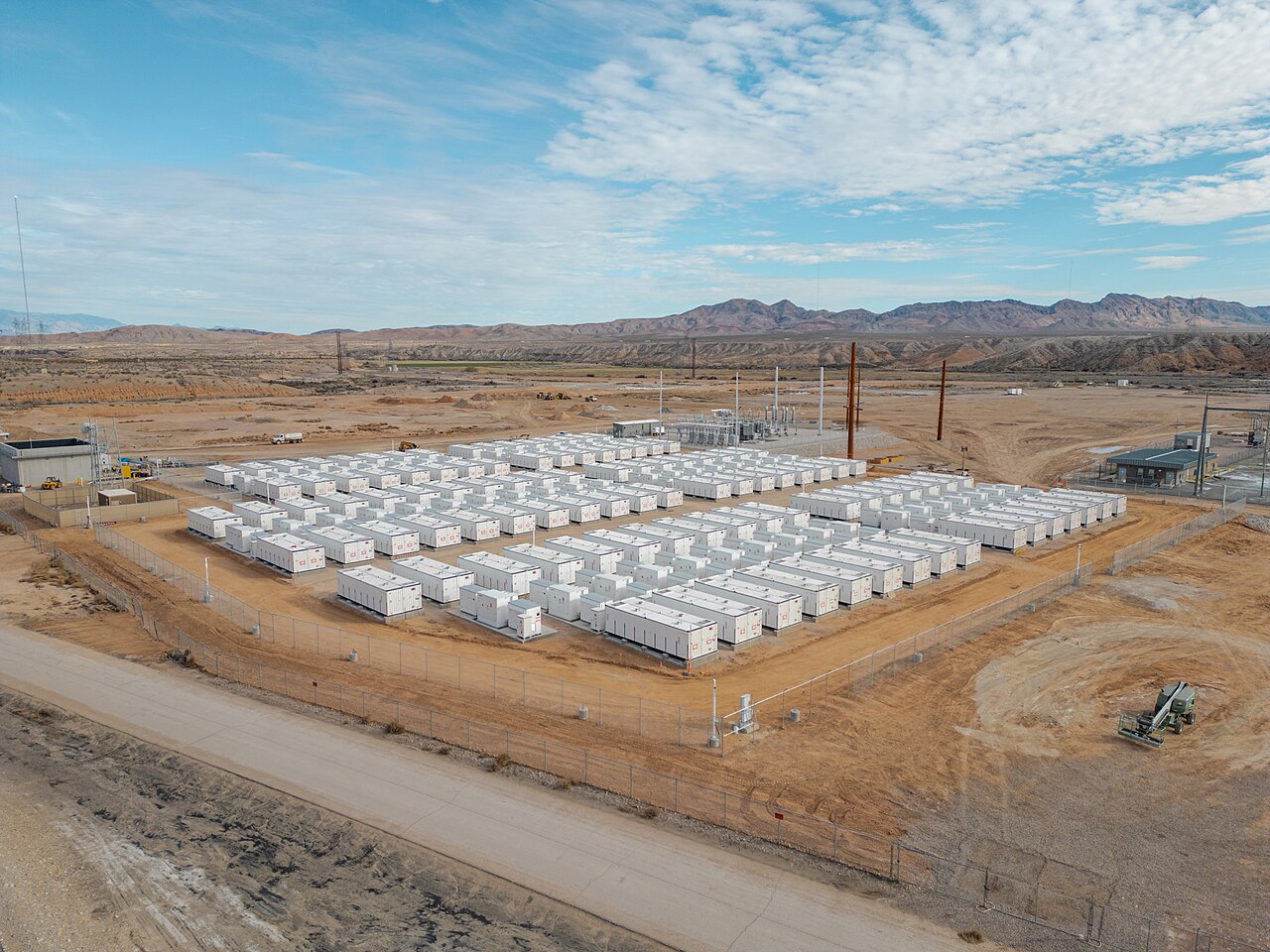
- Wikimedia Commons, "File:Reid Gardner BESS.jpg" - source page for the lead photograph of the Reid Gardner Battery Energy Storage project near Moapa, Nevada.