GE Vernova's quarter landed into a market that already believes the obvious story: U.S. electricity demand is rising again, data centers are forcing utilities and developers to buy gear faster, and gas turbines are scarce.[5] That part is priced. The harder question after first quarter 2026 is whether GE Vernova can convert that demand into enough Electrification revenue and margin to justify a higher full-year guide without leaning too heavily on one-time acquisition gains and early working-capital benefits.[1][2][4]
The headline numbers were undeniably strong. Orders reached $18.3 billion, backlog rose to $163.3 billion, revenue hit $9.3 billion, and free cash flow reached $4.8 billion, more than the company's full-year 2025 total.[1][2] Power stayed hot, with total gigawatts under contract rising from 83 GW to 100 GW in the quarter and management now aiming for at least 110 GW by year-end 2026.[1][3] But the more important new signal sat next to the gas story rather than inside it: Electrification booked $7.1 billion of orders, ran at an approximate 2.5x book-to-bill ratio, and included $2.4 billion of equipment orders for data centers, which management said was more than all of last year.[1][3]
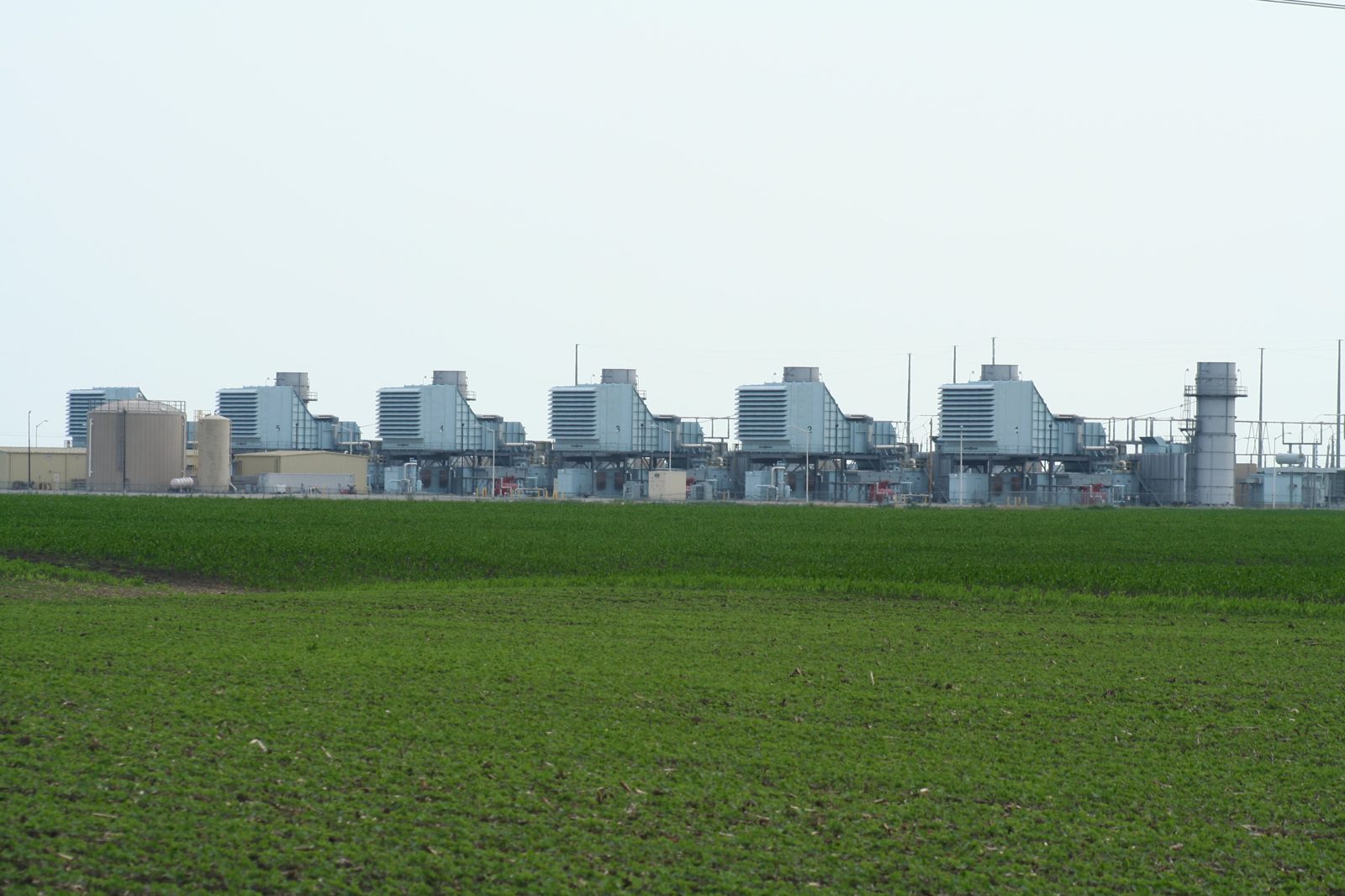
Image context: the cover uses a real Wikimedia Commons photograph of the Goose Creek Energy Center in Illinois rather than a stock chart, server rack, or AI-themed illustration.[6] That is the right documentary scale for this article because the argument depends on equipment delivery in the real world: turbines, substations, transformers, and switchgear.
Priced vs new
What the market already knows is that GE Vernova sits in the right industrial lane. EIA said in January that U.S. electricity use is expected to grow 1% in 2026 and 3% in 2027, the strongest four-year growth stretch since 2000, with large computing facilities as the main driver.[5] Against that backdrop, GE Vernova's Power segment did exactly what investors expected a scarce gas-equipment supplier to do: orders rose to $10.0 billion, revenue to $5.0 billion, and management described favorable pricing for both equipment and services.[1][3]
The new information is narrower and more financially important. Management said first-quarter gas equipment contracting consisted of 19 GW of slot reservation agreements and only 2 GW of orders, while 6 GW of prior slot reservations converted into orders and 4 GW shipped in the quarter.[1] That is the critical distinction. Slot reservations prove demand, but reservations are not the same thing as recognized revenue. The money moves through the income statement only when backlog converts, equipment ships, and margin holds.
This is why Electrification matters more than the headline gas scarcity story. Electrification orders rose to $7.1 billion, revenue to $3.0 billion, and equipment backlog to $38.6 billion, up 75% year over year and including roughly $5 billion from the Prolec GE acquisition.[1] In the presentation, management also raised 2026 Electrification revenue guidance to $14.0 billion-$14.5 billion, including about $3 billion from Prolec GE, and lifted the segment margin target to 18%-20% from 17%-19%.[2] If investors are going to pay up for the quarter, that is the lane that has to convert cleanly.
Why the raised guide can work
The best evidence in favor of the raised outlook is that this is not just a story about one future gas backlog number. GE Vernova lifted total 2026 revenue guidance to $44.5 billion-$45.5 billion from $44.0 billion-$45.0 billion and raised free-cash-flow guidance to $6.5 billion-$7.5 billion from $5.0 billion-$5.5 billion.[2] That is a meaningful move, and it came with near-term operating checkpoints. Management said Power should grow organic revenue 15%-17% in the second quarter with 17%-18% EBITDA margin, while Electrification should deliver $3.3 billion-$3.5 billion of second-quarter revenue with modest sequential margin expansion.[2]
The 10-Q adds the timing detail that makes this more than a slogan. GE Vernova reported total remaining performance obligations of $163.3 billion, of which equipment-related RPO was $75.9 billion and services-related RPO was $87.4 billion.[4] Importantly, the company expects 38% of equipment RPO to be recognized within one year and 69% within two years.[4] That gives the bullish case a real mechanism. If Electrification backlog is growing because utilities and developers are ordering actual substations, transformers, HVDC systems, and switchgear, then a visible portion of that backlog should show up in reported revenue on a timetable investors can monitor.[2][4]
There is also a reason the Power story and the Electrification story reinforce each other rather than compete. In the transcript, management said about 80% of total gigawatts under contract are with traditional customers and 20% explicitly support data centers.[3] That matters because it keeps the quarter from becoming a one-theme hyperscaler fantasy. GE Vernova is not relying on one customer type alone. It is serving a broader power-capacity build cycle while also monetizing the extra pressure large computing loads put on the grid.
Six numeric anchors
- $18.3 billion: first-quarter total orders, up strongly year over year, showing that demand is broad rather than isolated to one business line.[1][2]
- $163.3 billion: total remaining performance obligations at quarter-end, which is the clearest balance-sheet expression of future revenue visibility.[2][4]
- 83 GW -> 100 GW -> 110 GW: total gas turbine backlog plus slot reservation agreements moved from 83 GW to 100 GW in the quarter, and management is now targeting at least 110 GW by year-end 2026.[1][3]
- $7.1 billion and 2.5x: Electrification orders reached $7.1 billion with an approximate 2.5x book-to-bill ratio, showing that grid equipment is not a sidecar but a second engine.[1][2]
- $44.5 billion-$45.5 billion and $6.5 billion-$7.5 billion: the updated full-year revenue and free-cash-flow guide, which is the real financial consequence of the quarter.[2]
- $250 million-$350 million: management's estimated 2026 tariff-cost impact in the 10-Q, a reminder that this is not a clean straight-line margin story.[4]
Strongest counterweight
The strongest pushback is that the quarter's headline quality was flatter than the top line made it look. Net income was $4.7 billion, but that included a $4.5 billion pre-tax M&A net gain, primarily from the Prolec GE transaction.[1] Free cash flow of $4.8 billion was also helped by working capital, not only by structural earnings power.[1][3] And the 10-Q still warns that global tariffs could cost $250 million-$350 million in 2026 even after contractual protections and mitigation actions.[4] Wind remains a real drag as well: second-quarter Wind revenue is expected to be down mid-teens with EBITDA losses of $200 million-$300 million.[2]
That counterweight matters because it keeps the thesis honest. The claim here is not that the stock should be valued off first-quarter GAAP earnings or one unusually cash-rich quarter. The narrower claim is that the quarter improved the quality of the 2026 story by making Electrification conversion more visible. If that visibility proves false, the guide raise will look more fragile than the press release headline suggests.[1][2][4]
Falsifier
This view breaks if backlog keeps growing but conversion does not. Concretely, if Power keeps signing slot reservations, Electrification keeps reporting large orders, and yet second-half revenue and margin fail to follow because Prolec integration drags, grid-equipment delivery slips, or tariff costs overwhelm the improvement, then the quarter should be read as a demand signal without enough earnings durability.[2][3][4]
Watchlist
- 2026-05-12 - EIA's next Short-Term Energy Outlook. If the power-demand forecast weakens materially, the market's willingness to pay for every electrification-adjacent backlog number should cool as well.[5]
- Q2 2026 gas bookings. Management said it now expects to book 10-15 GW of contracts in Q2 after already booking more power-equipment value in April than in all of Q1.[3]
- 3Q 2026 gas-output capacity. Management said it remains on track for 20 GW of annualized output by the third quarter, which is a concrete test of whether order momentum can be manufactured, not just marketed.[3]
- Year-end 2026 contract and guide checkpoints. The two key numbers are at least 110 GW under contract in Power and the raised Electrification revenue and margin targets embedded in the full-year outlook.[2][3]
Takeaway
GE Vernova's first quarter did not make the demand story more surprising. Gas scarcity, data-center load growth, and rising utility equipment demand were already in the market's field of view.[5] What changed is that the raised guide now has a more legible second leg. Electrification is large enough, growing fast enough, and near enough to the revenue line that it can either validate the quarter or expose its limits.[1][2][4]
That is why gas slots are priced but electrification conversion is the real upgrade. Reservations tell you the power market is tight. Conversion tells you whether the quarter deserves a lasting rerating.
Sources
- GE Vernova, "GE Vernova reports first quarter 2026 financial results and raises 2026 guidance" (April 22, 2026) - headline results, segment detail, gas-contracting mix, and the updated full-year framing.
- GE Vernova, "1st Quarter 2026 Earnings Webcast Presentation" (April 22, 2026) - backlog composition, segment order/revenue trends, second-quarter outlook, and raised 2026 revenue and free-cash-flow guidance.
- GE Vernova, "1st Quarter 2026 Earnings Webcast Transcript" (April 22, 2026) - management remarks on data-center order mix, gas-pricing trends, 10-15 GW Q2 bookings, and the 20 GW annualized output target by 3Q.
- GE Vernova, "Form 10-Q for the quarter ended March 31, 2026" - remaining performance obligations, Prolec GE acquisition accounting, and the estimated 2026 tariff-cost range.
- U.S. Energy Information Administration, "EIA forecasts strongest four-year growth in U.S. electricity demand since 2000, fueled by data centers" (January 13, 2026) - U.S. electricity-demand and natural-gas-demand context.
- Wikimedia Commons, "File:Goose Creek Energy Center.jpg" - source page for the article image.