Ford's first quarter was good enough to support a real guide raise, but not clean enough to close the debate. Revenue reached $43.3 billion, adjusted EBIT came in at $3.5 billion, and management raised full-year adjusted EBIT guidance to $8.5 billion to $10.5 billion from $8.0 billion to $10.0 billion.[1] Those are strong numbers for a company that still gets treated as a low-multiple auto cyclical.
The part the market can already see is the easiest one. First-quarter results included a $1.3 billion one-time IEEPA tariff benefit, and Ford still used $1.9 billion of adjusted free cash flow in the quarter.[1] So the right priced-vs-new split is narrower. Priced is the headline beat and the tariff tailwind. New is whether Ford Pro's margin durability, Ford Blue's mix recovery, and the company's promised cost reductions can keep the raised guide believable while Model e still lost $777 million and Ford keeps spending into the Universal EV platform and Ford Energy.[1][2]
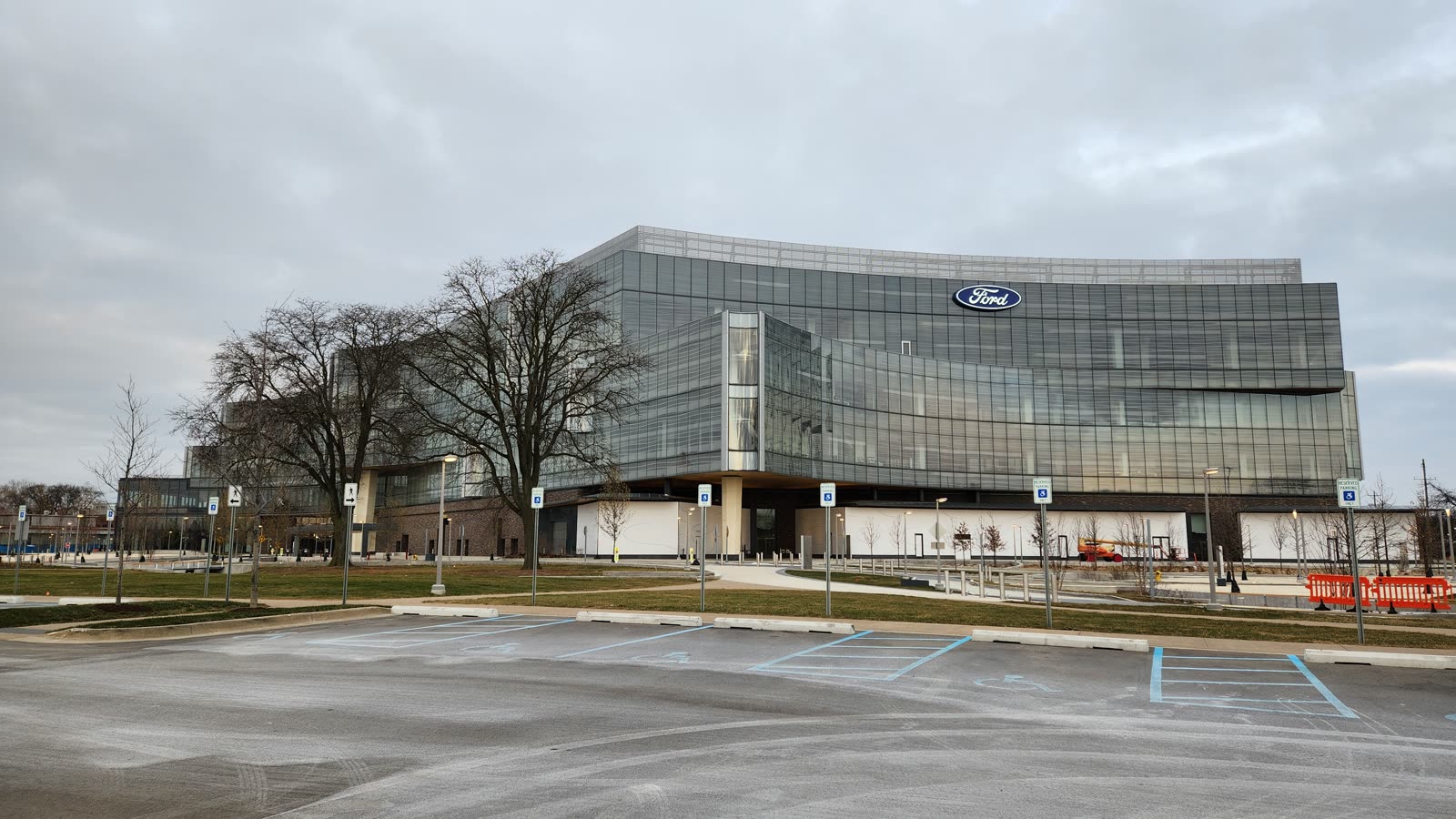
Image context: the cover uses a real Wikimedia Commons photograph of Ford World Headquarters in Dearborn, Michigan.[4] That is the right visual here because the quarter's core question sits inside a real corporate machine: a mature truck-and-commercial business is being asked to finance software growth, cost repair, and a still-unfinished EV strategy at the same time.
What actually improved
The quality of the quarter was better than a unit-volume headline would suggest. Ford's wholesales fell 4% year over year, yet revenue still rose 6% and adjusted EBIT rose from $1.0 billion to $3.5 billion.[1] That tells you mix, pricing, and segment discipline mattered more than raw volume. The strongest proof came from Ford Pro. The segment generated $14.7 billion of revenue and $1.685 billion of EBIT for an 11.4% margin, even with wholesales down 10%.[1] Paid software subscriptions rose 30% to 879,000.[1] That is the cleanest high-quality earnings stream inside Ford today.
Ford Blue also did real work. Revenue rose 14% to $23.9 billion, and EBIT swung from $96 million to $1.942 billion, lifting margin to 8.1%.[1] Management tied that strength to F-Series, Bronco, and double-digit Explorer and Expedition sales growth.[1] For investors, this matters because it says the legacy internal-combustion and hybrid side of Ford is still capable of throwing off far more cash than the market gives it credit for when launches, incentives, and quality costs are behaving.
That segment split is the real equity story now. Ford entered 2026 with the Ford Blue, Ford Model e, and Ford Pro structure fully established, and the 2025 annual report already framed the company around that internal capital-allocation hierarchy rather than around one undifferentiated auto line.[3] The first quarter made the hierarchy easier to see in numbers. Ford Pro is the earnings anchor. Ford Blue remains the bridge. Model e is still the cost center that has to justify the patience.
Why the beat is not clean
The beat still needs cleaning before it deserves a larger multiple. The most obvious reason is that $1.3 billion of first-quarter benefit came from a one-time IEEPA tariff item tied to amounts Ford had paid between March 2025 and February 2026.[1] That does not make the quarter fake. It does mean investors should resist reading the entire guide raise as pure underlying margin repair.
Cash flow is the second reason. Operating cash flow was only $1.3 billion, and adjusted free cash flow was a use of $1.9 billion.[1] Some of that can normalize across the year, and management still guided to $5.0 billion to $6.0 billion of full-year adjusted free cash flow.[1] Even so, weak first-quarter cash conversion is exactly the kind of detail that keeps a low-multiple industrial from rerating too early.
Then there is Model e. The segment lost $777 million on just $1.2 billion of revenue, for an EBIT margin of -63.1%.[1] That was an improvement from the prior year, but it is still a large drag on consolidated quality. Ford's presentation makes the 2026 bargain explicit: the company expects $4.0 billion to $4.5 billion of Model e losses for the full year, about $1 billion of incremental investment to support the UEV platform and Ford Energy, about $2 billion of commodity headwinds, and about $1 billion of ongoing tariff impacts, offset by a $1 billion Novelis recovery and $1 billion of material and warranty cost reductions.[2] That is not a passive setup. It is an execution gauntlet.
Read the guide raise correctly
The guide raise matters, but the shape of it matters more than the headline. Ford now expects full-year adjusted EBIT of $8.5 billion to $10.5 billion, adjusted free cash flow of $5.0 billion to $6.0 billion, and capital expenditures of $9.5 billion to $10.5 billion.[1] Segment outlooks still point to $6.5 billion to $7.5 billion of Ford Pro EBIT, $4.5 billion to $5.0 billion of Ford Blue EBIT, $4.0 billion to $4.5 billion of Model e losses, and about $2.5 billion of Ford Credit earnings before taxes.[1]
That tells you the raised range is not a broad-based "everything is fixed" declaration. It is a claim that Ford Pro can stay strong, Blue can keep more of its price-and-mix gains, and cost actions can absorb a meaningful amount of commodity and EV-spend pressure.[1][2] The market will not need another quarter to notice the tariff benefit. It will need another quarter to decide whether the raised guide still holds once that easy piece is no longer the center of attention.
Six numeric anchors
- Q1 revenue and EBIT: Ford reported $43.3 billion of revenue and $3.5 billion of adjusted EBIT in the first quarter.[1]
- One-time tailwind: results included a $1.3 billion IEEPA tariff benefit.[1]
- Ford Pro quality: the segment produced $14.7 billion of revenue, $1.685 billion of EBIT, an 11.4% margin, and 879,000 paid software subscriptions.[1]
- Ford Blue recovery: the segment generated $23.9 billion of revenue and $1.942 billion of EBIT, lifting margin to 8.1%.[1]
- Model e drag: the segment lost $777 million on $1.2 billion of revenue, with a -63.1% EBIT margin.[1]
- Guide architecture: Ford now expects $8.5 billion to $10.5 billion of adjusted EBIT, $5.0 billion to $6.0 billion of adjusted free cash flow, and $9.5 billion to $10.5 billion of capex in 2026.[1]
Strongest counterweight
The strongest pushback is that the quarter still carries too much help from temporary and hard-to-repeat items. That objection has force. A one-time $1.3 billion tariff benefit is not a durable earnings stream.[1] Ford Pro wholesales were down 10%, adjusted free cash flow was negative, and the company's own guide still assumes about $2 billion of commodity headwinds, about $1 billion of ongoing tariff impacts, and billions more of Model e losses and EV investment.[1][2] If investors want to say the stock remains a trading vehicle until cash conversion improves, the quarter did not fully disprove them.
Falsifier
The constructive read in this article breaks if the next two quarters show that Ford Pro's margin was a local peak rather than a durable floor. Concretely, if Ford Pro drifts out of the low-double-digit margin zone, Ford Blue gives back its price-and-mix gains, and adjusted free cash flow fails to inflect toward the $5.0 billion to $6.0 billion full-year target while Model e losses stay heavy, then the raised range will start to look like a quarter that borrowed too much from temporary help.[1][2]
Watchlist
- Early June 2026 U.S. sales release: Ford needs to show that F-Series, Bronco, Explorer, and Expedition strength was not just a quarter-end snapshot.[1]
- Late July 2026 Q2 earnings report: the key confirmation is whether adjusted free cash flow improves sharply enough to keep the $5.0 billion to $6.0 billion full-year target credible.[1]
- Second-half 2026 Novelis recovery: management explicitly counts on about $1 billion of net improvement from that recovery, so it is part of the operating case rather than a side note.[2]
- Ford Pro subscriptions and Model e losses: if paid subscriptions build from 879,000 while Model e losses narrow from $777 million, Ford's earnings mix gets structurally better.[1]
Takeaway
Ford's first quarter was strong enough to move the burden of proof, but not to eliminate it. The market has already seen the easy part: tariff help, a solid beat, and a guide raise.[1] The harder and more interesting question now is whether Ford can convert that good print into repeatable earnings quality.
If Ford Pro holds its margin, Blue keeps behaving, and cost repair really offsets a meaningful slice of commodity and EV pressure, the stock has more room than a plain old auto cyclical normally gets.[1][2] If those pieces slip, the quarter will read less like the start of a cleaner earnings arc and more like a sharp quarter with too much temporary assistance.
Sources
- Ford Motor Company, "Ford Reports First-Quarter 2026 Financial Results; Raises Full-Year Guidance" (April 29, 2026).
- Ford Motor Company, "Q1 2026 Earnings Presentation" (April 29, 2026).
- Ford Motor Company, Annual Report / Form 10-K for the fiscal year ended December 31, 2025, filed February 11, 2026.
- Wikimedia Commons, "Ford World Headquarters under clouds, from parking lot" file page.