Fiserv no longer trades like a premium fintech compounder. On Fiserv's own investor-site ratios page, the stock currently screens at 9.89x trailing earnings, 1.58x revenue, and 7.77x free cash flow.[1] That is a cheap-looking surface. The cheapness is not mysterious. Full-year 2025 organic revenue growth was 4%, fourth-quarter organic revenue was flat, 2026 guidance calls for only 1% to 3% organic revenue growth and $8.00 to $8.30 of adjusted EPS, and the balance sheet still carries $28.997 billion of total debt against $2.776 billion of cash and equivalents.[1][2][3] Priced is the slow-growth, leveraged incumbent. New is whether Clover-led merchant mix can keep free cash flow strong enough to make that label stale.
The split inside the business is what makes the stock interesting at all. Fiserv's 2025 release says Merchant Solutions delivered 6% organic growth for the full year while Financial Solutions grew only 2%.[2] In the fourth quarter, Merchant Solutions still grew 1% organically while Financial Solutions fell 2%, leaving the whole company flat.[2] The attraction is easy to locate: Clover and the merchant stack still offer a live growth vector. The harder question is whether that vector is strong enough to carry a company whose consolidated guide still looks pedestrian and whose leverage still reads heavy.
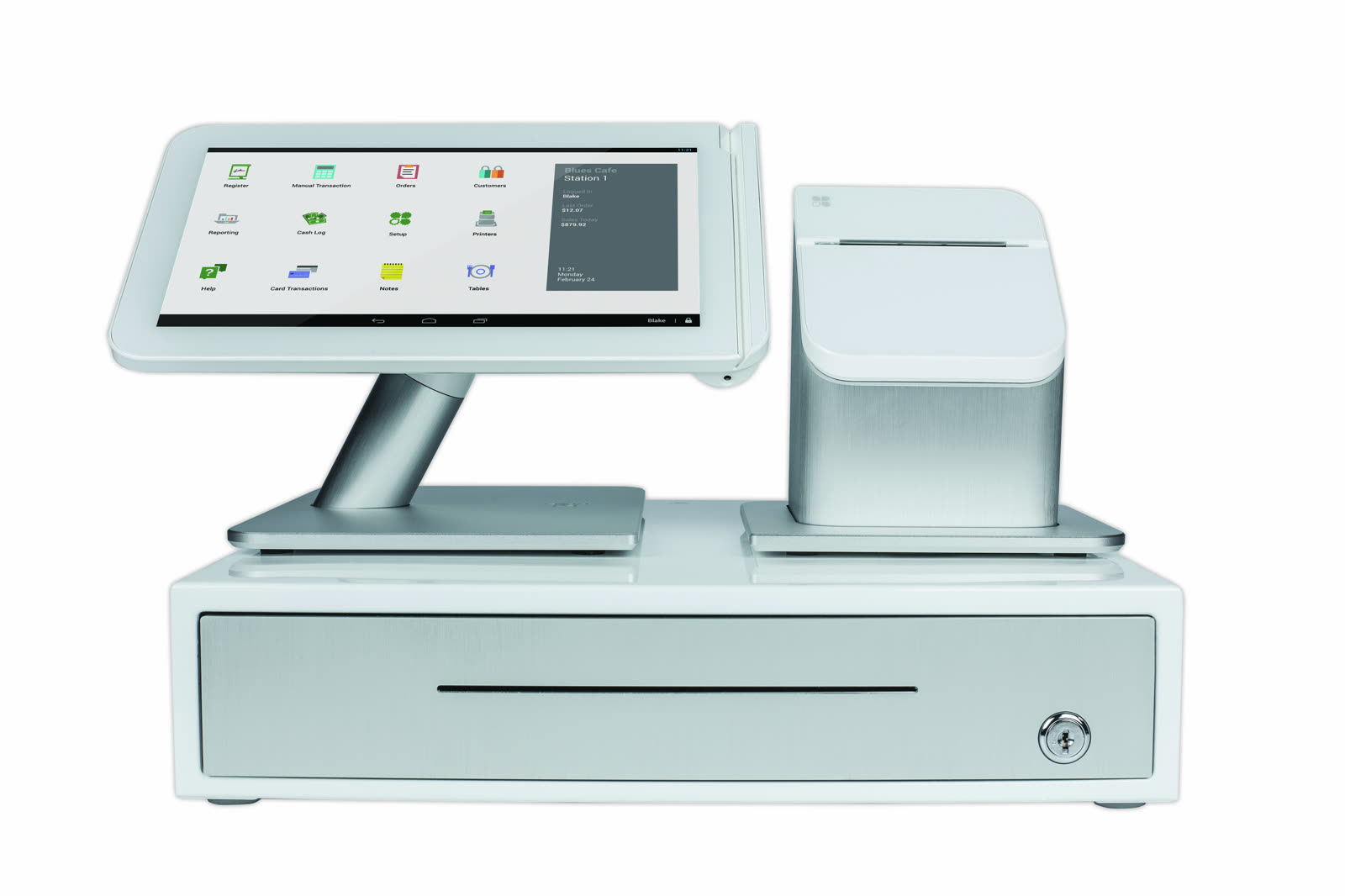
Image context: the cover uses a real photograph of a Clover Station terminal because the finance question here begins in a concrete merchant workflow. Fiserv's rerating case is not a metaverse-style payments abstraction. It is a claim that one physical checkout surface can pull more software, more processing, and more recurring service revenue into the same client relationship.[6]
Priced vs new
What the market has already priced is the drag. Fiserv reported $21.19 billion of GAAP revenue in 2025, but adjusted EPS still fell 2% to $8.64 for the year, and 2026 guidance points lower at $8.00 to $8.30.[2] Free cash flow was still a substantial $4.44 billion, yet the company also repurchased $5.6 billion of stock during 2025.[2] That mix can look less like compounding and more like financial engineering if the underlying growth engine does not broaden.
The new part of the story sits in quality of mix and uses of cash. Merchant Solutions remains the cleaner growth lane. Fiserv says Clover is central enough to its merchant pitch that the company is still using the platform as an international wedge; in January it announced a partnership with Sumitomo Mitsui Card Company to bring the Clover suite into Japan, emphasizing multistore support, smartphone-based operations, and centralized management tools for merchants.[4] That matters because the valuation case is not "payments volume goes up, therefore stock goes up." The valuation case is "the merchant relationship gets thicker, and the cash flows become harder to dislodge."
If that thicker relationship works, the multiple is too low. A business on 9.89x trailing earnings and 7.77x trailing free cash flow does not need spectacular top-line acceleration to re-rate.[1] It needs evidence that the better part of the portfolio is getting larger, that consolidated margins stop sliding, and that management treats free cash flow as a balance-sheet repair tool rather than only a buyback reservoir.
If that relationship does not work, the cheapness is justified. The same investor-site data that make the stock look inexpensive also show 112.43% total debt to equity and 107.62% long-term debt to equity.[1] The balance-sheet page reinforces the point: total debt ended 2025 at almost $29.0 billion, current maturities were $1.239 billion, and long-term debt was still $26.917 billion before lease obligations.[3] That is a structure that leaves less room for execution mistakes than the earnings multiple alone suggests.
Six numeric anchors
- The multiple is already compressed: Fiserv's investor-site ratios page currently shows 9.89x trailing P/E, 1.58x price to revenue, and 7.77x price to free cash flow.[1]
- The topline guide is modest: management's 2026 outlook calls for only 1% to 3% organic revenue growth and $8.00 to $8.30 of adjusted EPS.[2]
- The growth engine is narrow: full-year 2025 organic growth was 6% in Merchant Solutions versus 2% in Financial Solutions; in the fourth quarter those numbers were 1% and -2%, respectively.[2]
- Cash generation is still real: full-year 2025 free cash flow was $4.44 billion, even after a flat fourth quarter and lower adjusted EPS.[2]
- Capital allocation is the tension: the company repurchased $5.6 billion of stock in 2025, more than the year's free cash flow.[2]
- Leverage is still the discipline test: year-end cash and equivalents were $2.776 billion against $28.997 billion of total debt.[3]
Put together, those anchors describe a stock that is not expensive because the market does not trust the company to turn merchant strength into a cleaner corporate profile. That is the whole investment question.
Strongest counterweight
The strongest pushback is that the stock deserves to stay cheap because the difficult parts of the business are not gone. Consolidated organic growth is slow, Financial Solutions is barely growing, adjusted EPS guidance for 2026 sits below 2025's $8.64, and leverage remains too high for a company that wants the market to treat it as a software-thick payments platform.[1][2][3] On that view, Clover is interesting but not yet large enough to rewrite the group multiple.
That counterweight deserves respect. The article's narrower claim is not that Fiserv has already become a premium merchant-platform story. It is that the stock is priced as if Clover, Merchant Solutions, and cash generation will fail to improve the quality of the whole company. At 9.89x trailing earnings, the burden of proof is lower than it would be for a classic fintech favorite.[1]
Falsifier
This framework is too cautious if the next few quarters show three things at once: Merchant Solutions re-accelerates from the fourth quarter's 1% organic growth rate, Financial Solutions stops shrinking, and free cash flow remains robust enough that management can defend both balance-sheet discipline and selective buybacks without leaning on accounting adjustments.[2][3] If that happens, then the market is misreading Fiserv as a tired incumbent when it is actually moving back toward a cleaner merchant-led cash compounder.
Watchlist
- May 5, 2026 first-quarter earnings call: this is the next direct check on whether fourth-quarter flat organic growth was a trough or a warning.[5]
- May 14, 2026 Investor Day: management itself has pointed to this event, which makes it the clearest venue for showing whether One Fiserv and Clover are strategic slogans or a real capital-allocation roadmap.[2]
- Clover's international rollout, starting with Japan: the Sumitomo Mitsui launch matters because it tests whether Clover travels as an operating system, not just as a U.S. small-business terminal brand.[4]
Takeaway
Fiserv is cheap for understandable reasons. Slow consolidated growth, softer adjusted EPS, and nearly $29 billion of debt keep the stock from getting a premium multiple.[1][2][3] The reason to keep looking is that Merchant Solutions, Clover, and free cash flow still give the company a live rerating path. In 2026, flat growth is already priced. The new proof is whether Clover-led merchant mix and stricter use of cash can make Fiserv look less like a levered incumbent and more like a durable payments platform again.
Sources
- Fiserv, "Ratios" investor page, accessed May 2, 2026, showing trailing valuation multiples, profitability, per-share data, and leverage ratios sourced from LSEG.
- Fiserv, "Fiserv Reports Fourth Quarter and Full Year 2025 Results" (February 10, 2026).
- Fiserv, "Balance Sheet" investor page, accessed May 2, 2026, showing year-end 2025 cash, debt, and liability figures.
- Fiserv, "Fiserv and Sumitomo Mitsui Introduce Clover Suite of Products, Enabling Digital Commerce for Millions of Merchants" (January 21, 2026).
- Fiserv, "First Quarter 2026 Fiserv Earnings Conference Call" event page (May 5, 2026).
- Wikimedia Commons, "File:Clover Station with receipt printer and cash drawer.jpg" — photographic image of a Clover point-of-sale setup.