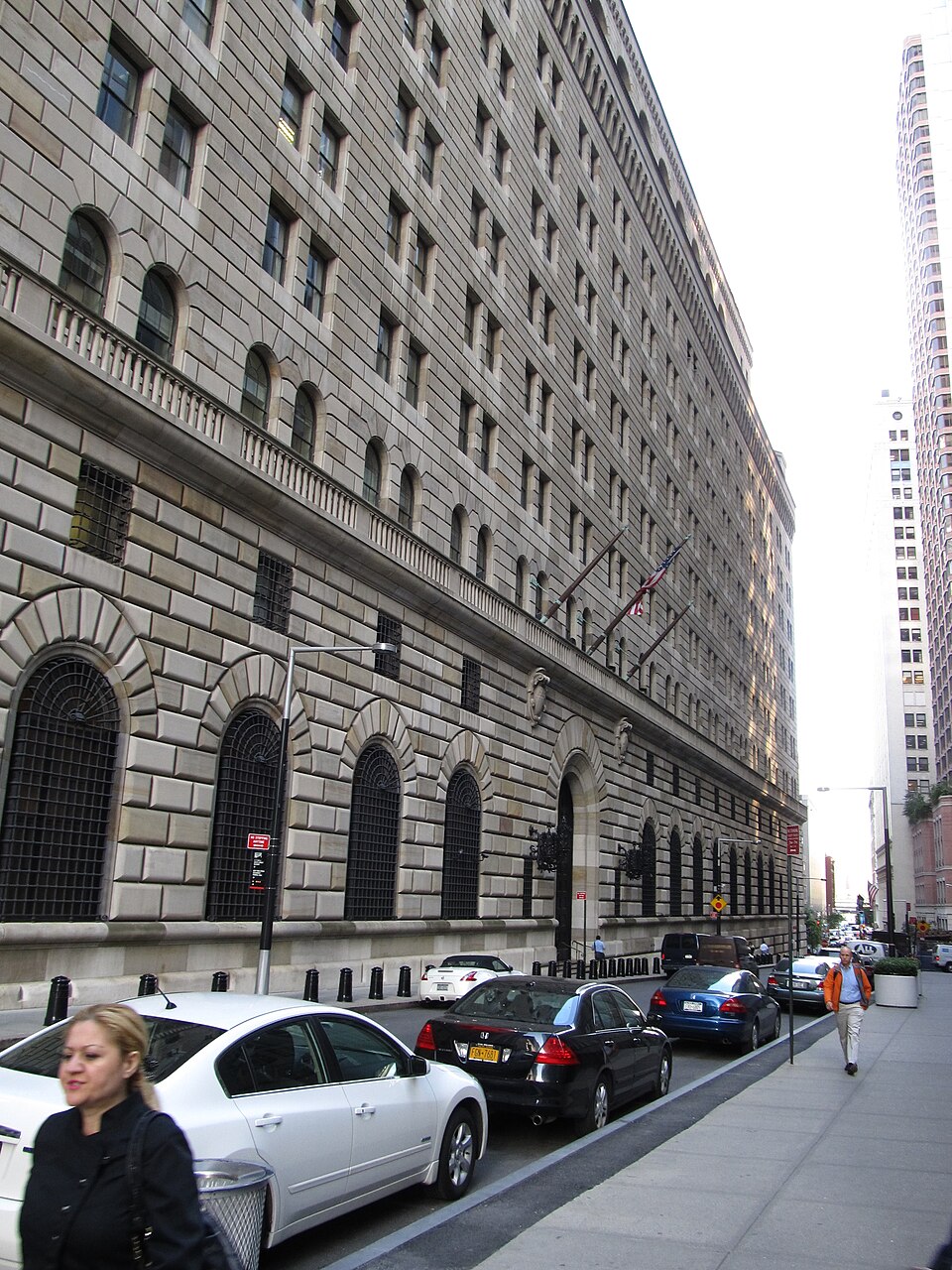
Priced: foreign central banks have a standing Federal Reserve backstop when dollar funding tightens. New: that backstop is not an open-ended swap line or a bailout of overseas banks. It is a repo against U.S. Treasuries already held at the New York Fed, offered at a deliberately expensive rate. The binding variable is therefore not dollar need alone; it is approved access plus prepositioned collateral.[1][5]
As of July 11, 2026, the facility is insurance, not evidence of a fire. The latest Federal Reserve balance sheet shows zero foreign-official repo outstanding even as foreign official and international accounts hold roughly $2.62 trillion of marketable Treasuries in custody at the Fed.[3] That gap is the cleanest way to understand FIMA repo: a large collateral base can support confidence without producing a large facility balance.
The Mechanism
FIMA stands for Foreign and International Monetary Authorities. An approved account holder—typically a foreign central bank or another official monetary institution—temporarily sells Treasuries held at the New York Fed to the Federal Reserve's System Open Market Account and agrees to buy them back at maturity. Economically, the official institution receives a secured dollar loan; the Fed receives Treasury collateral.[1]
The trade avoids an outright market sale. If a central bank needs dollars to supply banks or other institutions in its jurisdiction, it can raise the cash without dumping reserve assets into a stressed Treasury market. At maturity it returns the dollars plus repo interest and gets the securities back. The Fed says the transaction is entirely in dollars, eliminating foreign-exchange risk to the Fed, and is margined against Treasuries in a manner similar to discount-window collateral.[1]
That does not make the facility universal. The Federal Reserve must approve access. The collateral must be eligible Treasuries held at the Fed. The foreign authority, not the Federal Reserve, decides whether and how to pass dollars into its domestic financial system. FIMA repo can bridge a liquidity shortage; it cannot repair an insolvent borrower, create eligible collateral where none exists, or eliminate currency mismatch in the private sector.
The term is normally overnight, with a seven-calendar-day option. The Fed's published rule links the overnight offering rate to the rate on standing overnight repo operations; the June 17 implementation note set that rate at 3.75%. The seven-day rate is one-week overnight-index-swap pricing plus 25 basis points.[1][2] The penalty-like spread is a design feature. In normal markets, private repo should be cheaper, leaving the official facility unused.
Five Numbers That Constrain the Read
- 3.75%: the current standing overnight repo rate and, under the FIMA pricing rule, the default overnight FIMA repo rate.[1][2]
- Seven days plus 25 basis points: the longer FIMA term and its spread over the corresponding overnight-index-swap rate.[1]
- $2.619 trillion: marketable Treasuries held in custody for foreign official and international accounts in the week ended July 8.[3]
- $0: foreign-official repo outstanding in that same H.4.1 release.[3]
- $346.054 billion: reverse repos with foreign official and international accounts—not FIMA repo borrowing—in the same weekly table.[3][4]
The fifth number is the trap. The New York Fed runs both a FIMA repo facility and a FIMA reverse repo pool, but the cash travels in opposite directions. In FIMA repo, an official account receives dollars and posts Treasuries. In the reverse repo pool, an official account places excess dollars overnight with the Fed and receives securities under an agreement that reverses the next day. The reverse pool is a cash-management service dating to the mid-1970s; the standing FIMA repo facility dates to July 2021.[4]
So a large foreign-official reverse-repo balance is not evidence that central banks are drawing emergency dollars. In the July 8 snapshot, the reverse direction was large while the emergency-facing repo line was zero. That is a cash-rich operational baseline, not a stress signal.
Why Treasury Collateral Is the Gate
The facility was born from the March 2020 dash for cash. When dollar demand surges globally, reserve managers can face a bad choice: sell Treasuries into a falling, illiquid market or leave domestic institutions short of dollars. Those sales can push the world's benchmark collateral market in the wrong direction just when every other market is leaning on it.
FIMA repo inserts a temporary third choice. A central bank can retain its economic Treasury position while converting the securities into short-term dollar cash. New York Fed research argues that this fills a gap for authorities outside the small network of standing dollar-swap partners and can reduce the need for fire sales. But the research also draws the boundary clearly: FIMA liquidity is limited by the Treasuries held at the Fed and the counterparty's approved limit, whereas standing swap lines are not secured by the foreign central bank's reserve assets in the same way.[5]
Aggregate collateral is ample, but distribution matters. The $2.619 trillion custody total does not mean every dollar is approved for FIMA use, belongs to an eligible account, or can be mobilized instantly. Nor does Treasury's broader estimate of $6.907 trillion in foreign official holdings of all U.S. securities at June 30, 2025 translate one-for-one into facility capacity; equities, agency debt, corporate debt, securities held through other custodians, and assets outside the Fed's eligibility boundary do not become FIMA collateral merely because an official institution owns them.[3][6]
This is why the facility should be read as a Treasury-market stabilizer first and a global dollar faucet second. It is strongest where a reserve manager has already done the operational work: approved account, securities in custody, tested instructions, and a domestic channel ready to distribute the dollars.
The Strongest Counterweight
The skeptical view is that a facility with zero current usage is mostly ceremonial. Private repo is functioning, central-bank swap lines already cover the largest financial centers, and an authority forced to pay a backstop rate may prefer to sell a small amount of Treasuries rather than advertise stress through an official borrowing program.
That counterweight is real, but zero is not automatically failure. A properly priced backstop is supposed to sit unused when markets are calm. Its existence can change behavior before a transaction occurs: reserve managers know that eligible Treasuries can produce dollars without an outright sale, which can reduce precautionary cash hoarding and forced liquidation. The New York Fed's review of 2020 finds that the assurance itself likely helped authorities return to Treasury investment even though direct FIMA usage was light.[5]
The harder criticism concerns transmission. The Fed lends only to the official account holder. If that authority cannot or will not pass dollars to the local institutions under pressure, FIMA repo stops at the central-bank balance sheet. Collateral can solve the first leg of liquidity; governance, credit judgment, and domestic market plumbing still decide the second.
Falsifier
The collateral-backstop thesis fails in the next genuine global dollar shock if three things occur together: foreign official Treasury custody falls sharply, Treasury market liquidity deteriorates, and the H.4.1 foreign-official repo line stays near zero despite wide dollar-funding stress.[3][5]
That combination would show that approval, pricing, stigma, collateral location, or downstream distribution makes the facility too narrow to prevent the fire sales it was designed to discourage. By contrast, a temporary rise in FIMA repo alongside stable Treasury custody would be activation, not panic by itself—the insurance would be doing its intended job.
Watchlist
- July 14 — monthly TIC release: watch foreign Treasury holdings and transactions for evidence that reserve managers are selling rather than financing securities. TIC arrives with a lag and does not map perfectly onto Fed custody, so direction matters more than false precision.[6][7]
- July 16 and every Thursday — H.4.1: track the foreign-official repo line beside marketable Treasuries in custody and foreign-official reverse repos. The stress signature is not one number; it is repo activation, custody behavior, and the direction of cash management together.[3]
- July 29 — FOMC implementation note: the next scheduled policy decision can change the standing repo rate and therefore the default overnight FIMA price. The level matters because a backstop that is too cheap competes with private markets, while one that is too dear may not arrest a forced sale.[1][2][8]
The conclusion is narrower than the acronym. FIMA repo does not place the world's banks inside the Federal Reserve's discount window. It gives approved foreign official Treasury holders a secured bridge from reserve assets to dollars. In quiet weeks, the correct balance can be zero. In stressed weeks, the question is whether collateral that was already in New York moves into repo before it moves into the market for sale.
Sources
- Board of Governors of the Federal Reserve System, "FIMA Repo Facility FAQs" — eligibility, transaction structure, overnight and seven-day terms, pricing rule, collateral, risk, and disclosure.
- Board of Governors of the Federal Reserve System, "Implementation Note issued June 17, 2026" — current standing overnight repo rate and monetary-policy operating settings.
- Board of Governors of the Federal Reserve System, "H.4.1: Factors Affecting Reserve Balances" (July 9, 2026 release) — foreign-official repo, reverse-repo, and securities-custody balances for the week ended July 8.
- Federal Reserve Bank of New York, "Central Bank & International Account Services" — custody operations and the opposite mechanics of the FIMA reverse repo pool and standing FIMA Repo Facility.
- Mark Choi, Linda S. Goldberg, Robert Lerman, and Fabiola Ravazzolo, "The Fed's Central Bank Swap Lines and FIMA Repo Facility." Federal Reserve Bank of New York Economic Policy Review 28, no. 1 (June 2022) — 2020 mechanism, collateral boundary, swap-line comparison, and confidence channel.
- U.S. Department of the Treasury, "Report on Foreign Portfolio Holdings of U.S. Securities at End-June 2025" (April 30, 2026) — scale and composition of foreign official U.S. securities holdings.
- U.S. Department of the Treasury, "Release Dates of TIC Data" — July 14, 2026 monthly release date and data-lag notes.
- Board of Governors of the Federal Reserve System, "Meeting calendars and information" — July 28–29, 2026 FOMC meeting schedule.
- Wikimedia Commons, "Federal Reserve Bank of New York, Manhattan, New York" — Ken Lund's 2012 photograph of 33 Liberty Street, used as the article image.