Ferrari is no longer valued like a cyclical car company. At the June 5, 2026 close, RACE traded at $346.99, with a roughly $61.15 billion market cap, 33.19x trailing earnings, and 30.38x forward earnings.[4] Priced is the idea that Ferrari can keep acting like a luxury house with an engine plant attached. New is the 2026 test: model changeovers, hybrids, the first full-electric Ferrari, and higher brand investment all have to pass through the income statement without breaking the margin story.[1][3]
The bullish case begins with restraint. In Q1 2026 Ferrari shipped 3,436 cars, down 157 units from the prior year, yet net revenue still rose 3% to €1.848 billion, or 6% at constant currency.[1] That is the core difference between Ferrari and a normal automaker. Lower deliveries did not automatically mean lower economics because mix, personalization, country mix, sponsorship, and brand activity carried more of the load.[1] A mass-market car company generally needs scale to defend fixed costs. Ferrari needs controlled availability to defend desire.
Six Anchors
- $346.99: RACE's June 5, 2026 closing price, with a $61.15 billion market cap and 33.19x trailing P/E.[4]
- €1.848 billion: Q1 2026 revenue, up 3% reported and 6% at constant currency.[1]
- 3,436 units: Q1 shipments, down 157 units year over year during planned model changeovers.[1]
- 39.1%: Q1 2026 EBITDA margin, with €722 million of EBITDA.[1]
- €653 million: Q1 industrial free cash flow, up 5% despite €253 million of capex.[1]
- €9.0 billion and at least €3.6 billion: Ferrari's 2030 targets for revenue and adjusted EBITDA, respectively.[3]
Those anchors explain why the stock can look both expensive and defensible. Ferrari's valuation asks investors to believe that unit scarcity can keep compounding through price, mix, personalization, racing, licensing, and client access. That is plausible. It also asks them to believe that electrification and model renewal will not turn a high-margin luxury machine into a more ordinary capital cycle.
Why The Multiple Exists
The cleanest evidence is Q1 profitability. Operating profit was €548 million, with a 29.7% EBIT margin, while EBITDA rose to €722 million, with a 39.1% margin.[1] Those figures are not normal auto economics. They are luxury economics running through industrial assets. Ferrari can sell fewer cars than last year and still hold high margins because the car is only one layer of the transaction. Allocation, personalization, model hierarchy, after-sales, racing identity, and brand adjacency all matter.
The 2025 annual report context matters here. Ferrari reported €7.153 billion of 2025 net revenues, €2.772 billion of adjusted EBITDA, and €1.602 billion of net profit, while shipments were 13,752 units.[2] Put simply, Ferrari built an earnings base on a tiny fraction of global auto volume. The business model depends on staying small enough to keep the client relationship scarce while large enough to fund product development, racing, retail experience, and manufacturing complexity.
That is why "car company" can be a misleading label. Ferrari sells cars, but the margin comes from controlled mix. The Q1 filing says cars and spare parts revenue was more than €1.5 billion, while sponsorship, commercial, and brand revenue reached €218 million, up 14%.[1] That second line is not bigger than the core car business, but it thickens the brand's economics and helps explain why investors tolerate a premium multiple. Formula 1, licensing, retail, and lifestyle are not side ornaments; they are part of the pricing environment around the metal.
The Hybrid Question
The investment debate is not whether Ferrari can build desirable combustion cars. The debate is whether it can move through hybrids and the first full-electric Ferrari without compressing the very scarcity premium investors are buying.
Ferrari's 2030 strategic plan makes the balancing act explicit. The company says it plans an average of four new car launches per year between 2026 and 2030, targets about €9.0 billion of 2030 net revenue, at least €3.6 billion of adjusted EBITDA, and about €8.0 billion of cumulative industrial free cash flow over 2026-2030.[3] It also frames the 2030 sports-car range as roughly 40% internal-combustion models, 40% hybrid models, and 20% electric models.[3]
That mix is conservative in a useful way. Ferrari is not telling investors that battery-electric volume will become the whole identity. It is telling them that powertrain choice will remain segmented. For valuation, the important question is not whether an electric Ferrari exists. It is whether the electric and hybrid products strengthen allocation pressure instead of widening the addressable market so much that exclusivity becomes harder to police.
Q1 gives both encouragement and warning. The encouragement is that Ferrari confirmed 2026 guidance: about €7.50 billion of revenue, at least €2.93 billion of adjusted EBITDA, an adjusted EBITDA margin of at least 39.0%, and at least €1.50 billion of industrial free cash flow.[1] The warning is embedded in the offsets. The company cited higher depreciation and amortization from new-model production starts, higher marketing expenses, and U.S. import tariffs as drags.[1] The transition is real, even if the margin is still excellent.
What The Stock Is Assuming
At a 33x trailing P/E, RACE is not being priced for ordinary execution.[4] The market is assuming three things.
First, personalization and mix keep doing more work than volume. If Ferrari must grow units aggressively to hit targets, the stock's luxury multiple weakens. The company can add models and still stay scarce, but only if allocations remain disciplined and demand exceeds supply in the models that matter.
Second, electrification investment has to be absorbed inside luxury margins. Ferrari's Q1 capex was €253 million, total R&D was €267 million, and amortization of capitalized development costs rose to €90 million from €73 million a year earlier.[1] Those numbers are manageable today. They become more important as the company funds more platforms, more digital systems, and more powertrain variation.
Third, capital allocation has to stay rational. Ferrari moved to €388 million of net industrial cash at March 31, 2026, from €32 million of net industrial debt at year-end 2025, while also repurchasing €226 million of shares during the period.[1] That is a strong position. But buybacks at a premium multiple only create value if the business keeps compounding. If margins slip, the same repurchases can look like expensive confidence.
Counterweight
The strongest counterargument is that Ferrari has already earned the benefit of the doubt. The company has repeatedly shown that pricing, product cadence, and customer access can matter more than unit growth. Its 2025 and Q1 2026 numbers show a business that still converts scarcity into cash at a level most automakers cannot approach.[1][2]
The pushback is valuation, not quality. Ferrari can be an exceptional company and still have a narrow margin of safety if the market is already capitalizing it as a luxury compounder. A 52-week range of $312.51 to $519.10 shows how much sentiment can move when investors debate whether the next powertrain era expands the brand or dilutes the mystique.[4] The business has premium characteristics; the stock already knows that.
Falsifier
The thesis breaks if Ferrari's new-model and electrification cycle forces a tradeoff between growth and exclusivity. The concrete version: 2026 EBITDA margin falls below the 39.0% guide, industrial free cash flow misses the €1.50 billion target, shipments have to accelerate faster than demand quality justifies, and the hybrid/electric mix needs discounts or looser allocation to move through the channel.[1][3]
Under that branch, Ferrari would still be a great brand. It would no longer deserve to be valued as cleanly apart from auto-cycle economics.
Watchlist
- Q2 2026 results: watch whether Q1's mix and personalization strength persists when the model-changeover calendar keeps moving.[1]
- First electric Ferrari reception in 2026: the full-electric product should be judged less by headline novelty than by whether it deepens allocation pressure without hurting combustion and hybrid demand.[1][3]
- Margin bridge: track depreciation, marketing, tariffs, and R&D against the 39.0% adjusted EBITDA margin guide.[1]
- 2030 plan cadence: the average of four launches per year through 2030 has to add freshness without making Ferrari feel over-supplied.[3]
Ferrari's valuation is understandable because the business has unusually good answers to the usual auto questions. It does not need mass volume. It has client scarcity. It has pricing power. It has a racing halo and brand revenue around the core product. The 2026 issue is narrower: whether new powertrains and model investment can pass through Maranello while preserving the margin and scarcity that made the stock expensive in the first place.[1][2][3][4]
Sources
- Ferrari N.V., "Ferrari (NYSE: RACE) posts Q1 2026 results and reiterates 2026 outlook" / Form 6-K filing mirror (May 5, 2026) - Q1 revenue, shipments, EBITDA, EBIT, free cash flow, capex, net industrial cash, guidance, and management commentary.
- Ferrari N.V., Annual Report and Form 20-F for the year ended December 31, 2025 / Form 20-F filing mirror - 2025 revenue, adjusted EBITDA, net profit, shipments, business model, risk, and reporting context.
- Ferrari N.V., "Ferrari Capital Markets Day targeting new heights" / company announcement mirror (October 9, 2025) - 2030 revenue, EBITDA, free-cash-flow, launch cadence, and powertrain-mix targets.
- StockAnalysis.com, "Ferrari N.V. (RACE) Stock Price & Overview" - June 5, 2026 closing price, market cap, P/E ratios, 52-week range, shares outstanding, and market data snapshot.
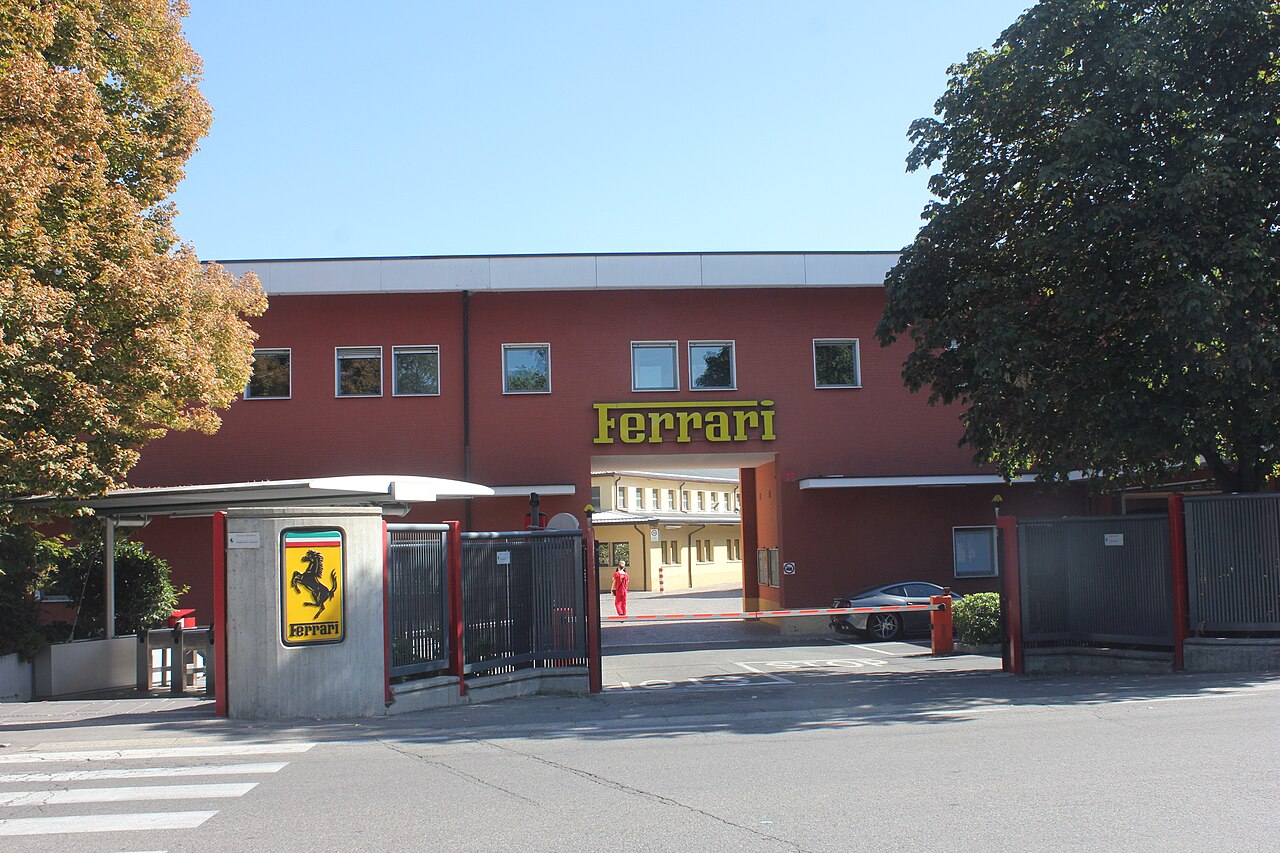
- Wikimedia Commons, "File:Ferrari factory (Maranello, Modena) in 2018.02.jpg" - CAPTAIN RAJU photograph of the Ferrari factory in Maranello, Italy, dated September 25, 2018.