Fastenal is priced like a distributor that has learned how to become customer infrastructure. At the latest StockAnalysis snapshot, the shares carried a $53.72 billion market cap, a 41.73x trailing P/E, a 36.78x forward P/E, and a next earnings date of July 13, 2026.[3] Priced is that Fastenal can keep compounding by embedding itself in factories and maintenance workflows. New from Q1 is that the embedding story is still working, but the market has to decide whether price-cost pressure and lower-margin large-customer mix are only a tax on gross margin or an early ceiling on the model.[1][2][3]
The headline quarter looked strong. Net sales rose 12.4% year over year to $2.2017 billion, net income rose 13.8% to $339.8 million, and diluted EPS increased to $0.30 from $0.26.[1] Operating margin improved to 20.3% from 20.1%, even though gross margin fell to 44.6% from 45.1%.[1] That combination is the whole story in miniature: Fastenal is gaining enough scale and productivity to offset some margin drag, but the drag is real.
Five Anchors
- 12.4% sales growth: Q1 net sales increased by $242.2 million, with both years having the same number of selling days.[1]
- 61.5% digital footprint: sales through Fastenal's digital footprint reached $1.3718 billion, up 13.6%, and represented 61.5% of sales.[1]
- 44.9% FMI share: Fastenal Managed Inventory sales reached $1.0014 billion, up 16.6%, and represented 44.9% of sales.[1]
- 50 basis points of gross-margin compression: gross margin fell to 44.6%, mainly from unfavorable price-cost, with transportation, rebates, and customer mix adding pressure.[1]
- 111.4% operating-cash-flow conversion: operating cash flow reached $378.4 million, helped by inventory discipline.[1]
Those anchors explain why the quarter was better than a cyclical bounce. Fastenal did not merely sell more bolts into a healthier factory tape. It sold more through deeper customer plumbing: Onsite-like large accounts, digital procurement, sensor bins, vending, and managed inventory.
The Growth Was Embedded, Not Loose
Fastenal's strongest Q1 signal came from where the growth occurred. Total manufacturing customers represented 76.2% of sales and grew daily sales by 12.3%, with heavy manufacturing up 14.1%.[1] Contract customers continued to outperform, and Distribution Strategy Group's readout put contract sales at 75.4% of revenue, up from 73.1% a year earlier.[4] That matters because contract growth is stickier than ordinary counter traffic. It usually means Fastenal is being written into a customer's purchasing routines, production support, MRO replenishment, or site-level inventory design.
The 2025 annual report explains the mechanism behind that shift. Fastenal says 61.4% of total 2025 revenue flowed through its digital footprint, 44.7% came through FMI programs, and 95% of revenue came from customers using more than one sales channel or tool.[2] It also reported 136,638 weighted FASTBin and FASTVend installations at year-end 2025 and said 54% of its $1.7 billion of inventory was staged locally or within customer sites for same-day access.[2] In other words, the company is less a catalog distributor than a distributed inventory system with people, software, trucks, vending machines, bins, and customer contracts wrapped around it.
Q1 extended that system. Fastenal signed 6,950 weighted FASTBin and FASTVend devices and still targeted 28,000 to 30,000 signings for 2026.[1] Installations ended the quarter at 137,702 machine-equivalent units, up 5.9% year over year.[1] The investable point is not that vending machines are novel. It is that each device can move replenishment closer to the point of use while giving Fastenal better visibility into consumption, shrinkage, and reorder cadence.
The Price-Cost Tax Is Not Gone
The bearish read starts with gross margin. A business can grow into larger accounts and still dilute headline margin if those accounts have more buying power, lower product gross margins, longer payment terms, and more complex service demands. Fastenal said customer mix remained a structural gross-margin headwind because growth skewed toward larger customers, while still being positive to operating margin because fixed-cost leverage improved.[1]
That last clause is important. The quarter did not show simple deterioration. SG&A fell to 24.3% of net sales from 25.0%, helped by FTE productivity and occupancy leverage.[1] Operating margin rose despite the gross-margin hit.[1] This is the bull case: Fastenal can accept lower gross margin at large accounts if those accounts generate enough throughput, digital attachment, and operating leverage to improve total economics.
Still, the burden of proof is higher at a valuation above 40x trailing earnings.[3] A premium distributor can absorb temporary price-cost noise. It cannot let price-cost, rebates, customer mix, and logistics costs become a permanent leak that requires ever-faster sales growth just to hold operating margin.
Counterweight
The strongest counterweight to a cautious valuation read is cash quality. Operating cash flow of $378.4 million was 111.4% of net income, and inventories rose only 1.1% year over year while sales rose 12.4%.[1] That is not the pattern of a distributor buying growth by stuffing the channel or letting working capital run wild.
The balance sheet also leaves room. Total debt was $125.0 million, only 3.0% of total capital, down from $200.0 million and 5.1% a year earlier.[1] Fastenal returned $295.7 million, or 87.0% of net income, through dividends and repurchases in the quarter.[1] If the model keeps converting growth into cash with little leverage, the multiple is easier to defend.
Falsifier
The thesis breaks if Fastenal's embedded-customer growth stops producing operating leverage. The concrete test is this: digital footprint and FMI sales keep rising, but gross margin keeps compressing, SG&A leverage fades, operating margin slips below the prior-year level, and inventory or receivables start growing faster than sales.[1][2] In that branch, the vending-and-Onsite story would still be strategically attractive, but the market would have to admit it is paying a software-like multiple for distributor economics that are becoming harder, not cleaner.
Watchlist
- Q2 results on July 13, 2026: watch whether gross margin stabilizes after the Q1 price-cost hit and the anniversary of fastener-expansion benefits.[1][3]
- FMI signings pace: the 28,000 to 30,000 2026 target matters because device growth is the clearest proof that customers are accepting deeper site-level integration.[1]
- Contract-customer mix: contract sales can improve operating leverage, but only if large-account terms do not keep pulling gross margin lower.[1][4]
- Working capital: inventory and receivables discipline should remain visible if the growth is high quality rather than merely fast.[1]
Fastenal's Q1 was good. The more precise conclusion is that it was good in the way bulls need it to be: sales growth came through embedded channels, not just a loose macro rebound. But the valuation already assumes that embedded distribution deserves a premium. From here, the proof is less about whether Fastenal can grow and more about whether FMI, contracts, and digital procurement can keep turning that growth into operating leverage faster than price-cost and mix take it back.[1][2][3][4]
Sources
- Fastenal Company, "Fastenal Company Reports 2026 First Quarter Earnings" (April 13, 2026) - Q1 sales, end-market growth, digital/FMI metrics, margin bridge, cash flow, working capital, capital returns, debt, and 2026 capex/signing targets.
- Fastenal Company, 2025 Annual Report - business model, digital footprint, FMI programs, local inventory placement, branch count, channel usage, and customer-site service model.
- StockAnalysis.com, "Fastenal Company (FAST) Stock Price & Overview" - market cap, valuation ratios, dividend, trading range, beta, analyst target, and next earnings date.
- Distribution Strategy Group, "Fastenal Sales Climb 12.4% in First Quarter" (April 2026) - independent distribution-sector read on contract sales, manufacturing mix, and customer/channel implications.
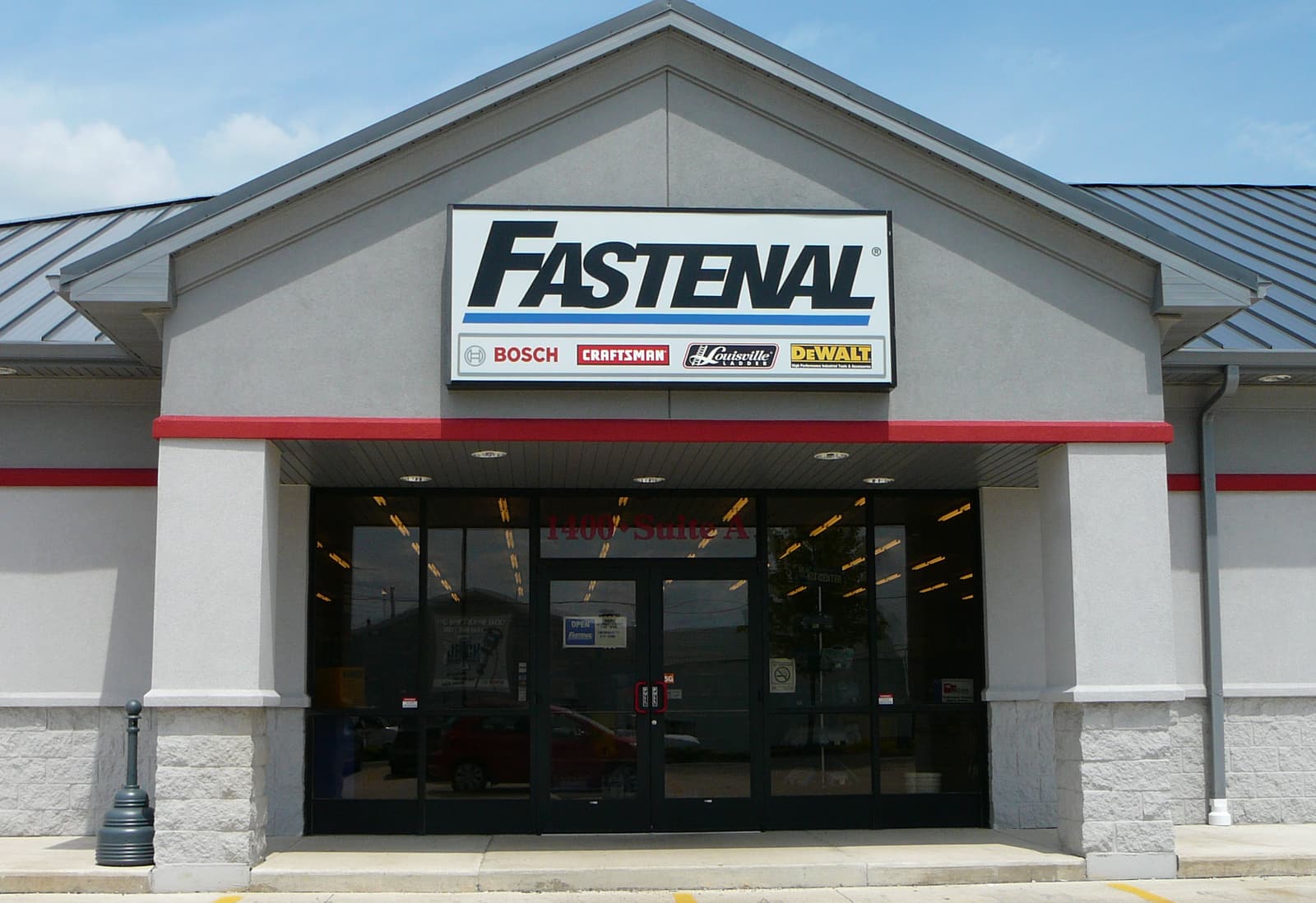
- Wikimedia Commons, "File:Fastenal.jpg" - IlliniGradResearch photograph of the main entrance of a Fastenal building in Macomb, Illinois, taken August 5, 2009, used as the article image.