Priced: a public EU carbon market proxy’s 2.43% Thursday drop to €79.19 per tonne says traders are leaning toward a gentler post-2030 scarcity curve. New: the nearby auction pipe has already narrowed, another 190.5 million allowances are scheduled to enter the Market Stability Reserve, and Ember estimates that emissions associated with fossil generation rose in June despite record solar.[1][2][3][6][8][9]
That combination makes the break below €80 a policy-duration trade, not clean evidence of a prompt allowance glut. As of 03:38 UTC on July 17, the European Commission’s ETS review was still scheduled for later in the day; market data in this wrap run through the July 16 close.[1][4]
Thursday’s Move Was About the Terminal Cap
The tracked proxy fell from €81.16 to €79.19 on July 16. That left it only 0.74% lower over one month but still 12.25% above its year-earlier level.[1] Separately, ICE data placed the December 2026 EUA contract in a roughly €79.4-to-€82 July range before the selloff.[8] The daily move was sharp; the larger picture was not a collapse. It looked more like investors taking policy premium out of a market that had spent July waiting for Brussels.
An EU allowance is a one-tonne compliance instrument, but its price carries more duration than a spot fuel contract. A utility or industrial installation must surrender allowances against covered emissions. Traders also value the future path of the cap, because today’s banked allowance can remain useful later. Change the rate at which the cap shrinks and the whole forward scarcity curve moves, even if this month’s factory output and auction schedule do not.
That is the “new” the market is trying to price. Under the current framework, the linear reduction factor—the annual rate at which the cap contracts—is 4.3% through 2027 and 4.4% from 2028. The pre-review path would drive new issuance toward zero around 2040. Commission signals reported ahead of the review instead pointed to allowances continuing into the 2040s, while debate included a slower reduction factor and a later phase-out of free allocations for exposed industries.[4] The European Parliament’s pre-legislative briefing confirms that the review reaches the cap, the reserve, auction-revenue use, and the treatment of industrial competitiveness; any Commission proposal must still pass through Parliament and the Council.[5]
This distinction is crucial. A slower reduction factor would loosen total post-2030 supply. Extending free allocation would chiefly change distribution within the cap—reducing exposed industries’ need to buy while leaving less for auction—rather than create allowances outside it. Neither mechanism adds a tonne to next Monday’s sale before legislation and calendars change. Thursday’s fall therefore says more about the price assigned to scarcity in the next decade than it does about an oversupplied market this summer.
The Prompt Supply Pipe Is Already Narrower
The current EEX calendar points the other way. Its July 13 revision records the cessation of two Recovery and Resilience Facility auction streams. For the common EU auction, volume stepped down from 3.1985 million allowances in early June to 2.2465 million from July 14—a reduction of almost 30% before any new reserve adjustment.[2]
That is not the same thing as permanently cancelling allowances. It is a change in when and through which earmarked program supply reaches the primary market. Yet timing matters to the prompt balance. Compliance buyers and intermediaries face the volume actually offered now, not the volume implied by an old calendar.
The Market Stability Reserve is the second near-term constraint. The Commission calculated the 2025 total number of allowances in circulation at just over 1.02 billion. Under the existing rules, 190,494,202 allowances are to be withheld from auction and placed in the reserve from September 2026 through August 2027.[3] That automatic response is designed to absorb surplus inventory; it runs independently of the political argument over the post-2030 cap.
There is an easy trap in the published schedule. The July 13 calendar shows a provisional common-auction volume of 3.699 million for September dates, above July’s 2.2465 million. But EEX marks every September–December figure as indicative and subject to adjustment by July 31, or as soon as practicable, for the reserve withdrawal.[2] Reading 3.699 million as settled supply would compare a live July number with a September placeholder.
Demand Is the Strongest Counterweight
Tighter auctions do not guarantee a higher carbon price when covered emissions are falling. But Ember’s July estimate for June does not support that bearish shortcut. Solar generated a record 52 TWh, or 25% of EU electricity.[6] Yet the underlying monthly data show EU fossil generation rising about 5.1 TWh, or 11.2%, from a year earlier, with estimated emissions associated with that generation up about 4.0 million tonnes of CO2 equivalent, or 13.4%.[9] Higher demand and weaker wind and hydro output outweighed the solar gain. The estimate is a directional signal, not verified ETS surrender data, but it points to firmer—not weaker—fossil burn.
Industry supplies the other demand leg. A slower cap can be bearish because it promises more future allowances, but weak steel, chemicals, cement, or refining activity can pressure the market without any rule change at all. This is why the Thursday close cannot be read as a referendum on the review alone. Policy expectations, utility hedging, speculative positioning, and actual emissions all meet in the same price.
The strongest bear case is therefore not simply “Brussels will weaken the ETS.” It is that a softer long-run cap arrives and, if June’s year-on-year fossil increase reverses, renewable output and industrial efficiency reduce the tonnes that installations need to cover. In that combination, the reserve may withdraw allowances without making the prompt market genuinely scarce.
The strongest bull counterweight is equally concrete. July auction supply has already been cut, the reserve calculation is rules-based, June fossil output was firm, and a proposal is not legislation. If the final political bargain preserves a steep cap decline while the reserve removes supply, sellers who treated every review concession as immediate tonnage will have moved too early.
What the €79 Print Is Actually Saying
The tracked proxy closed at €79.19, down from the prior day’s €81.16 but nowhere near repudiating carbon scarcity. The more useful reading is a spread:
- Long duration: a slower cap contraction would increase total supply after 2030, while extended free allocation would reduce exposed industries’ need to buy.[4][5]
- Prompt supply: smaller July auctions and the scheduled reserve intake reduce what can reach the market in the nearer term.[2][3]
- Prompt demand: Ember estimates that June fossil generation and its associated emissions rose despite record solar, a directional counterweight to the bearish review story.[6][9]
The next durable move requires one side of that spread to win. A headline about “more flexibility” is not enough; the proposal needs a reduction-factor path, dates, and quantities. Likewise, a smaller auction is not automatically bullish if bid coverage weakens and covered emissions keep falling.
Falsifier
The thesis is that the break below €80 is mainly a repricing of long-run policy, not proof of a current allowance glut. It is falsified if the Commission preserves a post-2030 cap path close to today’s pace, EEX materially cuts the September–December calendar for the reserve, and EUAs still remain below the July range through successive auctions while fossil generation remains firm. That result would show that positioning or another demand channel—not a softer terminal cap—was doing the heavier work.
The thesis strengthens if the review explicitly lowers the reduction factor or extends free allocation while the price stays weak despite firm auction bid coverage. That would connect the repricing to a looser future balance—more total supply under a slower cap or less industrial buying under extended allocation—rather than to a disappearing prompt buyer.
Watchlist
First, read the July 17 Commission review for the actual linear reduction factor, the start date of any new cap path, and how changes to free allocation would shift allowance distribution and industrial buying after 2034. Those details separate total supply from allocation—and both from distant political optionality.[4][5]
Second, watch the July 20 common auction, currently scheduled for 2.2465 million allowances. Clearing price and bid coverage will show whether the smaller prompt offering is finding compliance demand after Thursday’s selloff.[2]
Third, watch for the auction-calendar adjustment by July 31 or as soon as practicable, then the first currently provisional post-reserve common auction on September 1. The gap between the placeholder volume and the revised number will convert the 190.5-million 12-month reserve intake into the supply traders can actually model.[2][3]
Thursday supplied the price move. Brussels now owes the market the units. Until the cap path, calendar, and reserve sit on one page, “carbon broke €80” is a description—not yet a verdict on scarcity.
Sources
- Trading Economics, “EU Carbon Permits” (updated July 17, 2026) — July 16 tracked market-proxy level, daily move, and one-month and one-year comparisons.
- European Energy Exchange, Primary Auction Calendar (version 3.2, July 13, 2026) — current July auction volumes, provisional September volumes, and the reserve-adjustment notice.
- European Commission Directorate-General for Climate Action, “190 million EU ETS allowances to be placed into the Market Stability Reserve between September 2026 and August 2027” (May 29, 2026) — official surplus and withdrawal calculation.
- Argus Media, “Carbon — In focus: All eyes on the EU ETS review” (July 10, 2026) — pre-review cap, reduction-factor, free-allocation, and implementation debate.
- European Parliamentary Research Service, Update of the EU emissions trading system for stationary installations, aviation, and maritime transport (April 2026) — institutional scope and legislative context for the review.
- Ember, “A quarter of EU power came from solar for the first time in June” (July 2026) — June generation volume and solar share.
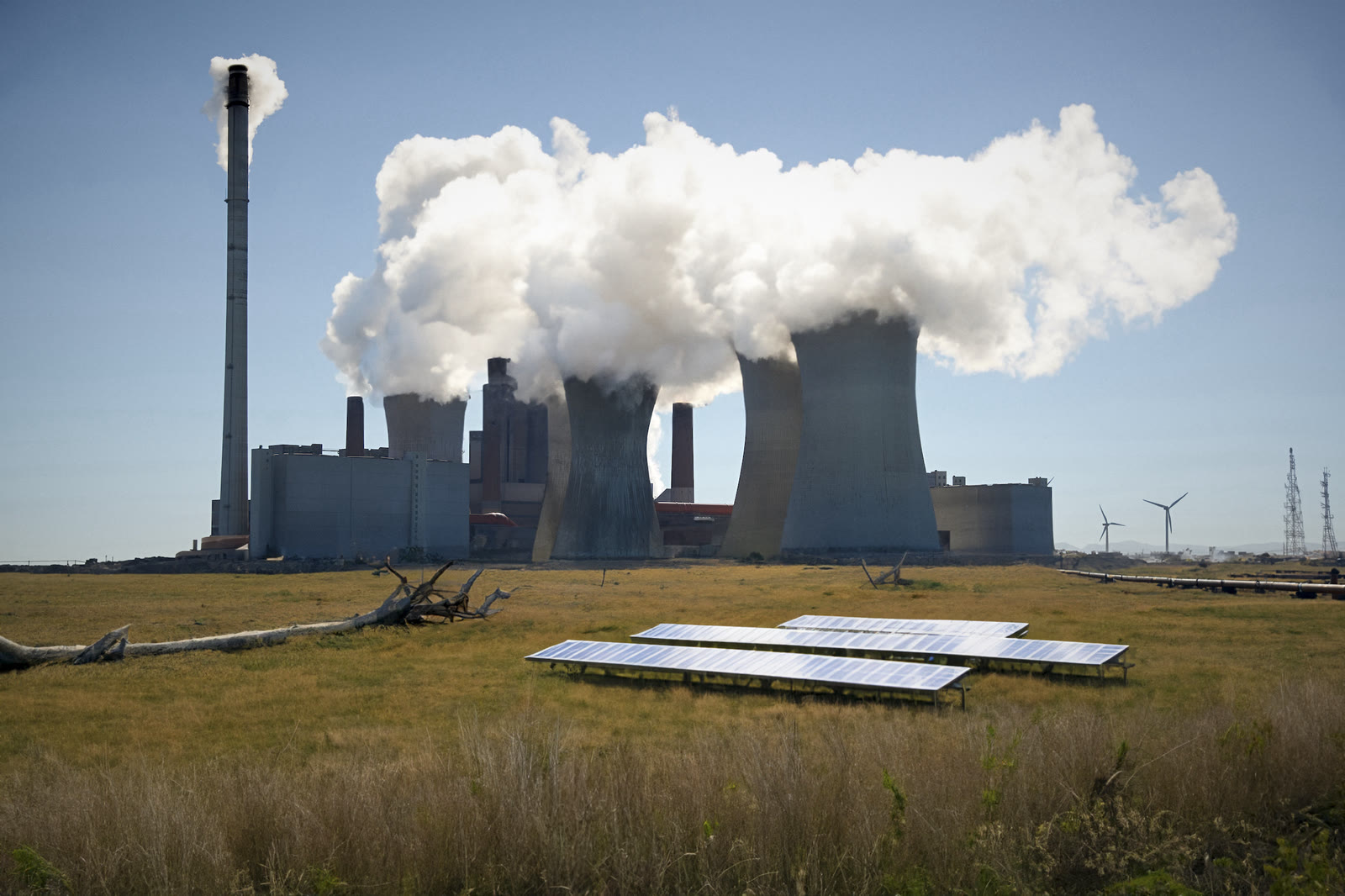
- Wikimedia Commons, Anil Öztas, “Grevenbroich (DE), Kraftwerk Neurath — 2023 — 0062X” (photographed June 24, 2023) — source page for the original photograph used as the article image. License: CC BY-SA 4.0.
- IndexBox, “European Carbon Prices Fluctuate in July 2026 Ahead of ETS Reform” (July 16, 2026) — ICE December 2026 EUA contract range and identification of the contract followed by the market.
- Ember, Monthly Electricity Data Explorer (download updated July 2026) — provisional June EU generation, demand, and estimated fossil-emissions series.