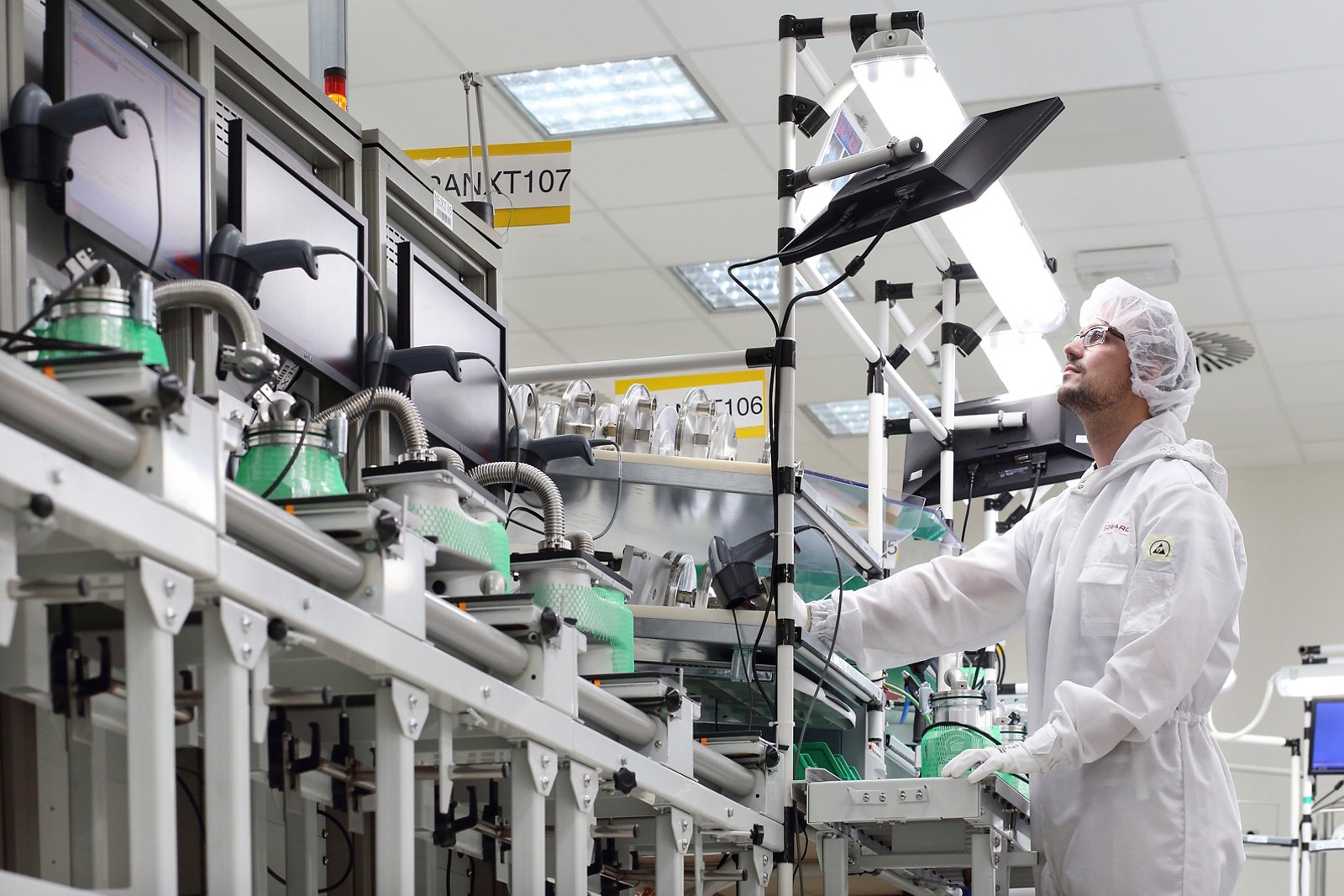
Priced: Atlas Copco is an unusually profitable industrial compounder, and the A share closed on July 16 at SEK 195.15, or about 35.7 times trailing earnings. New: second-quarter orders rose 26% organically while revenue rose only 8%, creating a conversion opportunity that the valuation already treats almost like a promise.[1][4][5]
The quarter was strong enough to justify enthusiasm. It was not strong enough to remove timing risk. The investment question is no longer whether semiconductor demand has returned to Atlas Copco's vacuum franchise; record Vacuum Technique orders answer that. The question is how much of the order surge becomes revenue, margin, earnings, and cash before the cycle changes again.
The multiple already assumes that quality persists
Atlas Copco earned its premium before this quarter. In 2025, the group produced SEK 168.3 billion of revenue, a 20.3% operating margin, SEK 26.8 billion of operating cash flow, and a 24% return on capital employed.[2] Those figures describe a business with pricing power, a large installed base, decentralized operations, and service revenue that can soften the edges of equipment cycles.
The July 16 valuation leaves little room to discover those qualities twice. Atlas Copco reported basic EPS of SEK 5.43 for 2025. Replacing first-half 2025 EPS of SEK 2.69 with first-half 2026 EPS of SEK 2.73 produces trailing EPS of roughly SEK 5.47. Dividing the A-share close of SEK 195.15 by that figure gives the 35.7x multiple.[1][4][5]
That is an A-share calculation, not a blended market-cap model. Atlas Copco's A and B shares have equal economic rights but different voting rights and trade at different prices.[2][4] The distinction matters for execution, but not for the central conclusion: an investor buying the A share is paying a premium-industrial multiple before the record order intake has fully reached the income statement.
Orders are the asset; conversion is the valuation
The quarter's causal chain is simple:
customer capital spending -> Atlas Copco orders -> production and installation -> reported revenue -> operating profit -> cash flow.
Q2 orders reached SEK 51.0 billion against revenue of SEK 45.0 billion, a book-to-bill ratio of about 1.13x.[1] That is the constructive gap. If delivery capacity holds and customers take equipment on schedule, the excess orders provide a bridge into later revenue. The less comfortable version is that a long bridge also exposes the company to postponements, cancellation risk, unfavorable mix, capacity costs, and currency movement before cash arrives.
The first half already shows why investors should keep the full chain in view. Operating profit rose 2% and EPS rose from SEK 2.69 to SEK 2.73, yet operating cash flow before acquisitions, divestments, and dividends fell to SEK 11.1 billion from SEK 12.7 billion. Q2 cash flow itself improved, but first-half working-capital absorption means record demand has not yet translated cleanly into every financial line.[1]
This is not an accounting red flag. It is a valuation boundary. At 35.7x trailing EPS, a buyer needs the order-to-cash interval to behave like a temporary timing difference rather than a recurring claim on working capital.
Vacuum supplies the acceleration; compressors protect the floor
Vacuum Technique delivered the headline. Orders rose 60% year over year, or 59% organically, to SEK 14.4 billion. Revenue rose 17% to SEK 10.5 billion, and operating margin expanded to 21.0% from 18.9%. Semiconductor and flat-panel-display equipment reached a record order level, while industrial and scientific vacuum equipment also set a record.[1]
The spread between orders and revenue is what gives the share an earnings path. It is also what makes execution the next proof. Atlas Copco said higher revenue volume helped Vacuum Technique's margin, while capacity-ramp costs and acquisition dilution worked in the other direction. If those costs are genuinely front-loaded, later conversion can carry attractive incremental margin. If each new demand step requires another expensive capacity step, the earnings leverage will be weaker than the order chart implies.[1]
Compressor Technique is the counterbalance because it remains the largest profit pool. Its Q2 revenue was SEK 19.7 billion and operating margin slipped to 24.1% from 25.0%, even as orders rose 19%. Recent acquisitions diluted the margin, and currency also weighed modestly.[1] The valuation therefore depends on two things happening together: Vacuum converts its record intake, and Compressor prevents its much larger base from leaking away the benefit.
That is a stricter test than “semiconductor orders are strong.” A premium group multiple should be supported by the portfolio, not rescued by one hot business area.
A three-case sensitivity for the A share
Atlas Copco targets 8% average annual revenue growth over a business cycle, sustained high returns on capital, and a dividend near half of net profit.[3] The middle case below uses that 8% target as a simple EPS-growth starting point only if margins remain broadly stable. It is not management guidance or a price target.
The multiple bands are deliberately a sensitivity rather than a forecast. A 36x exit multiple preserves roughly today's A-share valuation.[1][4][5] 32x applies modest compression, and 28x applies a larger discount while still recognizing a group earning a 24% return on capital employed.[1][2] They are assumptions, not historical or peer medians.
| Case | One-year EPS assumption | Exit P/E | Implied A-share value | What must happen |
|---|---|---|---|---|
| Conversion stalls | SEK 5.47, flat | 28x | SEK 153 | Vacuum orders fade before revenue catches up; compressor margin remains under pressure. |
| Disciplined conversion | SEK 5.91, up 8% | 32x | SEK 189 | Revenue closes part of the order gap, group margin holds near its recent level, and cash follows profit. |
| Premium persists | SEK 6.29, up 15% | 36x | SEK 226 | Vacuum converts at attractive incremental margin while Compressor and the smaller divisions stay firm. |
The table's message is less dramatic than its range. A 28x multiple would still recognize Atlas Copco as a high-quality industrial company; it would simply stop paying the current price for near-frictionless conversion. The middle case lands slightly below the July 16 close. Meaningful upside requires either earnings growth materially above the group's through-cycle revenue target, a multiple that remains close to today's, or both.
That is the priced-versus-new gap. The market is not waiting to learn that Atlas Copco has good businesses. It is paying in advance for an order surge to behave like high-quality earnings.
The strongest counterweight
The cautious view can become too semiconductor-centric. Q2 was broad: all four business areas delivered double-digit organic order growth, service orders grew across all business areas and regions, Industrial Technique lifted operating margin to 20.0% from 17.1%, and Power Technique grew revenue 16%. Net debt was only 0.5x EBITDA, leaving room to invest through the cycle and continue bolt-on acquisitions.[1]
That breadth matters. It lowers the odds that Vacuum Technique is disguising a weak group. A stronger compressor order book, improving industrial automation demand, and service growth can support conversion even if semiconductor spending becomes less explosive. The low leverage also means Atlas Copco is not forced to choose between capacity, acquisitions, and balance-sheet repair at the worst moment.
The bull case is therefore credible: Q2 may mark the start of a broader industrial acceleration with Vacuum as the first visible engine. The valuation problem is simply that credibility and cheapness are different claims.
Falsifier
The “conversion still has to earn the premium” thesis fails if the next two reports show that the gap is closing without financial strain. Specifically, Vacuum Technique would need to convert its record intake while holding operating margin around or above 21%, Compressor Technique would need to stabilize rather than extend its margin decline, and group cash flow would need to rise with profit instead of remaining held back by working capital.[1]
If those three conditions arrive together, today's multiple would be supported by a demonstrably faster earnings base rather than by hope embedded in orders. If order growth falls back before revenue catches up, or if capacity and acquisition costs keep the profit conversion shallow, the current A-share price will have pulled too much of the future into the present.
Watchlist
- October 22, 2026 — Q3 report: compare Vacuum Technique revenue with its SEK 14.4 billion Q2 order intake, then check whether its margin holds as capacity ramps. The second read is Compressor Technique's margin; conversion in Vacuum matters less if the largest division gives the gain back.[1]
- January 28, 2027 — Q4 and full-year report: reconcile full-year EPS and operating cash flow with the second-half order bridge. The decisive evidence is not another record-order headline but a cleaner sequence from backlog to revenue, profit, and cash.[1]
Atlas Copco's Q2 made the business case easier and the valuation case harder. Record demand, broad order growth, expanding Vacuum margins, and low leverage all deserve a premium. At roughly 36 times trailing A-share earnings, however, the premium already assumes that the factory, installation base, service network, and working-capital cycle will turn those orders into cash with little slippage. The next rerating belongs to conversion, not celebration.
Sources
- Atlas Copco Group, “Second-quarter report 2026” (July 16, 2026) — group and business-area orders, revenue, margins, cash flow, leverage, outlook, and reporting calendar.
- Atlas Copco Group, Annual Report 2025 — full-year financials, business mix, share rights, cash flow, and return on capital employed.
- Atlas Copco Group, “Our targets” — through-cycle revenue-growth, return-on-capital, and dividend targets.
- Atlas Copco Group, “Share information” — A/B share structure, 2025 EPS, market capitalization, and dividend schedule.
- Google Finance, “Atlas Copco AB Class A (ATCO-A:STO)” — July 16, 2026 closing share price used in the valuation calculation.
- Atlas Copco Group, “Photos and videos” — official laboratory photograph of Atlas Copco vacuum equipment used as the article image.