Priced: the VIX rebounded to 18.70 on July 23, so broad index hedging is no longer asleep. New: the Cboe S&P 500 Dispersion Index, or DSPX, still closed at 45.78—15.4% above its June 10 level—even after retreating on Thursday.[1][2]
The gap is narrowing, not closed. As of the July 23 close, the index was charging more for common risk while the options underneath it continued to price unusually large differences among stocks. This is not a forecast that the S&P 500 must fall. It is a warning that one headline fear gauge still compresses the market's loudest argument.
Three Prices, One Uneasy Tape
The cleanest evidence sits in semiconductor options. Cboe's July 20 volatility digest put one-month implied volatility for the semiconductor ETF SMH at a one-year high of 59%. Its spread over one-month S&P 500 implied volatility widened to a record 44 percentage points. Meanwhile, S&P 500 downside skew climbed to the 82nd percentile of its recent range, evidence that demand for index protection was waking up.[5]
Read together with VIX and DSPX, those figures describe a transition. Investors were still paying heavily for movement around individual technology and semiconductor exposures, but they had also begun bidding more aggressively for broad downside insurance. The market had not yet become a single correlated risk-off trade. It was no longer content to rely on diversification alone.
The Mechanism: Cancellation Is Not Calm
The VIX and DSPX answer different questions. The VIX uses S&P 500 option prices to express the market's expectation of index volatility over the next 30 days. DSPX combines that index variance with option-implied variance from selected S&P 500 constituents, using a modified VIX methodology, to estimate how independently those stocks may move.[3]
The gap comes from correlation. Imagine two large index members making equally violent moves in opposite directions. Each stock can generate expensive options and painful position-level risk, while the gains and losses partly cancel inside the index. Low correlation suppresses index variance; it does not make the underlying positions safe. DSPX is designed to expose that difference by comparing the volatility embedded in the basket's members with the volatility embedded in the basket itself.[3]
This also sets a boundary around the signal. High dispersion does not predict which stock will win, and it does not guarantee that active managers will produce alpha. It says the option market expects a larger range of relative outcomes. Security selection may matter more, but the penalty for selecting badly rises at the same time.
The signal is not coming from a fringe market. OCC's June report shows substantial cleared activity across equity, ETF, and index options, with year-over-year growth across all three categories.[6] That depth makes the cross-market comparison more informative. It does not make it infallible: heavy volume can reflect hedging, speculation, market-making, structured products, or several motives at once.
Why Earnings Turned Dispersion Into the Trade
The first impulse was calendar-driven. Cboe noted that DSPX often rises before earnings and falls afterward, because company results create discrete event risk that an index can diversify. The unusual feature in July was persistence: dispersion had remained elevated after the previous earnings season and then pushed above its prior stress peak even while the VIX was falling.[4]
The second impulse was thematic. By July 20, semiconductor volatility had detached from the broader index as investors reassessed the AI trade. Five S&P 500 sectors rose during a week when the broader market fell, according to Cboe's read of the rotation.[5] That is almost a textbook environment for cancellation: weakness in one large, volatile complex is offset by money moving into cheaper or less crowded sectors.
Call buying complicates any simple “fear” label. Cboe saw retail opening activity in mega-cap technology leaning heavily toward calls before the rotation intensified.[4] Some investors were paying for upside convexity at the same time that others were paying for downside protection. Both flows can lift single-name option prices. The result is expensive uncertainty, not a unanimous bearish vote.
Thursday then supplied the first serious convergence test. Official Cboe histories show VIX rising while DSPX fell at the July 23 close.[1][2] Broad hedging demand was catching up just as implied dispersion began to mean-revert. One session does not end the regime, but it prevents the lazy conclusion that index volatility is still simply “calm.”
Counterweight: The Index Hedge Is Catching Up
The strongest counterargument is visible in the same data. S&P 500 skew had moved from a low part of its range to the 82nd percentile by July 20.[5] Investors were no longer treating diversification as free protection; they were bidding more aggressively for out-of-the-money index puts.
That matters because a common macro shock can turn a dispersion market into a correlation market quickly. If policy, rates, or an earnings shock pushes many stocks in the same direction, cancellation weakens. VIX can rise even while DSPX falls, because broad index risk becomes more expensive relative to independent single-stock risk. In that regime, a portfolio that looked diversified by ticker can discover that its economic exposures were shared.
There is also a benign version of the counterweight. Event premiums can simply expire. If large technology companies report without changing the market's earnings or capital-spending map, single-name implied volatility can fall as uncertainty becomes fact. DSPX could normalize without a selloff. July's extreme would then have been mostly the price of waiting for answers.
Falsifier
The thesis is that VIX has begun to catch up but still understates position-level risk because elevated dispersion and semiconductor volatility are being netted out inside the index. It is invalidated if DSPX retreats toward its pre-earnings range, the semiconductor-to-index volatility spread normalizes, and index skew relaxes after the next cluster of policy and earnings events while VIX remains contained. That combination would show that July's gap was a temporary event premium, not a durable change in the market's risk map.
A broad VIX spike would not validate the same trade indefinitely. It would mean the hidden risk had migrated into the index. Once correlations rise, the useful question changes from “which stocks are cancelling?” to “how much common exposure does the portfolio actually own?”
Watchlist
- July 29 — Federal Reserve decision. The FOMC statement is scheduled for 2:00 p.m. ET, followed by the chair's press conference at 2:30 p.m.[7] Watch whether macro uncertainty lifts VIX faster than single-name volatility, which would signal a turn from dispersion toward correlation.
- July 29 — Meta results. Meta is scheduled to release quarterly results after the close and hold its call at 1:30 p.m. PT.[8] The useful read is the post-event change in its option premium and the broader technology basket, not the share-price direction alone.
- July 30 — Amazon results. Amazon's call is scheduled for 2:00 p.m. PT.[9] A second orderly volatility collapse after a mega-cap report would support the calendar-premium counterargument; spillover into index skew would support the broader-risk case.
- July 31 — the first clean comparison. At that close, compare VIX, DSPX, semiconductor relative volatility, and S&P 500 skew together. A single fear gauge cannot distinguish a quiet market from a noisy market whose components happen to cancel.
The clean conclusion is not “buy volatility” or “sell the index.” It is narrower: VIX is a statement about the portfolio called the S&P 500. In July 2026, even a rising VIX is not a complete statement about how loudly the stocks inside that portfolio are moving.
Sources
- Cboe, “VIX Historical Price Data” — official daily open, high, low, and close series through July 23, 2026.
- Cboe, “DSPX Historical Price Data” — official daily open, high, low, and close series through July 23, 2026.
- Cboe, “Cboe S&P 500 Dispersion Index” — official index definition, methodology overview, and relationship among DSPX, VIX, and constituent volatility.
- Cboe, Mandy Xu, “Week of 7/13/2026: DSPX Index Jumps to 6-Year High Ahead of Earnings” (July 13, 2026) — retail call activity and the persistence of earnings-season dispersion.
- Cboe, Mandy Xu, “Week of 7/20/2026: Hedging Demand Spikes Amid AI-Driven Market Rotation” (July 20, 2026) — semiconductor and index implied volatility, relative-volatility spreads, sector rotation, and S&P 500 skew.
- Options Clearing Corporation, “OCC June 2026 Monthly Volume Data” (July 2, 2026) — cleared equity, ETF, and index options activity.
- Federal Reserve Board, “Calendar: July 2026” — July 28–29 FOMC meeting and July 29 statement and press-conference schedule.
- Meta Platforms Investor Relations, “Meta to Announce Second Quarter 2026 Results” (July 2026) — official July 29 release and call timing.
- Amazon Investor Relations, “Amazon.com to Webcast Second Quarter 2026 Financial Results Conference Call” (July 16, 2026) — official July 30 event timing.
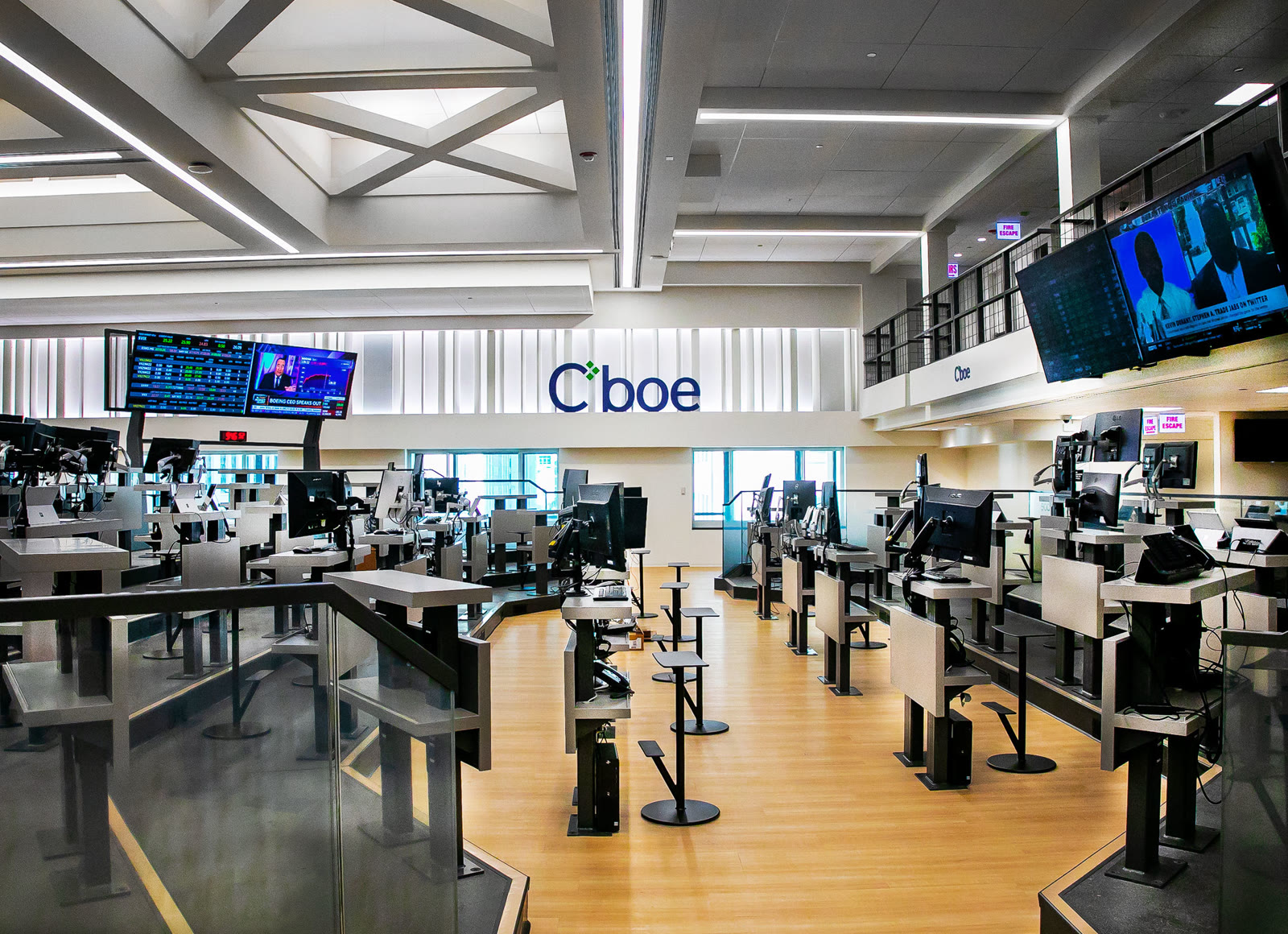
- Cboe Global Markets via PR Newswire, “Cboe Opens New Trading Floor, Begins New Era of Open Outcry” (June 6, 2022) — provenance and caption context for the official trading-floor photograph.