By mid-March, investors already knew Delta's March quarter was running ahead of the original setup. At the J.P. Morgan Industrials Conference, management raised expected March-quarter revenue growth from an initial 5% to 7% range to high-single digits while still keeping earnings inside the original band.[3] The April 8 result narrowed the debate even further: adjusted revenue reached a record $14.2 billion, up 9.4% year over year, while adjusted operating margin came in at 4.6%, earnings per share at $0.64, and free cash flow at $1.2 billion.[1] The market no longer needs proof that Delta can sell premium travel in a healthy demand backdrop. The live question is whether June-quarter fuel recapture can move fast enough across premium, corporate, and main cabin demand to protect margins when projected fuel rises to about $4.30 per gallon.[1][2]
That is a more interesting finance question than the usual airline headline. Delta's 2025 annual report shows the company serving more than 200 million customers with a fleet of 1,314 aircraft, leaning on core hubs, coastal gateways, premium products, and loyalty economics that management treats as durable structural advantages rather than temporary cycle help.[4] March-quarter results suggest those advantages are still real. The June-quarter guide says they now have to do harder work.
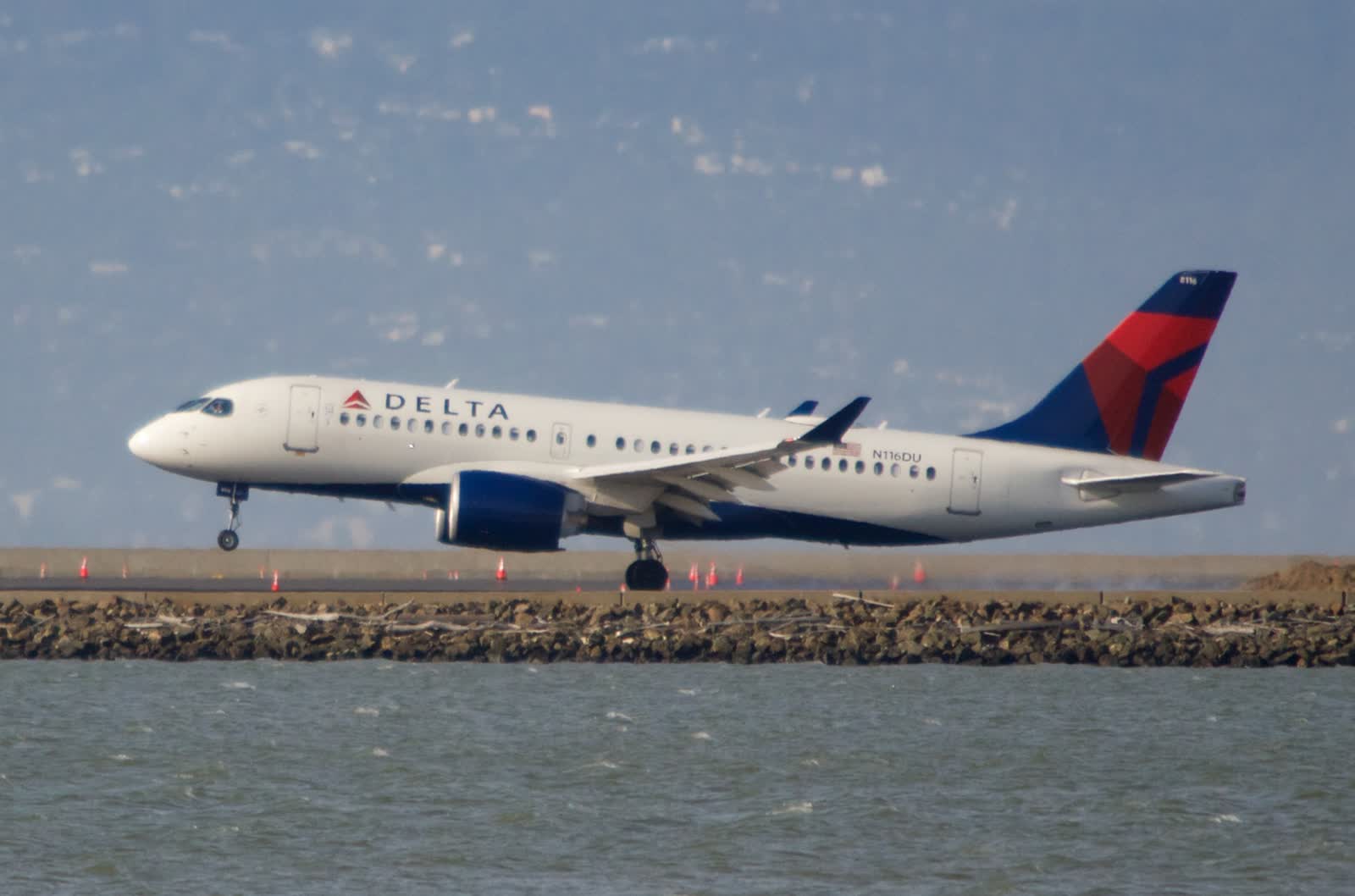
Image context: the cover uses a real Delta A220 photograph rather than a logo or fare chart. That fits because this article is about the physical and commercial machinery behind the quarter: fleet renewal, premium seat mix, and an airline trying to monetize brand preference quickly enough to outrun a fuel shock.[6]
Priced vs new
Priced is Delta's differentiated revenue model. Investors already knew the airline was leaning harder into premium cabins, loyalty, American Express remuneration, and a stronger coastal-and-international network than most U.S. peers.[3][4]
New is the speed test now embedded in the June quarter. Delta expects low-teens total revenue growth on flat capacity, a 6% to 8% operating margin, and $1.00 to $1.50 of EPS, even though the forward curve implies more than a $2 billion fuel headwind in the quarter. The guide also assumes only a $300 million refinery benefit, so this is not a story about Monroe Energy doing all the work.[1][2]
Why the quarter mattered
1. Premium and loyalty absorbed the first hit
The cleanest bullish signal is that Delta's higher-margin revenue streams still scaled even with fuel running away in March. Diverse revenue streams represented 62% of total revenue in the quarter, with premium and loyalty both growing in the mid-teens. Premium revenue rose 14%, loyalty and related revenue rose 13%, American Express remuneration topped $2 billion and grew 10%, and MRO revenue increased by more than $200 million year over year.[1] That tells you the quarter was not carried by one lucky fare pocket. Delta's commercial stack is still wide.
This matters because fuel shocks punish airlines with commodity revenue first. Delta's March quarter says its mix is still meaningfully less commodity-like than the group average. That does not make fuel irrelevant. It does mean the company starts from a better base when it tries to pass higher costs through.[1][4]
2. This stopped being a front-cabin-only story
A second important signal is that demand strength was no longer confined to the obvious premium lanes. Domestic unit revenue grew 6%, international unit revenue grew 5%, and March quarter 2026 became Delta's first full quarter of positive main cabin unit revenue growth since the end of 2024.[1] At the same time, main cabin capacity contracted 3%, which means the company was still tightening supply even before the latest June-quarter cuts.[1]
Corporate demand also stayed firm enough to matter. Delta said corporate sales increased double-digits in the March quarter, with positive growth across all sectors, and 85% of recent corporate-survey respondents expected June-quarter travel spend to increase or stay the same.[1] On the earnings call, management added that March cash sales grew in the mid-teens and that momentum carried into April across both premium and Main Cabin.[2] That combination is why the recapture case is plausible. If only premium cabins were strong, fuel pass-through would be narrower and slower.
3. June quarter is a pricing-speed test, not a demand victory lap
The June-quarter guide is strong, but it is also demanding. Ed Bastian said Delta is "meaningfully reducing capacity" with a downward bias until the fuel environment improves, and management framed the June quarter around recapturing only 40% to 50% of the more than $2 billion fuel headwind.[2] Historically, fuel recapture has lagged by 60 to 90 days; Delta now says the industry response is happening faster because the move in fuel was both sharp and broad.[2]
That is the real financial hinge. A business that can post low-teens revenue growth on flat capacity while fuel jumps this hard is doing something right. But partial recapture in the June quarter also means the story is not finished in June. The next question is whether the pass-through broadens through the summer fast enough to keep margins from flattening again once the first round of pricing and schedule actions is in the market.[2]
Six numeric anchors
- March-quarter adjusted revenue: $14.2 billion, up 9.4% year over year.[1]
- March-quarter profitability: adjusted operating margin 4.6%, EPS $0.64, and free cash flow $1.2 billion.[1][2]
- High-margin revenue mix: diverse revenue streams were 62% of revenue; premium grew 14% and loyalty grew 13%.[1][2]
- Card and services support: American Express remuneration was over $2 billion, up 10%; MRO revenue rose by more than $200 million.[1]
- Breadth of demand: domestic unit revenue grew 6%, international unit revenue grew 5%, and main cabin capacity was down 3% while main cabin unit revenue turned positive.[1]
- June-quarter hurdle: low-teens revenue growth on flat capacity, 6% to 8% operating margin, $1.00 to $1.50 of EPS, and fuel around $4.30 per gallon with only a $300 million refinery benefit.[1][2]
Strongest counterweight
The strongest pushback is that the recapture story may already be more advanced than this framing allows. Delta's transcript makes clear that March and April demand held up in both premium and main cabin even as higher fuel was moving through the system, and management argued that industry response is happening faster than in a normal lag cycle.[2] If that is right, June-quarter guidance is less a stress test than a sign that the market structure is already tightening in Delta's favor.
That counterweight is serious, especially because Delta enters the period with a healthier balance sheet than it had in 2019: adjusted net debt ended March at $13.5 billion, below 2019 levels, and liquidity stood at $8.1 billion.[1] This is not a fragile operator trying to survive a fuel spike. It is a structurally stronger airline trying to prove the next step of margin defense.
Falsifier
This recap is too cautious if Delta delivers the June-quarter guide cleanly and then shows that fuel recapture keeps strengthening through the summer. Concretely, if low-teens revenue growth on flat capacity translates into something near the top half of the 6% to 8% operating-margin range while main cabin demand and corporate sales remain firm, then the argument that Delta still has to prove the pass-through would lose force.[1][2]
Watchlist
- April 21-22, 2026: United's first-quarter 2026 results and webcast. United will issue results after market close on April 21 and hold its call on April 22. If United also talks about rapid fuel recapture and capacity restraint, Delta's read becomes an industry signal rather than a company-specific one.[5]
- June 6-7, 2026: Delta's new LAX-HKG and LAX-ORD launches. Delta's new Los Angeles service to Hong Kong begins June 6, and three-daily Los Angeles service to Chicago O'Hare begins June 7. Those launches are a live check on whether Delta keeps leaning into premium coastal-network investment even while fuel remains the main near-term earnings variable.[7]
Takeaway
Delta's March quarter did not really answer whether demand is healthy. It answered that already. Premium, loyalty, corporate sales, and even main cabin trends were strong enough to produce record March-quarter adjusted revenue in a much tougher fuel tape.[1][2] The investable question has moved one step forward: can Delta turn that brand and mix advantage into fast enough price discipline across the whole network to keep June-quarter margins and summer earnings power intact? That is the variable that now matters most.
Sources
- Delta Air Lines, "Delta Air Lines Announces March Quarter 2026 Financial Results" (April 8, 2026 PDF press release).
- Delta Air Lines, "Corrected Transcript: Delta Air Lines, Inc. (DAL) Q1 2026 Earnings Call" (April 8, 2026 PDF transcript).
- Delta Air Lines, "J.P. Morgan Industrials Conference" presentation (March 17, 2026 PDF).
- Delta Air Lines, Annual Report on Form 10-K for the fiscal year ended December 31, 2025 (February 11, 2026 PDF).
- United Airlines, "United to Hold Webcast of First-Quarter 2026 Financial Results" (April 1, 2026).
- Wikimedia Commons, "File:Delta Airbus A220 -100 N116DU DSC 0047.jpg" (documentary aircraft photograph used for the cover image).
- Delta News Hub, "Delta deepens LAX investment with new service to Hong Kong and Chicago" (July 16, 2025).