Deere is priced for a trough that investors can see past, not for a clean farm-equipment boom. At the latest StockAnalysis snapshot, the shares carried a $157.49 billion market cap and a 33.06x trailing P/E.[4] Priced is that Deere has already defended the downturn better than an old-line machinery maker should. New from fiscal Q2 is more conditional: construction, small agriculture, financial services, currency, and a tariff refund helped offset large-ag weakness, but the large-ag engine itself still has to turn before the multiple feels fully earned.[1][2][3][4]
The headline quarter was resilient. Deere reported fiscal Q2 net income of $1.773 billion, or $6.55 per diluted share, for the quarter ended May 3, 2026, down only slightly from $1.804 billion and $6.64 a year earlier.[1] Worldwide net sales and revenues rose 5% to $13.369 billion, and management maintained fiscal 2026 net income guidance of $4.5 billion to $5.0 billion.[1] That is enough to keep the cycle-bottom argument alive.
Six Anchors
- $1.773 billion: Q2 net income, down 2% year over year, with diluted EPS of $6.55.[1]
- $13.369 billion: Q2 worldwide net sales and revenues, up 5% year over year.[1]
- -14%: Production & Precision Agriculture net sales decline, with operating margin falling to 15.7% from 22.0%.[1]
- +29%: Construction & Forestry net sales growth, with operating profit up 48%.[1]
- $272 million: recovery recorded for refund claims tied to invalidated IEEPA tariffs.[1]
- $4.5 billion to $5.0 billion: maintained fiscal 2026 net income guidance.[1]
Those anchors make the quarter look better than the farm cycle, but not immune to it. Deere did not beat the downturn by making large tractors suddenly healthy. It bridged the downturn with mix, geography, construction, small equipment, finance spreads, and one-time tariff recovery.
The Bridge Worked
Production & Precision Agriculture is still the pressure point. Sales fell to $4.503 billion from $5.230 billion, and operating profit fell 39% to $706 million.[1] The margin drop is the important part. A business that moves from 22.0% operating margin to 15.7% is not merely selling a few fewer units; it is losing factory absorption and pricing room in the segment investors most closely associate with Deere's peak-cycle power.[1]
The offset came from two places that matter. Small Agriculture & Turf sales rose 16% to $3.485 billion, and operating margin improved to 20.6% from 19.2%.[1] Construction & Forestry sales rose 29% to $3.790 billion, and operating profit rose 48% to $561 million.[1] Financial Services net income also rose 18% to $190 million, helped by financing spreads and derivative valuation adjustments, partly offset by a lower average portfolio.[1]
This is why the quarter can be constructive without being euphoric. Deere has built a portfolio that can absorb a large-ag downdraft for a period. Construction, compact equipment, turf, financing, and dealer execution can keep the income statement from breaking. But they do not remove the large-ag question. They buy time for it.
The Farm Customer Is Not Loose
The customer backdrop is mixed rather than booming. USDA's 2026 farm-income forecast puts nominal net farm income at $153.4 billion, down 0.7% from 2025, while net cash farm income is forecast at $158.5 billion, up 3.0%.[3] In inflation-adjusted terms, USDA expects net farm income to decline 2.6% and net cash farm income to rise 1.1%.[3] That is not a collapse, but it is not the kind of broad income surge that makes a farmer eager to replace expensive equipment early.
Deere's own industry outlook says the same thing in machine terms. For fiscal 2026, the company expects U.S. and Canada large-ag industry sales to be down 15% to 20%, South America tractors and combines down about 15%, and Asia flat.[1] Small Ag & Turf in the U.S. and Canada, by contrast, is expected to be flat to up 5%, while U.S. and Canada construction equipment and compact construction equipment are each expected to be up about 5%.[1]
That split is the earnings story. The stock wants investors to underwrite the bottom in the weakest business while giving Deere credit for the healthier businesses. That can work, but only if large-ag inventories, order books, and production schedules keep moving toward normal rather than forcing another reset.
Why The Multiple Is Demanding
At a 33.06x trailing P/E, Deere is not priced like a deep cyclical at the bottom.[4] It is priced like a higher-quality industrial franchise whose earnings trough is cushioned by technology, parts, finance, construction, dealer reach, and better cost discipline. That is a reasonable argument. Deere is not simply selling commodity machines off a lot. Its business includes precision-ag systems, recurring parts, financing, dealer service, fleet replacement logic, and software-enabled productivity.
The problem is that valuation compresses patience. A cheaper stock could get a pass for a weak large-ag segment if management maintained full-year guidance. A premium stock needs cleaner proof. It needs large-ag decremental margins to stop widening, construction strength to hold, and the tariff recovery not to blur the true run rate. The $272 million tariff refund is real money, but investors should separate it from repeatable operating improvement.[1]
The May 28 Form 10-Q filing matters here less for a single line item than for timing discipline: Deere has now put the Q2 period through the formal SEC reporting cycle, so the next debate shifts from press-release resilience to whether the back half can support the same guidance without another one-time bridge.[2]
Counterweight
The strongest bullish counterweight is that Deere may already be doing what high-quality cyclicals are supposed to do at the bottom: keep investing, preserve guidance, and let weaker segments pass through the trough without cutting into the long-term franchise. Management kept the $4.5 billion to $5.0 billion net income guide, while the segment outlook still expects Construction & Forestry net sales up about 20% and Small Ag & Turf up about 15% for fiscal 2026.[1]
There is also a portfolio-quality point. If Deere can make close to $5 billion in net income while large-ag industry sales are down double digits, then peak-cycle earnings power may be less fragile than the old farm-equipment playbook implied. That is the reason investors keep paying for the stock even when the farm tape is not clean.
The bearish answer is that "less fragile" is not the same as cheap. A high-quality trough can still be fully priced if the recovery takes longer, crop margins disappoint, used equipment pressure returns, or production discipline slips. Deere has given investors a bridge. The stock price assumes the bridge reaches the other side.
Falsifier
The constructive thesis breaks if fiscal 2026 stops looking like the trough and starts looking like a plateau. The concrete version: Production & Precision Agriculture sales keep falling, operating margin stays in the mid-teens or worse, large-ag industry demand remains down beyond Deere's 15% to 20% U.S. and Canada outlook, and construction strength can no longer offset the lost absorption.[1]
Under that branch, Deere would still be a strong company. It would not deserve to trade as if the cycle bottom is already bankable.
Watchlist
- Large-ag order and inventory commentary: the key signal is not only reported sales, but whether dealer and customer inventories are moving toward replacement rather than delay.[1]
- Production & Precision margin: the segment needs a path back from 15.7% before investors can call the trough healthy.[1]
- Construction & Forestry durability: the 29% Q2 sales growth and 48% operating-profit growth are carrying a lot of the bridge.[1]
- USDA September forecast update: farm income and cash income revisions will affect how much replacement capacity farmers really have before 2027 buying decisions.[3]
Deere's Q2 was good enough to keep the stock's cycle-bottom case intact. It was not good enough to declare the farm cycle fixed. The cleaner reading is narrower: Deere has a stronger bridge than many machinery companies, but at a premium multiple, investors still need the large-ag side to confirm that the bridge is temporary and not the new earnings altitude.[1][3][4]
Sources
- Deere & Company, "Deere Reports Second Quarter Net Income of $1.773 Billion" (May 21, 2026) - Q2 earnings, segment sales and margins, tariff recovery, industry outlook, segment outlook, financial services, and fiscal 2026 guidance.
- U.S. Securities and Exchange Commission, "EDGAR Filing Documents for Deere & Co Form 10-Q, period ended May 3, 2026" (filed May 28, 2026) - formal Q2 filing record and reporting period.
- USDA Economic Research Service, "Farm Sector Income Forecast" (updated February 5, 2026) - 2026 net farm income, net cash farm income, inflation-adjusted farm-income context, and expense backdrop.
- StockAnalysis.com, "Deere & Company (DE) Stock Price & Overview" - market capitalization, valuation ratios, analyst target, financial performance summary, and recent market context.
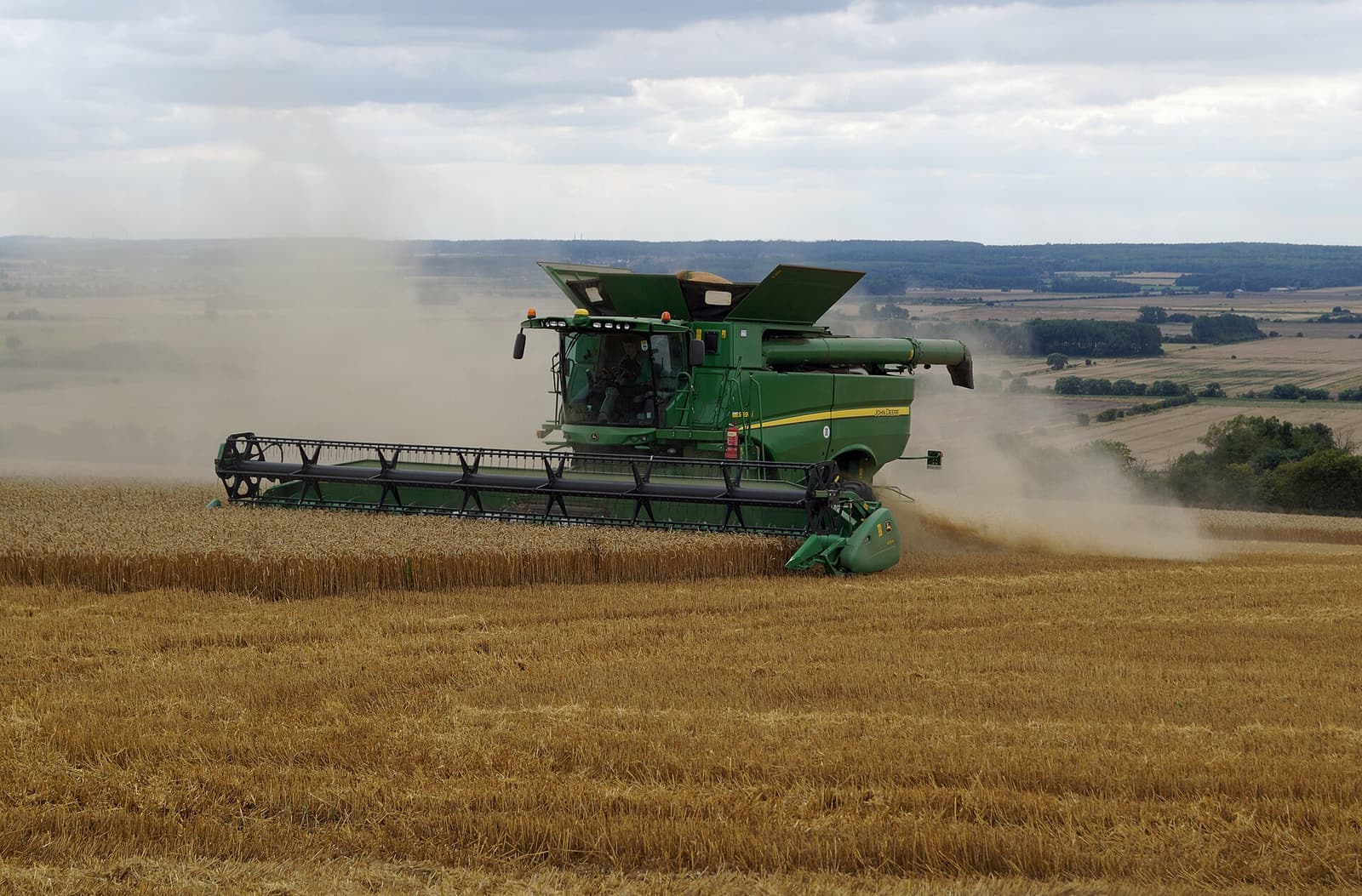
- Wikimedia Commons, "File:John Deere Combine.jpg" - David Wright photograph of a John Deere combine working a crop field near Worlaby, taken August 19, 2013, used as the article image.