A forward grain sale fixes a selling price before the crop is safely in the bin. What remains unpriced is the cost of obtaining any grain the farm fails to grow—and even Revenue Protection insurance only matches that bill under particular conditions.[1][2]
That distinction becomes expensive when a poor harvest coincides with rising prices. The farmer has less to deliver, while replacement grain costs more. Standard Revenue Protection, usually shortened to RP, contains a useful response: its revenue guarantee can rise with the insurance harvest price. The resulting payment can help preserve the economics of an earlier sale. It does not amend the buyer's delivery contract.[1][2]
The insurance price and the sale price do different jobs
RP starts with an approved yield and the farmer's chosen coverage level. Their product supplies the yield component of the guarantee; multiplying that by the higher of the projected or harvest insurance price, subject to the policy's price limit, establishes the revenue protection. Production counted under the policy is then valued at the insurance harvest price to determine whether an indemnity is due.[2][3]
Those prices come from specified futures contracts. They are not simply the prices printed on the farmer's grain-sale invoices. Consequently, the policy calculation can assign a higher value to harvested grain even when the farmer has already agreed to sell it for less.[2]
Iowa State's explanation identifies why the upward adjustment matters to a producer who sells ahead of harvest: when production falls short, the larger guarantee can help finance purchases of the missing bushels. The protection responds to insured production and reference prices, rather than reimbursing a particular replacement invoice.[3]
When the pieces match
Consider an invented corn example, expressed per insured acre. The yield component of the guarantee is 100 bushels, after applying the chosen coverage level. The farmer forward sells that same quantity for $5 a bushel, also the assumed projected insurance price. Only 80 bushels are harvested, while the insurance harvest price rises to $7.
Assume an insured cause of loss, full ownership share, uniform results across the insured unit, no additional appraised production, and no quality adjustments. Replacement grain is available at the insurance harvest price and satisfies the sale contract. Farming costs, premiums, freight, fees and financing costs are excluded. These are scenario assumptions, not current market quotations.
Because the harvest price is higher, standard RP uses it on both sides of the calculation. The difference simplifies to:
RP indemnity = (100 insured bushels − 80 harvested bushels) × $7 = $140 per acre.
Buying the missing grain also costs $140 per acre under the stated assumptions. The farmer can therefore complete the sale and receive $500 per acre from the buyer. Replacement expenditure and insurance proceeds cancel in the combined cash calculation:
Contract receipts − replacement purchases + indemnity = $500 − $140 + $140 = $500.
This is a useful counterweight to the idea that selling before harvest necessarily turns a drought into a financial trap. The extra protection has a specific job: in this matched example it pays for the grain needed to complete the promised delivery. The result is preserved receipts before costs, not a profit guarantee or an assurance that claim money arrives before the replacement purchase.
Change the policy, keep the weather
Now substitute Revenue Protection with Harvest Price Exclusion, or RP-HPE. Its guarantee stays tied to the projected price, while production is still valued at the harvest price. Iowa State explains that this exclusion carries a lower premium because the guarantee cannot rise with the harvest market.[3]
In the example, that fixed guarantee remains $500 per acre. Valuing the harvested bushels at $7 puts assessed production revenue above the guarantee, so no indemnity is due. The farmer nevertheless has the same delivery shortfall and replacement expenditure. Before accounting for the premium saving, cash retained falls by the entire $140.
There is no contradiction. The policy's assessed crop revenue and the farmer's contracted cash receipts are different measures. A higher reference price can make the crop look sufficiently valuable for RP-HPE while making the forward seller's missing bushels more expensive.
The lower premium remains a real counterweight. University of Illinois farmdoc research treats the decision as dependent partly on forward selling and finds RP-HPE more attractive to consider when little or none of the crop has been sold ahead. The example here isolates a bad combination for that policy; it does not rank every coverage choice for every farm.[4]
Change the local price, keep standard RP
Return to standard RP, but let replacement grain cost more locally than the insurance reference price. The claim calculation is unchanged. The extra purchase expense now reduces retained receipts dollar for dollar.
This is a boundary of the model, not a defect discovered in the arithmetic. The farmdoc study explicitly excludes changes in the cash-futures basis and assumes missing grain can be replaced at the insurance harvest price. A real buyer needs grain of the specified quality at the specified place and time. University of Wisconsin Extension warns that fixed cash forward contracts introduce production risk and can carry substantial penalties for failure to deliver.[4][5]
Quantity can break the match too. If a farmer contracts more than the policy's protected yield component, there can be a delivery deficit even when production is high enough to produce no RP payment in a rising-price scenario. That follows directly from the formula: the insurance threshold and the contracted quantity are separate inputs.
The testable concern is therefore an uncovered delivery expense, not merely a disappointing harvest. That concern is disproved for a settled transaction if the actual indemnity covers the full replacement purchase and all associated delivery costs. Until the invoices and claim agree, the apparent offset remains an assumption.
The next evidence arrives at identifiable points:
- When harvested production is certified: reconcile the insurer's production-to-count calculation with the quantity still owed to the buyer. A low yield alone does not establish either shortfall.[1][2]
- Before the contract's delivery deadline: obtain the actual replacement quote and confirm the buyer's terms for quantity, quality and any permitted shortfall settlement. Those terms determine the obligation the policy must help finance.[1][5]
- When the claim is settled: compare the indemnity actually payable with replacement and delivery expenses, then account for premiums and any bridging finance. The worked offset survives only to the extent those cash flows match.
Sources
- Iowa State University Extension, “Commonly Used Grain Contracts,” Ag Decision Maker, updated May 2020 — delivery commitments, production shortfalls and contract-specific obligations.
- USDA Risk Management Agency, “Revenue Protection” — insured causes, futures-based prices, guarantee and indemnity mechanics.
- Iowa State University Extension, “Revenue Protection Crop Insurance,” Ag Decision Maker, updated February 2021 — harvest-price adjustment, RP-HPE and replacement grain.
- Carl Zulauf and Gary Schnitkey, “RP vs. RP-HPE Insurance Decision: Premium, Cash Flow, and Forward Contracting,” farmdoc daily, February 27, 2023 — policy tradeoffs and the study's basis and replacement-price assumptions.
- University of Wisconsin–Madison Division of Extension, “Grain Marketing Tools” — fixed cash forward contracts, delivery requirements and production risk.
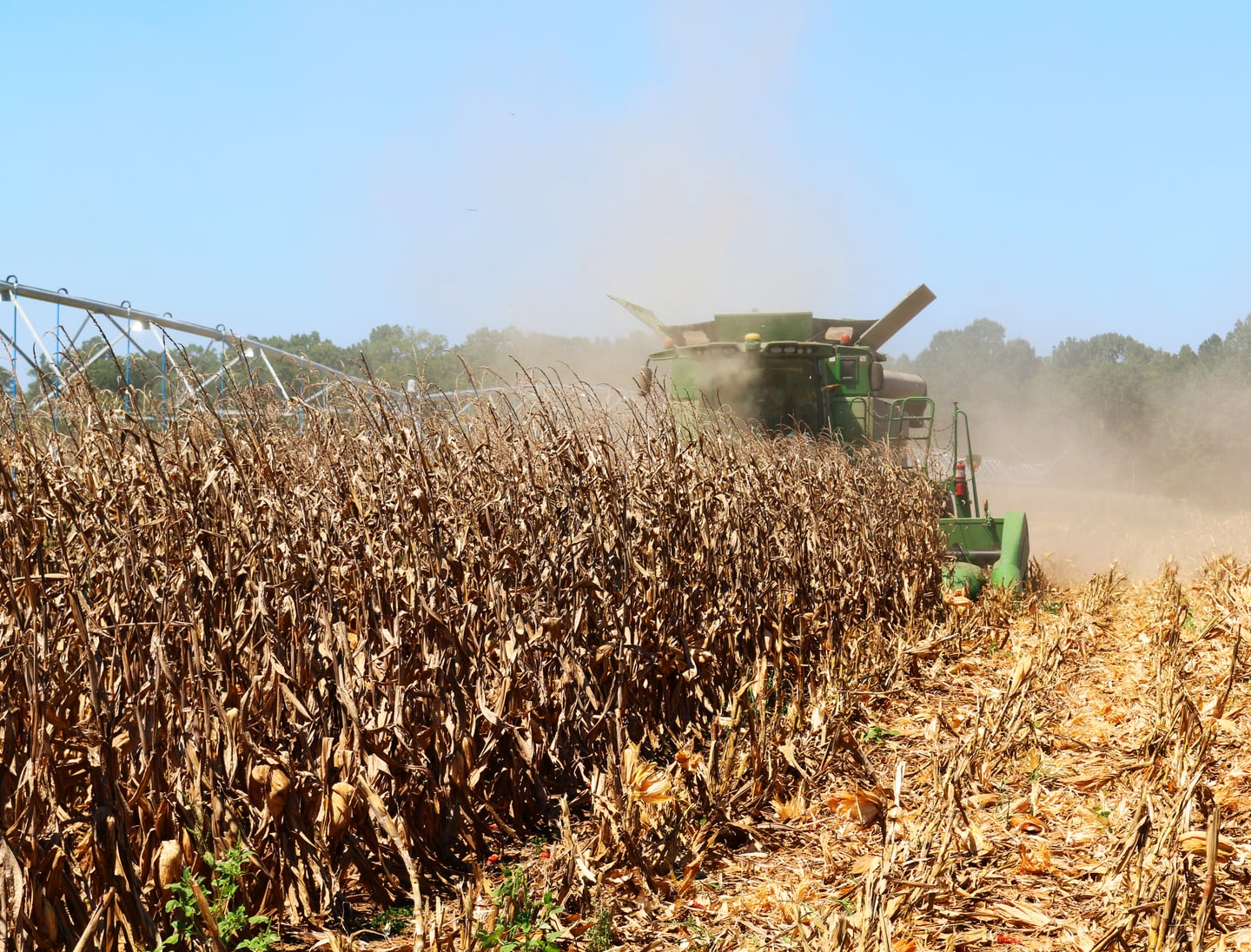
- Katie Nichols / Alabama Extension, “CORN HARVEST combine,” September 6, 2019, via Wikimedia Commons — photograph of feed-corn harvesting in Montgomery County, Alabama; CC0.