Corrugated packaging is an easy sector to oversimplify. The priced story is that e-commerce keeps lifting structural demand for boxes. The new and more useful question is whether producers can turn that demand into price-cost spread while customers keep ordering cautiously and mills keep balancing inventory.[1][2][3][4]
That distinction matters because the demand floor and the profit engine are no longer the same thing. U.S. retail e-commerce sales reached $1.2337 trillion in 2025, up 5.4% from 2024, and accounted for 16.4% of total retail sales.[3] That is a real box signal. But containerboard production still fell 4% in 2025, the operating rate ended above 91%, and inventories finished the year at their highest level since 2022.[4] In other words, the industry can have a durable end-market tailwind and still face a near-term discipline test.
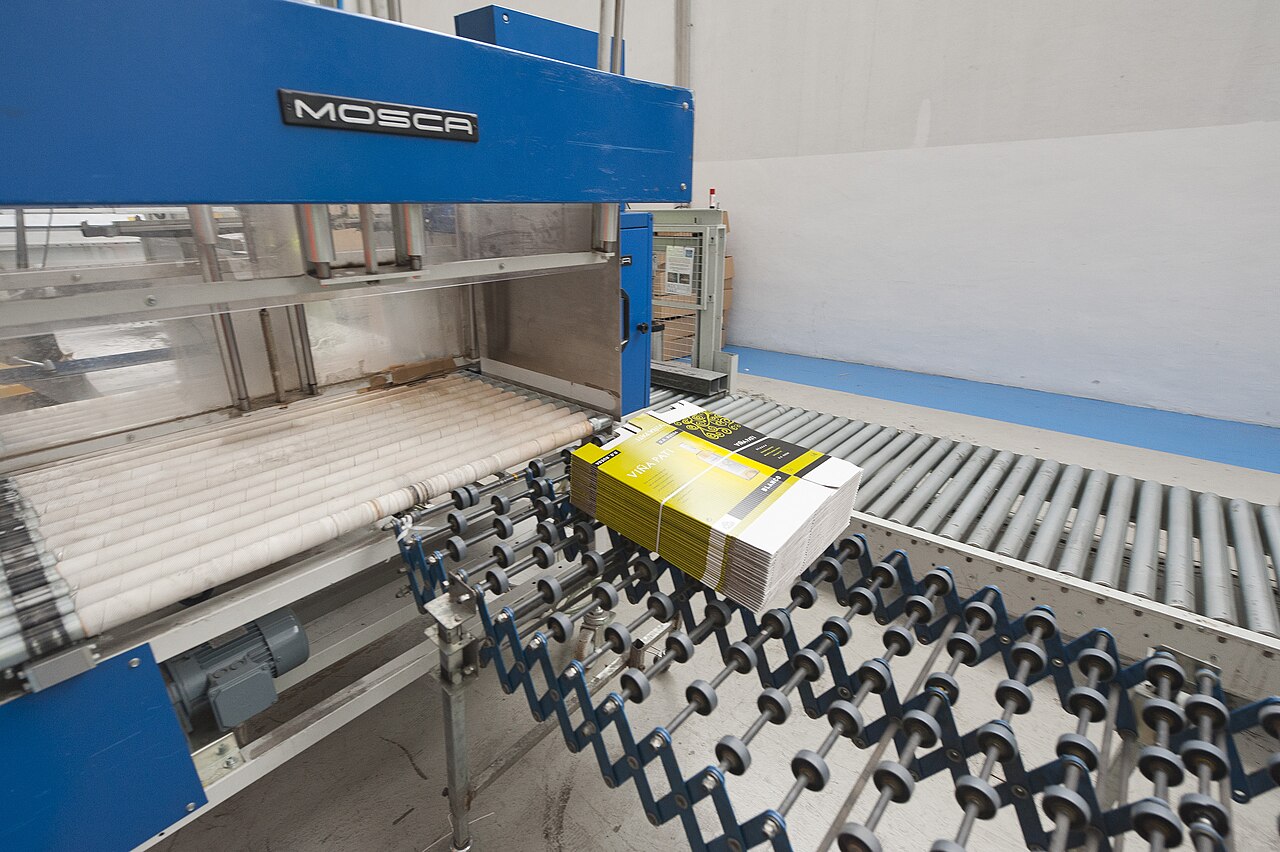
Image context: the cover image is intentionally ordinary. Corrugated packaging is not a software abstraction. The financial thesis lives inside conveyors, mills, old capacity, customer mix, working capital, shipping days, and how quickly management teams respond when boxes move slower than the structural e-commerce story implies.[1][2][4][6]
The demand floor is real, but it is not enough
Start with the supportive side. E-commerce is still taking share of retail rather than giving back the pandemic-era step change. The Census Bureau's fourth-quarter 2025 release put seasonally adjusted e-commerce sales at $316.1 billion, up 1.7% from the third quarter, and said e-commerce accounted for 16.6% of total retail sales in the quarter.[3] For the full year, e-commerce sales were $1.2337 trillion, up 5.4%, while total retail sales rose 3.5%.[3]
That matters for corrugated producers because parcel commerce does not only add volume. It changes the quality of packaging demand. More direct-to-consumer shipping means more individual cartons, more right-sizing pressure, more printing and fulfillment complexity, and more customer interest in packaging that survives delivery without excessive void fill. The secular story is still there: boxes remain one of the physical interfaces between digital ordering and real-world delivery.
But the sector is not paid on that sentence alone. The operating reality in 2025 was much more mixed. AF&PA's fourth-quarter containerboard report, summarized by Recycling Today, showed total U.S. containerboard production down 4% for the year, with operating rates flat and above 91%.[4] Production discipline helped keep the system from becoming a pure oversupply story, but inventories still climbed late in the year and ended at their highest point since 2022.[4] That is the first warning against treating corrugated as a clean e-commerce proxy.
What the company data says
Packaging Corporation of America gave the cleanest micro version of the tension. In the third quarter of 2025, legacy PCA corrugated product shipments were down 2.7% per day and down 1.1% overall versus the prior year, even though total shipments including the acquired Greif business rose 3.7% per day and 5.3% overall.[2] Legacy containerboard production was 1.255 million tons, acquired mills added 47,000 tons, and legacy containerboard inventory reached 417,000 tons, up 56,000 tons from the year-earlier quarter.[2]
The earnings bridge is more revealing than the headline shipment line. PCA said the year-over-year earnings improvement was driven by higher prices and mix in Packaging, lower fiber costs, and some paper-segment pricing, while lower packaging production and sales volume, higher operating costs, freight, depreciation, and fixed costs pulled the other way.[2] That is exactly the price-cost spread argument. The strongest operators can still expand segment profit in a soft-volume environment, but only if price, mix, fiber, and controllable cost beat the volume drag.
Smurfit Westrock's 2025 results describe the same phase at a larger and more global scale. The company reported fourth-quarter net sales of $7.580 billion, adjusted EBITDA of $1.172 billion, and adjusted EBITDA margin of 15.5%.[1] More important for the thesis, management said it exceeded its committed synergy target of $400 million, reduced loss-making businesses, and closed about 600,000 tons of high-cost or inefficient capacity during the year.[1] In North America, the company said performance reflected additional downtime taken to balance the system and manage working capital.[1]
International Paper adds a third signal: portfolio structure is now part of the investment case, not a side note. For 2025, IP reported net sales of $23.634 billion, with Packaging Solutions North America at $15.175 billion and Packaging Solutions EMEA at $8.451 billion.[5] The same release announced a plan to separate the North America and EMEA packaging businesses into two public companies over 12 to 15 months, and described fourth-quarter North America improvement as helped by higher box prices, strategic customer wins, mill actions, and lower input costs despite lower volumes from exiting non-strategic export containerboard and specialty markets.[5]
Read together, the three signals are consistent. Demand is not broken. But management quality now shows up in capacity choices, customer selection, acquired-mill integration, downtime, and whether box pricing survives softer order patterns.[1][2][5]
Six numeric anchors
- E-commerce floor: U.S. e-commerce sales reached $1.2337 trillion in 2025, up 5.4%, and accounted for 16.4% of total retail sales.[3]
- Quarterly share: fourth-quarter 2025 e-commerce sales were $316.1 billion, equal to 16.6% of total retail sales on a seasonally adjusted basis.[3]
- Industry discipline: total containerboard production fell 4% in 2025 while the operating rate ended above 91%.[4]
- Inventory pressure: containerboard inventories ended 2025 at their highest level since 2022, which keeps the volume story from becoming too clean.[4]
- PCA bridge: legacy PCA corrugated shipments fell 2.7% per day in Q3 2025, but Packaging segment operating income still rose to $327.5 million from $320.7 million.[2]
- Capacity action: Smurfit Westrock closed about 600,000 tons of high-cost or inefficient capacity in 2025 after beating a $400 million synergy target.[1]
These numbers point to a sector where "more boxes over time" is a floor, not a full thesis. Investors should care less about the generic e-commerce chart and more about how much old capacity leaves the system, how much inventory sits in mills and converters, and whether price/mix can keep outrunning fiber, freight, labor, and downtime.
Strongest counterweight
The strongest counterargument is that this discipline may be less durable than it looks. Corrugated packaging is cyclical, capital intensive, and exposed to customer destocking. If retailers and manufacturers stay cautious, producers can take downtime only for so long before fixed-cost absorption worsens. PCA's report already shows how volume, operating costs, freight, and depreciation can offset price/mix gains.[2] International Paper's EMEA result also shows that a larger footprint does not automatically create margin when lower prices and lower volumes meet integration and closure costs.[5]
There is also a second-order risk in the e-commerce thesis itself. Online sales growth supports demand, but packaging customers are not indifferent to cost. Right-sizing, reuse, lighter-weighting, private-label procurement, and customer efforts to reduce shipping waste can turn some of the volume tailwind into mix pressure. The sector can grow units while still fighting for each incremental point of margin.
Falsifier
The bullish discipline view is wrong if 2026 shows three things at once: containerboard inventories keep rising from already elevated levels, operating rates fall meaningfully below the low-90s zone, and producers lose box pricing faster than fiber or energy costs decline.[2][4][5] In that branch, capacity closure would look reactive rather than value creating, and the e-commerce floor would not be enough to protect earnings quality.
Watchlist
- AF&PA quarterly containerboard reports: watch whether production discipline holds and whether inventories stop building after the late-2025 rise.[4]
- PCA shipment mix: legacy corrugated shipments matter more than acquired-volume optics; the key test is whether price/mix can keep offsetting soft per-day volume.[2]
- Smurfit Westrock capacity and working capital: further closures, downtime, and synergy capture will show whether 2025's 600,000-ton capacity action was a one-off cleanup or the start of a tighter system.[1]
- International Paper separation milestones: the proposed 12- to 15-month split will test whether regional focus improves capital allocation or simply exposes two different demand cycles more clearly.[5]
The clean takeaway is that corrugated packaging still has a better structural floor than many old-economy materials businesses. E-commerce keeps the demand base visible, and the product remains hard to digitize away. But the investment edge in 2026 is not the existence of boxes. It is the operating spread between companies that remove bad capacity early, protect price/mix, and keep inventories under control, and companies that merely wait for volume to rescue them.
Sources
- Smurfit Westrock, "Smurfit Westrock Reports Fourth Quarter and Full Year 2025 Results" (February 11, 2026) - fourth-quarter results, synergy target, capacity closures, downtime, and 2026 guidance.
- Packaging Corporation of America, "Packaging Corporation of America Reports Third Quarter 2025 Results" - corrugated shipment rates, containerboard production and inventory, and packaging earnings bridge.
- U.S. Census Bureau, "Quarterly Retail E-Commerce Sales Report: 4th Quarter 2025" - e-commerce sales, growth, and share of total retail sales.
- Recycling Today, "Containerboard, boxboard production down in 2025" (February 3, 2026) - summary of AF&PA Q4 2025 containerboard and boxboard reports.
- International Paper / PR Newswire, "International Paper to Create Two Independent Public Companies and Reports Full-Year and Fourth Quarter 2025 Results" (January 29, 2026) - 2025 segment sales, box pricing, strategic exits, closures, and separation plan.
- Wikimedia Commons, "File:American boxes.jpg" - photographic source page for the article image.