Paying above face value for a 6% coupon can buy surprisingly little return: in the scenario below, an early call leaves the investor earning 1.92%. The price buys the remaining contractual payments, including the issuer's right to end them early; treating the coupon as money safely locked in overstates what was purchased.[1][2]
The price contains a premium to recover
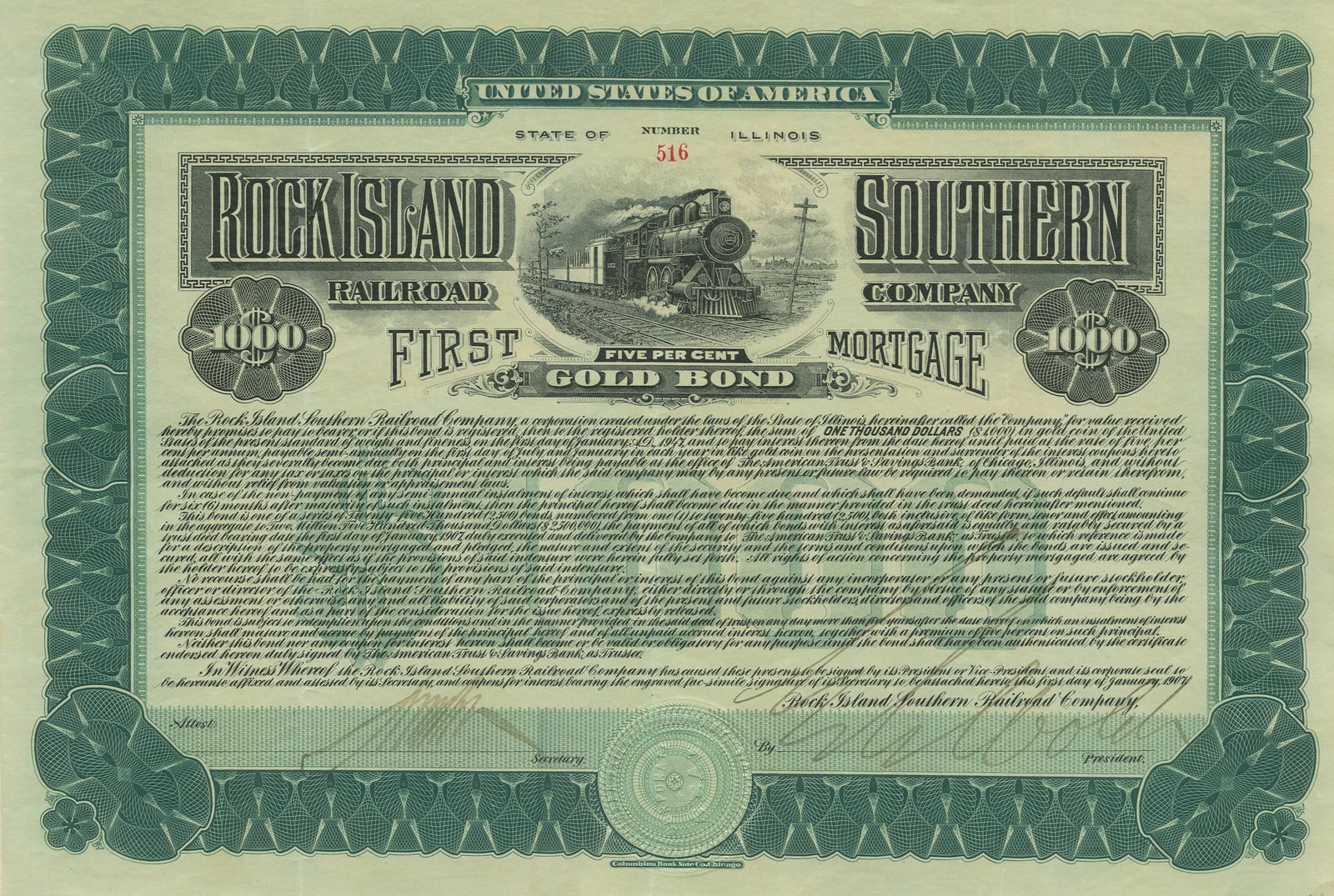
The archival railroad bond pictured here puts a large coupon label above much smaller repayment terms. Its redemption provision is a reminder that the attractive number and the conditions for receiving it belong to the same contract.[5]
Consider an illustrative fixed-rate bond bought for $104 per $100 of face value, immediately after a coupon payment. It pays interest annually and has several years until maturity. Its first permitted redemption is one year after purchase, at face value, on the next coupon date; later calls are allowed only on annual coupon dates, also at par.
Assume the whole position is redeemed if called, all payments arrive on time, and no earlier extraordinary or mandatory redemption is possible. Exclude taxes, fees and inflation. These are invented terms for a cash-flow exercise, not a current bond quotation. Actual securities may pay semiannually and require different day-count and yield conventions.
The annual coupon is $6. That payment is calculated on face value, even though the buyer paid more. The extra purchase cost is the premium: money committed at entry that the issuer has no obligation to return under these assumed redemption terms.
A high coupon can justify paying above par. But the buyer needs enough coupon income, over enough time, to compensate for that premium as well as earn a return. The call schedule decides how much time may be available. FINRA's distinction between coupon, current yield and yield to call matters because only the last of those incorporates the assumed early redemption payment.[2]
If the issuer calls at the first opportunity
Suppose cheaper financing becomes available and the issuer exercises its option. It repays face value and the coupon due that day, then owes no further interest. The SEC describes this refinancing incentive: issuers can replace expensive borrowing, while holders must find somewhere else to invest their returned cash.[1]
For our buyer, most of the coupon offsets the difference between the purchase price and the redemption payment. The return is:
(face value + annual coupon − purchase price) ÷ purchase price = 1.92%, rounded.
Because the only cash received arrives exactly one year after purchase, that holding-period return is also the effective annual yield to this call. There are no interim coupons to reinvest. The issuer has honored every promise, yet the investor has earned much less than the coupon rate.
This is where a bond screen can mislead without displaying any false information. A coupon describes the interest obligation. A yield to call describes the purchase price against a particular payment schedule. They answer different questions.
The MSRB documents a more extreme version in municipal bonds: an above-par purchase followed by a sufficiently prompt par call can produce a negative yield even while the bond pays positive interest. Its discussion also explains why annualizing a short holding period can make a quoted negative yield look much larger than the investor's actual percentage cash loss.[3]
If the call date passes and the coupons continue
An optional call is permission, not a repayment appointment. If the issuer leaves our bond outstanding, the holder collects the coupon and retains the security. Further payments give the investor more income over which to absorb the original premium.
This is the strongest counterweight to judging the purchase solely by its earliest-call yield. The MSRB describes investors buying premium bonds with unattractive immediate-call yields because they expect redemption to come later. That can work; it depends on the issuer's behavior, rather than on the coupon alone.[3]
For this scenario, a purchase thesis might therefore be: refinancing remains uneconomic and the bond survives several payment dates. That is a testable expectation, not a contractual entitlement. Nor does receiving the first coupon establish an attractive total return at that moment: the investor still owns a bond whose market value must be included.
If the bond survives to maturity and pays as promised, the investor receives the remaining coupons and par. Yield to maturity measures that specified stream against the entry price. It does not tell us the probability that the stream will survive the issuer's call rights.[2]
If the investor needs to sell first
A third branch breaks the tidy choice between call and maturity. Suppose the holder needs cash before either event, after market yields have risen. The sale price can fall enough to outweigh coupon income. A difficult market for that particular issue can further worsen the executable price. The SEC distinguishes these interest-rate and liquidity risks from the issuer's ability to pay its debt.[4]
Here the phrase yield to worst needs care. It compares contractual yield outcomes under specified payment assumptions; it is neither a guaranteed account return nor a floor under the price available in an early sale. Default also falls outside the promise of the calculation.[2][4]
Our example deliberately excludes unusual redemption rights. In a real prospectus, optional calls, sinking-fund redemptions and extraordinary redemptions need separate attention; the SEC identifies them as distinct mechanisms.[1] A screen's single yield cannot replace that reading.
What would change the assessment
Paying a premium is defensible when the available cash flows adequately compensate the buyer under realistic redemption outcomes. The weak thesis is that a generous coupon, by itself, secures generous income for the entire stated maturity.
The falsifier for the early-par-call concern is contractual: verified terms that prohibit redemption at or near par throughout the intended holding period would remove the scenario driving this article. The purchase price would still affect yield, but the assumed early exit would no longer be available to the issuer. The actual prospectus must settle that question.[4]
For a specific bond, three events deserve a place on the watchlist:
- Before the trade settles: reconcile the security identifier, total purchase cost, coupon calendar, call prices and yield calculation with the offering document. A different redemption price changes the arithmetic.[2][4]
- At the next call-notice deadline: check for the issuer's or trustee's formal notice. An approaching call date alone does not establish that repayment will happen.[1]
- At the next refinancing announcement or financial report: revisit whether leaving the bond outstanding remains economical and whether credit has weakened. The first changes the case for continued coupons; the second challenges the assumption that all payments arrive.[1][4]