Valuing bottle-return suppliers on the next national rollout captures the equipment sale; the harder question is what each installed machine earns afterward. TOMRA’s 45% year-on-year growth in reported Collection revenue in the second quarter of 2026 makes that distinction urgent: management said installations in Poland peaked during the quarter.[1]
The investment thesis is that deposit schemes create a growing base of machines that can earn money beyond launch day. The valuation trap is assuming that all of those later revenues have the same margins, capital needs and reliability. A valuation built around the rollout opportunity now needs evidence of cash earned by machines already in service.
Information checked on 8 October 2026. Financial comparisons below concern the Collection division unless explicitly stated otherwise.
Follow the bottle, then the payment
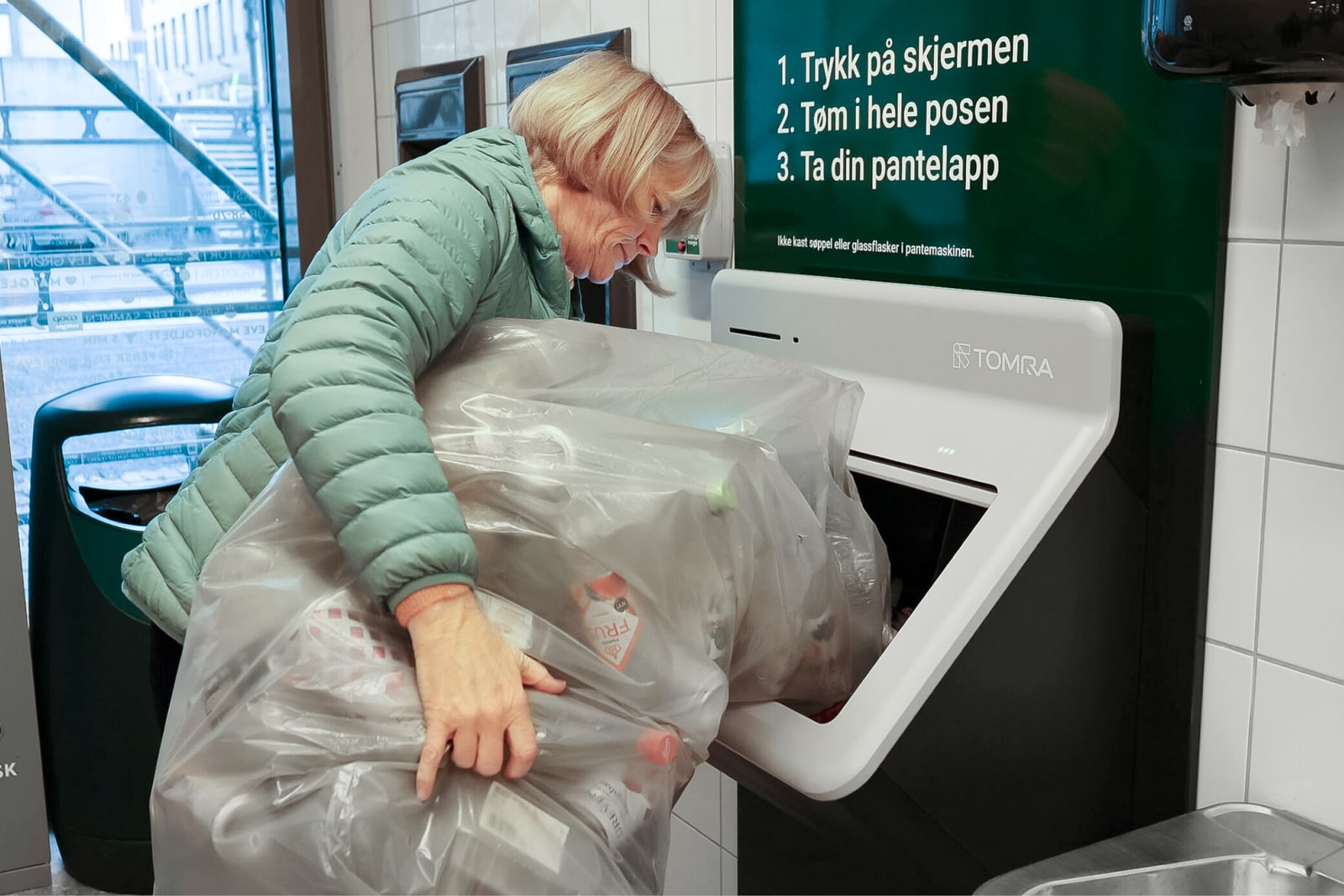
At Coop Mega Lillehammer in Norway, customers can tip a bag of empty bottles and cans into a TOMRA R2 instead of feeding them through individually. The installation also lets staff change a storage bag without stopping the machine. Those details come from a supplier-published customer account, so they establish how the equipment works rather than independently proving its financial return.[6]
They nevertheless identify what a retailer is buying: a way to process returns while limiting queues, staff handling and interruptions. A machine that takes up valuable floor space must justify its place in the store after the installation team leaves.
The UK’s forthcoming scheme illustrates how that demand becomes a procurement decision. Defra’s guidance for England and Northern Ireland requires qualifying grocery retailers to host return points, subject to exemptions, but permits both manual collection and automated machines. Retailers must refund deposits and store containers for collection.[4] The obligation therefore creates demand for a function. It does not automatically award an equipment contract.
Exchange for Change, the scheme administrator, describes a separate handling fee intended to cover the cost of accepting, storing and processing returns. That payment goes to the return-point operator; the consumer’s refundable deposit has a different purpose.[5] An investor cannot multiply the deposit by the bottles passing through a machine and call the result supplier revenue.
The revenue that survives installation
TOMRA’s 2025 annual report puts 61% of Collection revenue in the broad group of services beyond equipment sales. Its more detailed business-model breakdown assigns just 22% to Service itself. The remainder of the broad category comprises lease and throughput activities and material recovery.[2]
The distinction matters. Under a throughput arrangement, TOMRA retains ownership of the machine and receives a fee linked to collected volume. Maintenance revenue, equipment ownership and processing recovered material are different economic exposures, even when all involve the same stream of bottles. The annual report also records 11% growth in service revenue during a year when total Collection revenue declined.[2]
That is evidence of a business capable of earning beyond the installation cycle. It is insufficient evidence for valuing every non-equipment euro as an equally dependable annuity.
Timing adds another wrinkle. TOMRA generally recognizes product sales and sales-type leases at installation, while service contracts and operating leases produce revenue over the agreement’s duration.[3] A shift in contract type can therefore change the revenue profile even when the physical number of machines deployed looks similar.
For analysis, the useful unit is the installation cohort: machines placed into service in a given market and period. Follow what that cohort subsequently earns, what it costs to maintain and how much capital remains tied up in it. A new market announcement supplies none of those answers by itself.
The strongest counterweight is already in the quarter
Collection’s second-quarter gross margin fell 3.2 percentage points from a year earlier. TOMRA attributed the decline to lower product margins in Poland and a heavier equipment-sales mix. Yet the division’s EBITA margin—earnings before interest, tax and amortization as a share of revenue—rose 1.5 percentage points. Both changes are calculated from the reported margins.[3]
The quarter thus supports a serious competing interpretation: a large equipment wave can improve operating profitability immediately, even while diluting gross margin. Investors need not wait for maintenance contracts to see benefits from scale.
The danger is extrapolation. An installation peak lifts current activity, then becomes a demanding comparison for the following year. The relevant question is how much profit remains as that wave subsides. A higher service share can result from growing service revenue, falling equipment revenue, or both; the percentage alone cannot distinguish them.
Nor does recurring billing remove the need for capital. Where the supplier owns the equipment, it must recover that investment through later receipts. A busy machine with an inadequate fee can produce impressive collection statistics and a disappointing return. The commercial contract determines how much of the operational success belongs to the supplier.
What would earn the longer valuation
The UK rollout offers a visible test. Exchange for Change says retailers should consider machine footprint, available store space and expected return volumes. Its FAQ schedules a certified-supplier list for October 2026 and detailed registration from January 2027, ahead of the October 2027 launch.[5] These milestones connect policy to equipment selection and operational readiness; each is more informative than counting another country on a presentation slide.
The thesis fails if the enlarged installed base cannot increase cash generation after servicing costs and required reinvestment once the installation wave subsides. More machines would then expand activity without delivering the durable earnings improvement claimed here.
Three dated checks can sharpen that judgment:
- 23 October 2026, TOMRA’s scheduled third-quarter results: examine the transition after Poland’s installation peak, separating equipment mix from continuing revenue. A lower headline growth rate alone would not settle the case.[1][7]
- 24 November 2026, TOMRA’s scheduled Capital Markets Day: look for evidence on returns from supplier-owned equipment and the economics of established installations. Targets for machine deployment need a corresponding explanation of cash generation.[7]
- January 2027 registration, ahead of the UK’s October launch: follow the emerging mix of manual and automated return points and the progression from certified equipment to installed capacity. That is where a regulatory opportunity becomes identifiable procurement demand.[5]
Sources
- TOMRA, “Second Quarter 2026 Results Announcement,” 17 July 2026 — Collection revenue growth and management’s statement that Polish installations peaked in the quarter.
- TOMRA, Annual Report 2025, pages 23–24 — Collection business models, revenue composition and service growth.
- TOMRA, Second Quarter 2026 report, pages 7 and 15 — Collection margins, mix effects and revenue-recognition policy.
- Defra, “Deposit Return Scheme: drinks producer and retailer responsibilities” — England and Northern Ireland guidance on return points, exemptions, refunds and storage; consulted 8 October 2026.
- Exchange for Change, “FAQs” — handling fees, machine selection, supplier certification and registration milestones; consulted 8 October 2026.
- TOMRA, “Boosts return volumes and attracts new customers with TOMRA R2,” 19 December 2024 — Coop Mega Lillehammer customer account and photograph provenance.
- TOMRA, “Investor Relations,” financial calendar — scheduled third-quarter results and Capital Markets Day; consulted 8 October 2026.