The market already knows the annual bank stress test is theatrical in one sense: it imagines a recession that the Federal Reserve explicitly says is not a forecast. The more useful 2026 read is narrower. Priced is that large U.S. banks should enter the exercise from a profitable, well-capitalized base. New is that this year's scenario puts a hard number on the capital-return question: can banks keep defending dividends, buybacks, and loan supply under a test that combines a 10% unemployment peak, a 39% commercial real estate price drop, a 30% house-price drop, and a corporate-spread shock?[1][2]
That is the trade. The stress test is not asking investors to forecast a depression. It is asking whether current bank valuations, capital plans, and credit appetite still make sense if a supervisory model forces banks to carry a much uglier loss path than the base economy is showing today.
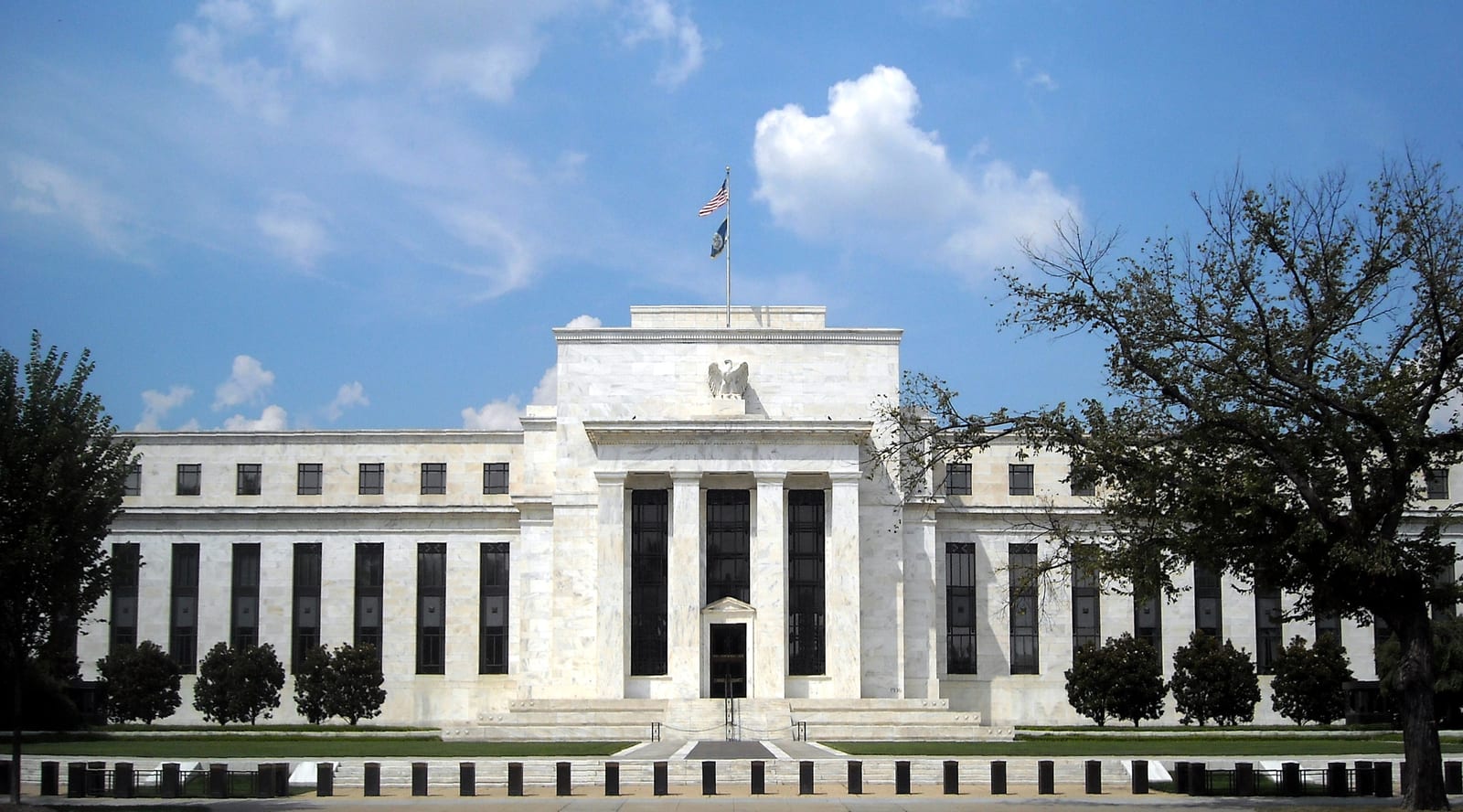
Image context: the cover uses a real Wikimedia Commons photograph of the Marriner S. Eccles Federal Reserve Board Building. That is the right visual anchor because the article is about a supervisory capital process run from an actual institution, not about symbolic recession graphics or candlestick charts.[6]
Base Case: Pass, But Not A Free Pass
The base case is still that the large-bank group clears the hurdle. The Fed said 32 banks are being tested in 2026, with the exercise estimating losses, net revenue, and capital levels over a two-year hypothetical recession.[2] That starting point matters because the tested population is not the whole banking system. It is the large-bank layer where capital planning, counterparty default shocks, trading shocks, and shareholder distributions become a public confidence mechanism.
The industry backdrop is not fragile on its face. FDIC-insured institutions reported $77.7 billion of aggregate net income in the fourth quarter of 2025 and a 1.24% return on assets.[3] That does not make credit risk harmless, but it gives the large-bank story a profit cushion before the stress-test math starts.
The April 2026 Senior Loan Officer Opinion Survey also argues against a simple "banks are already slamming the brakes" read. Banks reported basically unchanged lending standards and weaker or basically unchanged demand for CRE loans in the first quarter; large banks, in particular, reported easing standards across the three main CRE categories, while smaller "other banks" were more cautious in construction and multifamily.[4] That split is the key. Large banks can look comfortable while the more exposed regional and local bank layer still carries a different risk profile.
In this base case, stress-test results become a sorting event rather than a system alarm. Stronger banks pass and keep capital return active. Weaker stories pass too, but with less room to surprise on buybacks. Investors should not treat "pass" as the end of the analysis. The real question is how much capital flexibility remains after the modeled drawdown.
Downside Case: CRE And Corporate Credit Bite Together
The downside case begins with the scenario design itself. The Fed's 2026 severely adverse scenario is built around a severe global recession, a sharp risk-appetite shock, and impaired market functioning early in the path.[1] Equity prices fall about 58% in the first three quarters, the VIX peaks at 72%, BBB corporate spreads rise to 5.7 percentage points, and real GDP falls 4.6% from the fourth quarter of 2025 to its trough.[1]
Those numbers matter because bank stress rarely comes from one clean line item. A CRE shock hurts collateral values and loss assumptions. A corporate-spread shock hurts trading, underwriting, borrower refinancing, and private-credit marks. A housing shock can pressure mortgage books and consumer confidence. A falling 3-month Treasury rate, down to 0.1% in the scenario, is not automatically friendly if it arrives because credit losses are rising and fee activity is impaired.[1]
The CRE layer deserves special attention because it is not evenly distributed. A May 2026 Fed note estimates outstanding CRE mortgage debt at $6 trillion at year-end 2024 and says banks hold about half of it.[5] The same note finds that certain high-growth regional and small banks expanded CRE originations dramatically from 2015 to 2024, with construction loans rising from 10% to 40% of their CRE origination mix by 2024.[5] It also documents a funding vulnerability: some high-growth banks rely heavily on local deposits tied to the same geography as their CRE collateral.[5]
That is not the same population as the 32 large banks in the supervisory test, and the distinction is important. The public stress-test result can look clean while market concern remains concentrated in banks below the main test perimeter, in CRE-heavy lenders, or in nonbank credit channels. The large-bank trade therefore has a second-order risk: even if the tested banks pass, broader credit caution can still show up through loan growth, NDFI exposure, warehouse lines, or mark-to-market pressure.
Upside Case: Transparency Lowers The Risk Premium
There is a constructive scenario too. The Fed has made the 2026 process more explicit by publishing scenario materials, model guides, shocks, data files, and model-documentation links through its Dodd-Frank Act stress-test page.[1] The February announcement also said current stress-test-related capital requirements would be maintained while public feedback is considered.[2] For investors, that lowers one category of uncertainty: the immediate question is less "will the rulebook suddenly change before results?" and more "what does the model do to each bank's capital path?"
If the results show manageable capital drawdowns, the market can reward banks with cleaner fee mixes, diversified loan books, and enough earnings power to absorb stress while still returning capital. That does not require heroic macro optimism. It only requires evidence that pre-provision net revenue, capital buffers, and loss absorption remain thick enough under a deliberately harsh path.
The April SLOOS details fit that upside if they persist. CRE lending standards were not broadly tightening at large banks, and terms eased or stayed basically unchanged across most CRE policy categories over the prior year.[4] Banks also reported stronger demand for nondepository financial institution loans, even as they tightened NDFI standards and terms.[4] That combination is not risk-free, but it points to a market where credit is still being rationed by price and structure rather than withdrawn outright.
Five Numeric Anchors
- 32 banks: the number of large institutions in the Fed's 2026 annual stress test.[2]
- 10% unemployment: the severely adverse peak, up about 5.5 percentage points from the fourth quarter of 2025.[1][2]
- 39% CRE price decline: the commercial real estate trough in the 2026 scenario.[1][2]
- 58% equity-price drop: the early-market shock embedded in the severely adverse path.[1]
- $77.7 billion: aggregate fourth-quarter 2025 net income at FDIC-insured institutions, the profit cushion against which the stress story starts.[3]
The anchors pull in opposite directions. The stress path is severe enough to matter. The starting banking system is profitable enough that the obvious conclusion is not "crisis." That tension is exactly why the stress-test result is a capital-return event.
Falsifier
This view is too constructive if the 2026 results show that multiple large banks clear minimums only by giving up meaningful capital-return flexibility, while SLOOS simultaneously turns from mixed to broad tightening and CRE delinquency evidence worsens outside the large-bank group.[1][4][5] In that case, "pass" would become a legal minimum rather than an investable signal.
The opposite falsifier cuts the other way. If results show limited capital drawdowns, large banks keep lending standards stable, and CRE stress remains concentrated rather than spreading through NDFI or corporate-credit channels, the market should stop treating the stress-test scenario as a shadow forecast and read it as a successful capital proof.[1][2][4]
Watchlist
- 2026 stress-test results: focus on capital drawdown, stress capital buffer implications, and whether buyback plans stay credible after the modeled losses.[1][2]
- CRE standards in the next SLOOS release: the large-bank versus smaller-bank split matters more than the headline average.[4]
- NDFI lending terms: tighter standards plus stronger demand can be healthy discipline, or it can signal leverage moving to less transparent credit channels.[4]
- Regional CRE funding pressure: watch whether local deposit stress and local CRE collateral stress start reinforcing each other in high-growth banks.[5]
The clean takeaway: bank stress tests are not recession predictions. They are capital distribution tests wearing recession clothing. In 2026, the market should treat the exercise as a proof of how much shareholder return can survive a deliberately severe CRE, housing, equity, and corporate-credit path. Passing matters. Passing with room to lend and return capital matters more.
Sources
- Board of Governors of the Federal Reserve System, "2026 Stress Test Scenarios" - final severely adverse scenario details, including unemployment, CRE, house prices, equity prices, corporate spreads, GDP, and rate paths.
- Federal Reserve Board, "Federal Reserve Board finalizes hypothetical scenarios for its annual stress test..." (February 4, 2026) - 32-bank scope, severe scenario summary, and current capital-requirement decision.
- Federal Deposit Insurance Corporation, "Quarterly Banking Profile - Q4 2025" - fourth-quarter 2025 banking-industry net income, ROA, and full-year net income context.
- Federal Reserve Board, "The April 2026 Senior Loan Officer Opinion Survey on Bank Lending Practices" - Q1 2026 C&I, CRE, consumer, and NDFI lending-standard and demand signals.
- Dulce Lopez Cruz, Teodora Paligorova, and Toshihide Yorozu, "Monitoring High Credit Growth: The Link Between Local Deposits and CRE Lending," Federal Reserve FEDS Notes (May 1, 2026) - CRE debt scale, bank ownership share, high-growth regional-bank origination patterns, and local-deposit concentration risk.
- Wikimedia Commons, "File:Marriner S. Eccles Federal Reserve Board Building.jpg" - source page for the lead photograph of the Federal Reserve Board building.