Badger Meter is no longer priced as a simple meter maker. Even after a sharp reset from the 2025 high, the stock still carries a quality multiple because investors are paying for smart water infrastructure: ultrasonic meters, cellular AMI, software, water quality, network monitoring, and leak intelligence. The new debate is whether that quality premium can survive a project-pacing air pocket.
The priced part is clear. Badger sells into an end market with public infrastructure support, conservation pressure, and utility demand for better data. EPA says U.S. drinking-water systems need $625 billion over 20 years, including $422.9 billion for distribution and transmission systems.[6] EPA also frames advanced metering infrastructure as a way to collect frequent and accurate water-use data, improve billing, identify leaks faster, and support water-resource management.[7] That is the long runway behind the stock.
The new part is less comfortable. First-quarter 2026 sales fell 9% to $202.3 million, operating margin compressed to 17.4% from 22.2%, and EPS dropped to $0.93 from $1.30.[1] Management tied the shortfall to project timing, weaker short-cycle municipal ordering, and a comparison against a prior-year period when several large deployments were still active.[1] In other words, the story did not break because the water thesis disappeared. It bent because hardware deployment cadence still controls when the high-quality mix can show up in revenue.
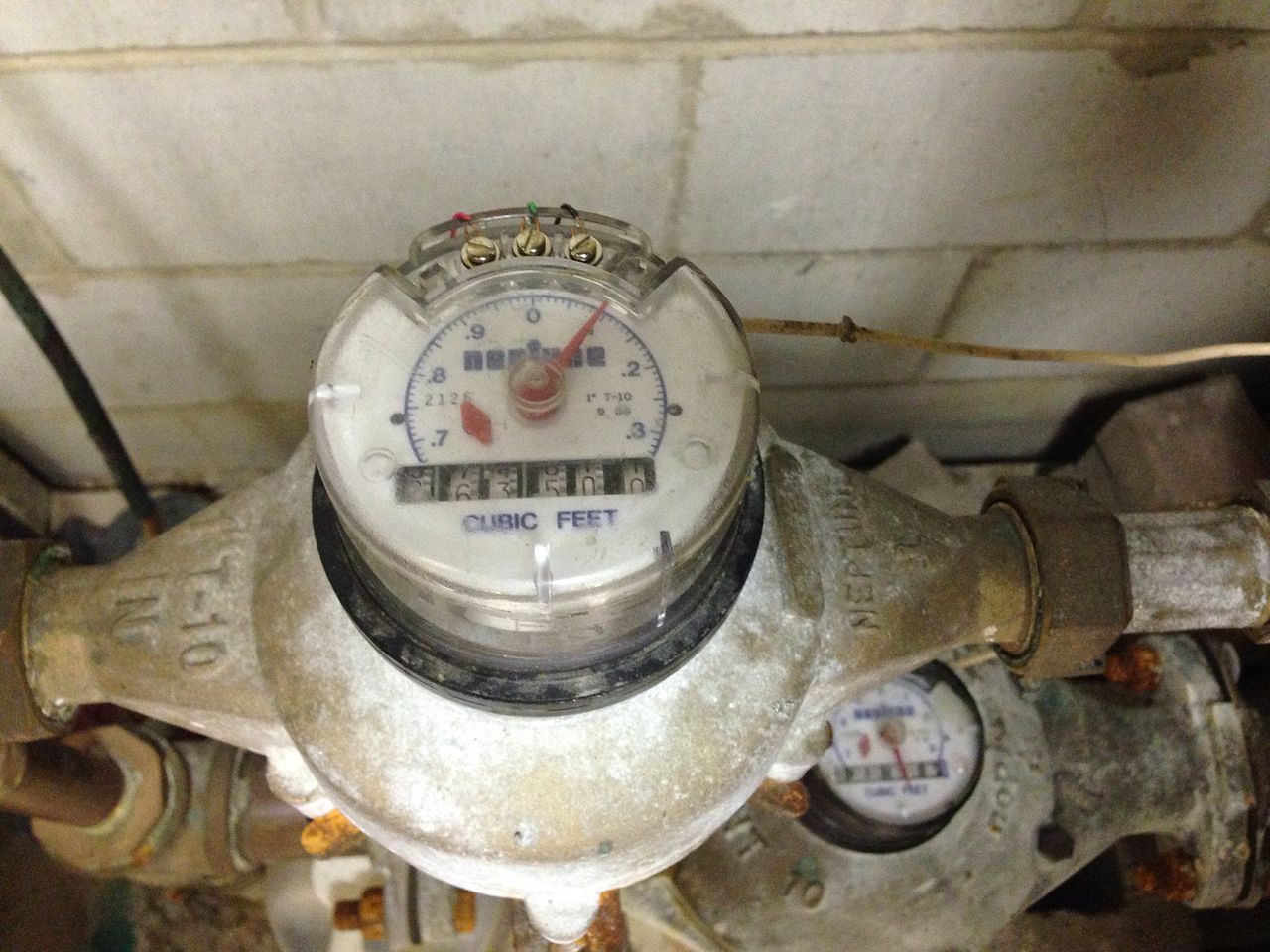
Image context: the cover uses a real Wikimedia Commons photograph of water meters with remote-reading connections. It is not a chart, diagram, or generated image. It fits because the whole investment case begins as a physical installed-base question before it becomes a software and data question.[9]
The Premium Was Earned
Badger's premium did not appear from nowhere. In 2025, sales reached a record $916.7 million, up 11%, while base sales grew 6%. Operating earnings rose 16% to $183.4 million, operating margin reached 20.0%, and diluted EPS rose 13% to $4.79.[3] That is not a commodity-parts profile.
The better evidence was mix. Badger said 2025 SaaS sales were about $74 million, up 27%, while SmartCover delivered about $40 million of sales in 11 months after acquisition and nearly 25% pro-forma annualized growth.[3] Gross margin also benefited from structural mix: ultrasonic meters, cellular AMI, water quality, and SmartCover sales were above line average.[3]
That mix is why investors have treated Badger differently from a cyclical industrial supplier. A brass meter shipment is useful, but it is finite. A cellular AMI deployment can create a longer customer relationship through endpoints, network services, software, analytics, customer portals, leak alerts, and utility workflow. The value is not only that municipalities buy meters. It is that a utility trying to reduce non-revenue water or improve billing accuracy needs a measurement layer it can trust.
The surrounding water-tech tape supports that broad argument. Xylem reported first-quarter 2026 revenue of $2.1 billion, orders of $2.2 billion, adjusted EPS of $1.12, and adjusted EBITDA margin of 20.6%, then guided to full-year revenue of roughly $9.2 billion to $9.3 billion with adjusted EBITDA margin of 22.9% to 23.3%.[4] American Water, on the utility side, invested $652 million in the first three months of 2026 and planned about $3.7 billion of investment across its footprint for the year.[5] Water infrastructure is not a fad budget line.
What The Market Has To Reprice
The valuation problem is that a premium multiple needs a premium clock. StockAnalysis showed Badger at roughly $3.81 billion of market cap, 29.60x trailing earnings, 27.94x forward earnings, and 22.54x price to free cash flow around this run.[8] That is not an extreme software multiple, but it is still too rich for a company whose revenue path looks like a one-quarter equipment cycle.
So the question becomes narrower: is Q1 2026 a timing trough or an early warning that the growth algorithm has become lumpier?
Badger's own slide deck argues for timing. It describes a historical cohort of four projects totaling about 800,000 connections across JEA, Orlando Utility Commission, Pinellas County Utilities, and Galveston. That cohort ramped, peaked, declined, and was nearly done by 2026, which made the comparison difficult.[2] The same deck points to future awarded projects: PRASA at 1.6 million connections with deployment expected in the second half of 2026, another utility at 330,000 connections with late-2026 deployment and scale in 2027, and a third at 210,000 connections expected in the second half of 2026.[2]
That is the bridge investors are being asked to cross. If those projects ramp on schedule, the Q1 decline may look like a valley between deployment waves. If they slip, the stock has to be valued more like a high-quality industrial with uneven order conversion, not like a water-data compounder with steady operating leverage.
The Margin Test
The cleanest positive sign in Q1 was that gross margin did not collapse. Badger's gross margin was 41.7%, down from a record 42.9% but still near the upper end of management's normalized range of 39% to 42%.[1][2] That matters because it suggests the core product mix remains strong even when revenue is lighter.
The weaker sign was operating leverage. Selling, engineering, and administration expense rose to $49.2 million, or 24.3% of sales, from 20.7% a year earlier.[2] Lower sales plus higher expense intensity pushed operating income down 28.7% to $35.2 million.[2] For a premium stock, that is the line to watch. If the business really is becoming more software-like over time, then revenue recovery should bring operating margin back quickly. If not, the multiple has to absorb the fact that people, acquisitions, software support, and international expansion still carry fixed-cost drag.
Free cash flow gives the bull case some protection. Badger generated $29.5 million of quarterly free cash flow in Q1, broadly in line with the prior year despite weaker earnings.[2] That does not erase the operating miss, but it helps distinguish a timing issue from a balance-sheet problem. A company can endure lumpy municipal projects better when cash conversion remains respectable.
The Counterweight
The strongest bearish case is not that water metering is bad. It is that public investors may have overpaid for smoothness. Municipal customers move on procurement cycles. Federal or utility capital plans can support long-term demand without making quarterly orders linear. Large AMI awards can create attractive revenue when they ramp, but they can also create awkward comparisons when they roll off.
There is also a customer-economics constraint. AMI improves billing, leak detection, and water management, but utilities still have to justify capital spending against rate pressure, staffing limits, installation logistics, cybersecurity expectations, and customer acceptance.[7] American Water's Q1 is a useful reminder: capital investment helped drive rate recovery, but operating costs, depreciation, and interest expense also rose.[5] The whole ecosystem has demand, yet that demand must still pass through regulated budgets and local execution.
Badger's acquisition strategy adds another double edge. SmartCover and UDlive strengthen the sewer-monitoring and BlueEdge story, but they also increase the burden to prove integration, cross-selling, and margin accretion. If acquisitions mostly add revenue complexity while organic municipal orders pause, the stock will not get full credit for the platform narrative.
The Falsifier
The bullish valuation case is wrong if project timing does not convert into renewed operating leverage. Concretely, if the second-half 2026 project ramp does not show up in utility water revenue, if operating margin stays closer to the Q1 17.4% level than the 2025 20.0% level, and if SaaS and monitoring growth cannot offset softer short-cycle municipal demand, then Badger is not merely between projects. It is being re-rated toward a lumpier industrial profile.[1][2][3]
The positive proof is equally specific. PRASA and the other awarded projects need to move from backlog narrative to shipment revenue. Gross margin needs to remain around the low-40s even as volume returns. SEA expense needs to fall back as a percentage of sales. And SaaS, SmartCover, water quality, and sewer monitoring need to keep growing fast enough that the company looks less dependent on one hardware deployment wave.
Watchlist
- Second-half 2026 deployment evidence: PRASA's 1.6 million connections and the 330,000 and 210,000 connection projects are the clearest cadence tests.[2]
- Operating margin recovery: Q1's 17.4% margin needs to move back toward the 2025 full-year 20.0% level as revenue recovers.[1][3]
- SaaS and monitoring mix: 2025 SaaS sales of about $74 million and SmartCover's roughly $40 million contribution set the baseline for whether the platform story is real.[3]
- Utility capital conditions: EPA's long-term need estimate and American Water's 2026 investment plan support demand, but rising costs and rate proceedings determine how quickly budgets become orders.[5][6]
Badger Meter still has the pieces investors want in a scarce industrial-tech compounder: mission-critical measurement, municipal relationships, data attach, strong gross margin, cash generation, and exposure to aging water infrastructure. The problem is not the destination. It is the clock. At this valuation, the market can tolerate one bad pacing quarter. It cannot tolerate a full year in which the water-data thesis keeps sounding strategic while revenue and margins keep behaving like a stop-start equipment cycle.
Sources
- StockTitan SEC-filing mirror, "Badger Meter (NYSE: BMI) Q1 sales slip 9% as EPS reaches $0.93" (April 17, 2026) - Q1 sales, EPS, gross margin, project timing, municipal order pacing, and UDlive acquisition note.
- Badger Meter, "First Quarter 2026 Financial Results" presentation PDF (April 17, 2026) - Q1 bridge, gross margin, free cash flow, SEA expense, historical project cohort, and future awarded project timing.
- Badger Meter, "Fourth Quarter & Full Year 2025 Financial Results" presentation PDF (January 2026) - 2025 sales, operating earnings, EPS, SaaS sales, SmartCover contribution, cash conversion, and mix commentary.
- Xylem, "Xylem Reports First Quarter Results" (April 28, 2026) - Q1 revenue, orders, EPS, adjusted EBITDA margin, 2026 revenue outlook, and margin guidance.
- PRNewswire / American Water, "American Water Reports First Quarter 2026 Results; On Track; Affirms 2026 EPS Guidance and Long-Term Targets" (April 29, 2026) - Q1 EPS, investment, 2026 capex plan, rate authorization, and cost pressure.
- U.S. Environmental Protection Agency, "EPA's 7th Drinking Water Infrastructure Needs Survey and Assessment" - 20-year drinking-water infrastructure need and category breakdown.
- U.S. Environmental Protection Agency WaterSense, "Advanced Metering Infrastructure" - utility and facility benefits of frequent meter data, billing, leak detection, and water management.
- StockAnalysis, "Badger Meter Statistics" (accessed June 10, 2026) - market cap and valuation ratios used for the valuation framing.
- Wikimedia Commons, "File:Water meter with remote reading.jpg" - source page for the real water-meter photograph used as the article image.