Airport retail has already won the easy argument: travelers are back. The harder Avolta trade is whether a concession operator can convert that footfall into cash when traffic growth is uneven, airport rents are competitive, foreign exchange is hostile, and conflict can move passenger flows overnight. Priced is the passenger recovery. New is the proof that Avolta's hybrid retail-and-food platform can keep expanding margins and equity free cash flow without depending on a perfectly smooth aviation cycle.[1][2][4][5][6]
That makes this a cash-conversion story rather than a simple travel-demand story. Airports Council International expects global airport passenger traffic to reach 10.2 billion in 2026, up 3.9% year over year, and to reach 18.8 billion by 2045.[6] IATA's January 2026 data point in the same direction but with a useful warning label: total RPK demand rose 3.8%, international demand rose 5.9%, and the international load factor hit 82.5%, but the timing of Lunar New Year and regional differences made the headline growth less uniform than the recovery narrative suggests.[5]
Six Anchors
- CHF 13.72 billion: Avolta's 2025 core turnover, with 5.5% organic growth.[2]
- 9.7%: 2025 core EBITDA margin, on CHF 1.324 billion of core EBITDA.[2]
- CHF 487 million: 2025 equity free cash flow, up 15% year over year and equal to 36.8% of core EBITDA.[2]
- CHF 2.905 billion: Q1 2026 core turnover, up 4.7% organically, or 5.9% excluding the Middle East drag.[1]
- 2.1x: Q1 2026 net debt to core EBITDA, with quarter-end liquidity of CHF 1.894 billion.[1]
- 43 stores over 8,000 square meters: Avolta's new Shanghai Pudong duty-free concession footprint, a concrete test of Asia-Pacific expansion rather than a generic China slogan.[3]
Those numbers frame the setup. Avolta is large enough to have operating leverage, procurement scale, data investment, and concession credibility. It is also exposed enough that small changes in passenger mix, currency, concession terms, or working capital can show up quickly in reported results. The appeal is not that the business is frictionless. The appeal is that friction is visible and measurable.
The Mechanism
Avolta sits at the intersection of two related but different airport wallets. The old Dufry identity was centered on duty-free and duty-paid retail. The post-Autogrill Avolta story adds food and beverage, convenience, hybrid formats, and loyalty into the same travel corridor. Management describes the company as operating in more than 70 countries, nearly 1,000 locations, and around 5,100 points of sale across airports, motorways, cruise lines, ferries, rail, and other high-traffic locations.[1]
That breadth changes the earnings mechanism. A pure duty-free retailer is highly exposed to international passenger mix, customs rules, luxury appetite, and destination shopping. A broader travel-experience operator has more ways to monetize the same traveler: coffee, quick service, specialty retail, convenience, beauty, spirits, destination goods, and loyalty-linked promotions. The investment case page puts the addressable markets at USD 86 billion for travel retail and USD 28 billion for travel food and beverage concessions, with mid-term turnover growth targeted at 5% to 7% CAGR.[4]
The 2025 result suggests that the model can work. Core turnover rose 5.5% organically despite North America softness that management says reduced organic growth by about 165 basis points.[2] Core EBITDA margin improved to 9.7%, and equity free cash flow reached CHF 487 million.[2] That is the line investors should care about most. A concession business can report attractive revenue growth while absorbing rent, labor, refurbishments, launch costs, and inventory. The proof is whether EBITDA turns into cash after those demands.
Q1 Shows The Stress Test
The first quarter was useful because it did not look cosmetically perfect. Avolta's Q1 2026 core turnover was CHF 2.905 billion, but reported growth was negative because foreign exchange cut 8.8% from the comparison.[1] Organic growth was 4.7%, and management said it would have been 5.9% excluding the Middle East drag.[1] That is exactly the kind of split that matters in this stock: underlying travel demand can be healthy while translation, conflict, and regional mix obscure the reported top line.
Profitability held up better than the reported turnover line. Q1 core EBITDA reached CHF 190 million, up 8.4% year over year at constant currency, with a 6.6% margin, up 20 basis points.[1] But equity free cash flow was negative CHF 164 million, which management attributed to normal first-quarter seasonality, working-capital investment in new operations, about CHF 50 million tied to Shanghai Pudong, and CHF 8 million from the Middle East situation.[1]
That cash outflow is not automatically a red flag. A retailer opening or scaling airport concessions has to invest before the passenger spend shows up. But it is the cleanest watch item. The bull case needs Q1 working capital to reverse into the year, not to become a new baseline. If the Shanghai investment turns into productive turnover and Asia-Pacific growth, the Q1 outflow looks like buildout cost. If not, it becomes evidence that concession wins are consuming more cash than expected.
Why The Airport Still Has Leverage
Airport retail has a structural advantage that ordinary retail lacks: controlled flow. A traveler inside a terminal has limited time, limited substitutes, and a reason to buy immediately. That does not make pricing unlimited. It does mean the operator's job is less about creating footfall from scratch and more about converting existing movement into basket size.
The traffic backdrop supports that job. ACI's forecast of 10.2 billion passengers in 2026 is not only a volume number; it implies continuing competition among airports to commercialize terminal space and fund infrastructure.[6] IATA's January data add that international traffic, the better duty-free lane, was still growing faster than total traffic.[5] For Avolta, the highest-quality version of this demand is not simply more passengers. It is more international passengers, longer dwell time, better store placement, more F&B attachment, and data that lets promotions follow repeat travelers across markets.
This is where Club Avolta matters without needing to be treated as a tech fantasy. The company says the program has more than 16 million members, with loyalty transactions every 2 seconds.[3] In airport retail, loyalty is less about replacing the concession model and more about reducing its bluntness. If the company knows who shops across duty-free, duty-paid, and food formats, it can do more than wait for a traveler to notice a perfume wall.
Counterweight
The strongest counterweight is that airport concessions are not free optionality. Airports understand their commercial value and auction it hard. New space can require upfront working capital, capex, launch labor, local assortment, and minimum guarantees before cash returns mature. Avolta's own Q1 showed this: Shanghai Pudong was strategically attractive, but it helped push first-quarter equity free cash flow negative.[1][3]
Currency is the second counterweight. Q1 reported growth was down 4.8% even though organic growth was positive, and management said 2026 currency translation was expected to be about negative 5% at then-current exchange rates.[1] A Swiss-reported global operator can do the right operational things and still present numbers that look worse in headline terms.
The third risk is traffic quality. ACI and IATA point to growth, but both also describe unevenness, capacity constraints, and uncertainty.[5][6] More passengers do not help equally if they skew domestic, price-sensitive, rushed, or rerouted away from high-yield terminals. The Avolta thesis depends on spend per passenger and conversion, not passenger counts alone.
Falsifier
The thesis fails if Avolta cannot turn traffic growth into cash after the current buildout phase. The concrete version is this: organic growth falls below the 5% to 7% mid-term target, annual EBITDA margin improvement misses the 20 to 40 basis point target, equity free cash flow conversion does not improve by the planned 100 to 150 basis points a year, and leverage moves above the 2.5x flexibility boundary rather than staying near the 1.5x to 2.0x target range.[1][4]
Under that branch, Avolta would still be a real airport platform, but it would deserve to trade more like a concession contractor than a scalable travel-retail compounder. The difference is cash conversion.
Watchlist
- Q2 and Q3 equity free cash flow: the Q1 negative CHF 164 million outflow should normalize as seasonality and opening working capital reverse.[1]
- Middle East impact: Q1 organic growth was 5.9% excluding the regional drag but 4.7% including it; the spread matters if conflict disruption persists.[1]
- Shanghai Pudong execution: the 8,000 square meters and 43 stores should become a productive Asia-Pacific base, not just a trophy concession.[3]
- FX translation: management flagged an expected negative 5% 2026 currency effect, so constant-currency growth and reported growth need to be read separately.[1]
The narrow conclusion: Avolta is not a bet that airports are busy. That is already visible. It is a bet that controlled airport space, hybrid retail/F&B formats, loyalty data, and disciplined concession selection can convert busy terminals into rising free cash flow after the launch costs are paid.
Sources
- Avolta, "Avolta reports a positive first quarter 2026, proving its resilience" (May 7, 2026) — Q1 turnover, organic growth, EBITDA, EFCF, leverage, liquidity, regional performance, Middle East drag, and outlook.
- Avolta Annual Report 2025, "Report from the Chief Financial Officer" — 2025 core turnover, organic growth, EBITDA, EFCF, net debt, leverage, liquidity, dividend, buyback, and North America growth drag.
- Avolta Annual Report 2025, "Highlights" — Shanghai Pudong concession, Club Avolta scale, data department, JFK wins, Kansai entry, and 2025 headline metrics.
- Avolta Annual Report 2025, "Avolta's Investment Case" — travel retail and F&B market sizes, mid-term growth targets, margin-improvement target, EFCF-conversion target, and leverage policy.
- IATA, "2026 Begins with 3.8% Air Passenger Demand Growth" (March 2, 2026) — January 2026 RPK, ASK, load-factor, international-demand, domestic-demand, and regional passenger data.
- Airports Council International World, "ACI World releases global airport traffic forecasts as long-term demand growth continues to reshape aviation" (January 28, 2026) — 2026 passenger forecast, 2045 forecast, CAGR, capacity constraints, and long-term demand context.
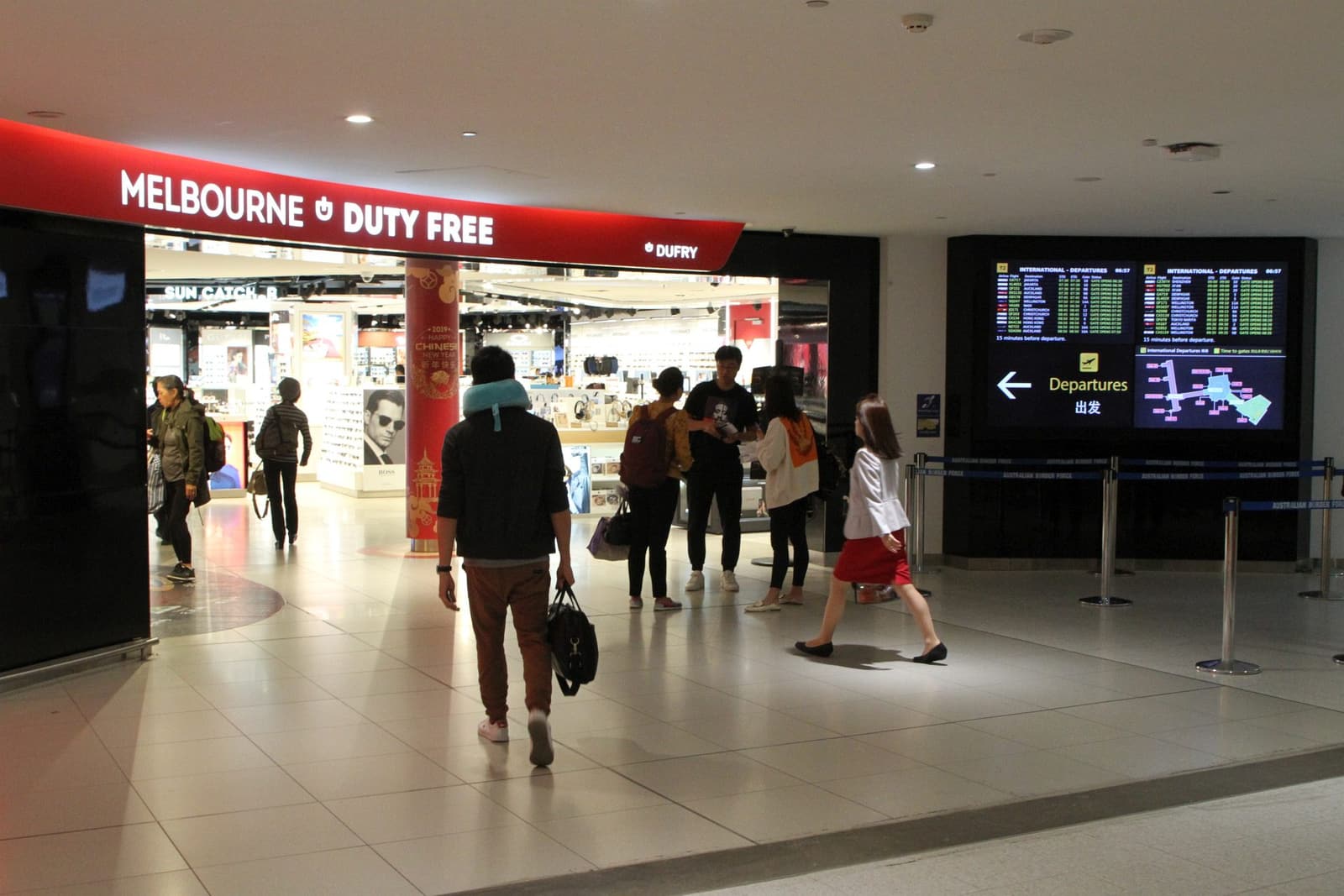
- Wikimedia Commons, "File:Dufry duty free store at Melbourne Airport.jpg" — Wongm photograph of a Dufry-operated Melbourne Duty Free store at Melbourne Airport Terminal 2 used as the article image.