A sold painting can reflect a buyer recruited before the auction, as well as demand discovered in the room. The financial twist is that this bidder may earn a fee even when somebody else takes the painting home: the payment rewards a purchase commitment, not success in the bidding contest.[1][2]
That changes how to read the result. The hammer price records where the bidding finished; it does not, by itself, reveal how much demand arrived without compensation for participating. The useful question is what risk someone agreed to carry before the auctioneer began.
A reserve can leave the painting unsold
Start with the seller's simplest protection. A reserve sets the lowest acceptable auction price. If bidding falls short, the lot can remain unsold. Christie's describes the reserve as confidential and agreed with the seller before the sale.[3]
This is a price boundary, not a promise of cash. For a seller who needs a completed transaction, the distinction is substantial: refusing an inadequate offer preserves ownership but does not turn the picture into spendable money.
A minimum-price guarantee adds that promise. Under the typical arrangement described by Christie's, the house pays the shortfall if the auction price misses the guaranteed amount; if the work fails to sell, the house acquires it and pays the guarantee. In return for assuming that exposure, the house can participate in proceeds above the guarantee.[1]
The auction house has therefore acquired an economic position in the work before it earns the ordinary rewards of conducting a sale. A disappointing auction can leave it with a payment obligation and an artwork to hold or sell.
An outside bidder takes on the purchase obligation
An irrevocable bid supplies a committed purchaser. Sotheby's explains that the bidder must buy at the agreed bid if nobody bids higher, although the bidder can also compete above that level. The house may compensate the commitment with a fee.[2]
This is why the arrangement belongs in finance as much as in art-market reporting. A party accepts a contingent need to fund an asset purchase. Someone else gains certainty. The fee is the price of moving that exposure between them.
Consider a deliberately simplified contract. A backer commits to a $1 million hammer-price bid and receives a $30,000 fee only if another buyer wins. These are invented terms, not a quotation from either auction house. The seller's guarantee is a separate agreement; this example does not assume that its amount equals the backer's bid.
If an independent buyer wins at $1.2 million, the backer receives the fee and acquires no painting. If nobody exceeds the commitment, the backer buys at $1 million and receives no fee under our assumed contract. Any applicable buyer's premium, tax and subsequent ownership costs would sit outside these simplified figures.
The fee equals 3% of the committed hammer amount, but calling it a risk-free return would conceal the important branch of the transaction. Capital may have to be found for the purchase. If the painting can later be sold for only $800,000, the backer has a loss before transaction costs. A commitment that expires profitably when another buyer appears can turn into ownership when demand is weakest.
For a collector already happy to own the picture at that cost, the obligation may be acceptable. For someone interested only in collecting fees, the same contract demands a much harder assessment of resale value and funding capacity.
The fee follows the contract
The hypothetical rule that compensation disappears when the backer wins is not universal. Sotheby's current symbol guide says an eligible fee paid to a successful irrevocable bidder is netted against the purchase price, and the reported purchase price is net of that fee.[2]
Christie's describes different mechanics: a successful third-party guarantor pays the hammer price and buyer's premium, with any permitted financing fee handled separately. Compensation varies by arrangement and local requirements; an unsuccessful guarantor's fee can be fixed or linked to the hammer price.[1]
Those differences matter when comparing apparently similar results. The amount called out in the room, the buyer's invoice and the backer's eventual economic cost need not be identical. A catalogue symbol identifies an arrangement; calculating its profitability requires the actual terms.
A guarantee is not evidence that the price is artificial
The strongest counterweight is straightforward: the committed buyer is still a buyer, and securing one can persuade a seller to bring a work to auction. Competitive bidding can continue above that commitment. Risk transfer can help a market function without proving that the final price has been inflated.
There is empirical reason for caution about the inflation claim. In their July 2015 working paper, economists Kathryn Graddy and Jonathan Hamilton found little evidence that guarantees themselves changed prices once the value of the work was accounted for. Their evidence included evening sales at Sotheby's and Christie's during 2010–2012 and a broader Christie's dataset from 2001–2011.[4]
That historical result is a counterweight, not a verdict on every later sale. The paper studies earlier arrangements, while today's compensation rules must be checked separately. Nor does a guarantee symbol tell an observer whether a committed buyer ultimately acquired the work.
The thesis here is narrower: a sale supported by an irrevocable bid provides less evidence of newly arriving, uncompensated demand than the sold label alone suggests. For an individual lot, that concern would be overturned by verified competition among independent, uncompensated bidders well above the commitment. The guarantee could then have protected the seller without determining the final price.
What to watch at the next sale
- When the catalogue appears: distinguish the seller's minimum-price guarantee from the separate irrevocable-bid disclosure. They describe different promises, even when attached to the same work.[1][2]
- Before the lot opens: check updated notices and saleroom announcements. Both houses use announcements to disclose relevant financial interests; the printed catalogue may not be the last word.[1][2]
- When results are released: check whether the quoted figure is a hammer price or a purchase price, and how fees are treated. Where the commitment amount and buyer's status remain undisclosed, leave the extent of independent demand unresolved.
Sources
- Christie's, “Financial information” — minimum-price guarantees, third-party commitments and compensation; published guidance checked 11 November 2026.
- Sotheby's, “Guide for Buyers | Symbol Key” — guaranteed property, irrevocable bids, fee treatment and disclosures; updated 13 September 2026.
- Christie's, “What is a reserve?” — the reserve threshold and the possibility of a lot remaining unsold.
- Kathryn Graddy and Jonathan Hamilton, “Auction Guarantees for Works of Art,” working paper, 29 July 2015 — historical datasets and evidence on price effects; University of Florida author-hosted PDF.
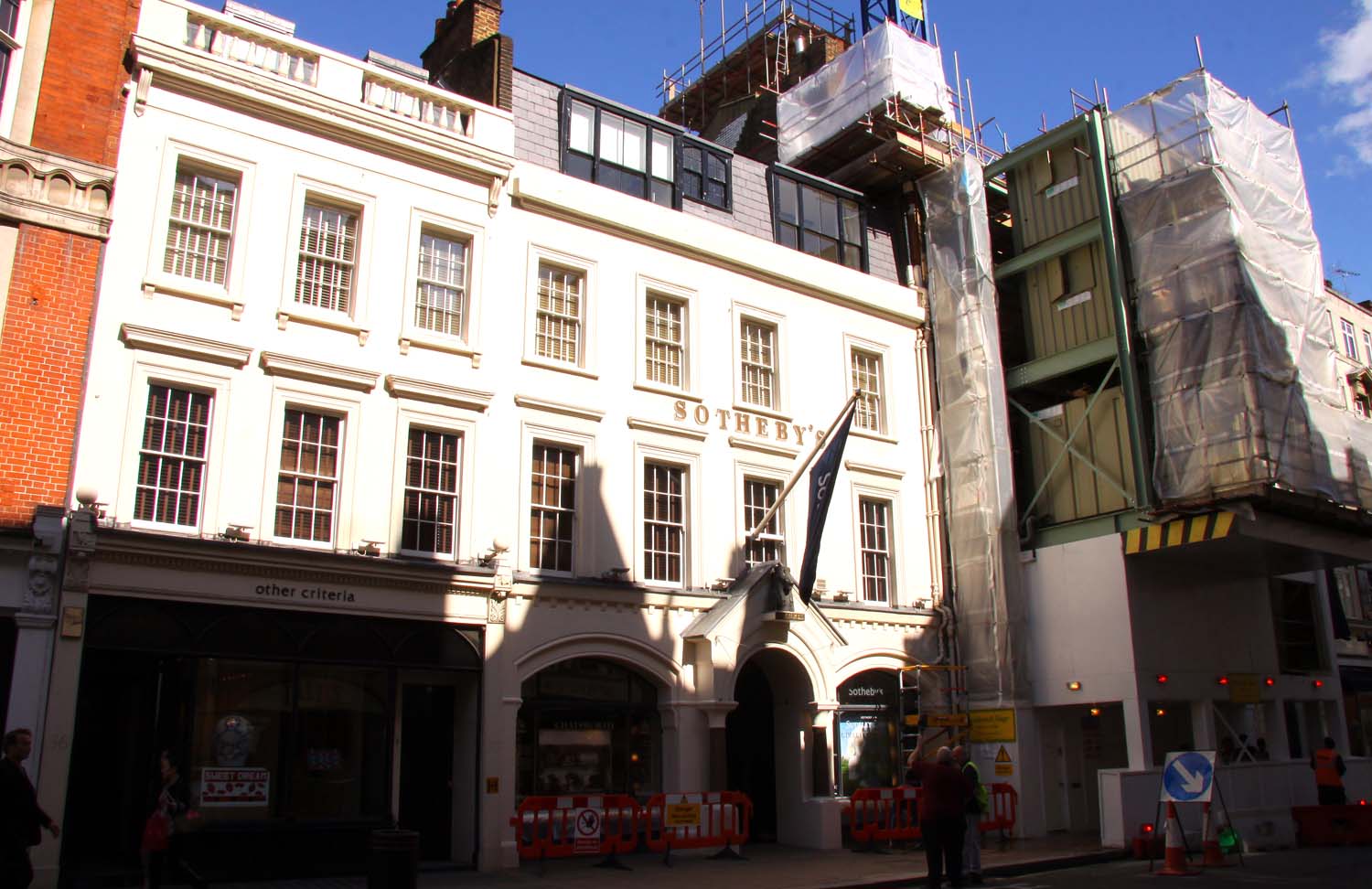
- Steve Daniels, “Sotheby's on New Bond Street,” 24 August 2010 — photograph, Geograph 2192002, via Wikimedia Commons; CC BY-SA 2.0.