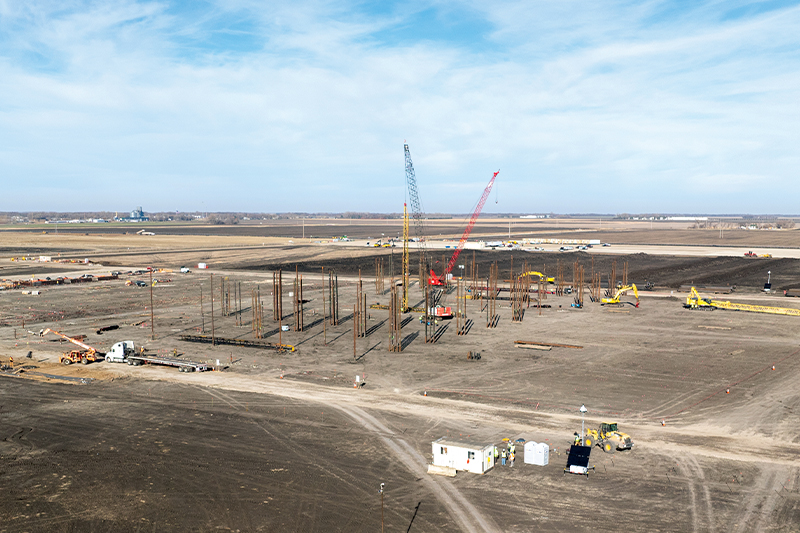
Priced: Applied Digital sold $2.15 billion of 6.75% senior secured notes against a roughly 15-year hyperscaler lease. New: the coupon starts before the rent, while principal amortization waits until after the final lease commencement. Investors did not buy a stabilized data-center income stream; they financed the conversion of a construction site into one.[1][2]
That distinction is the whole case. Polaris Forge 2 in Harwood, North Dakota, has a contracted customer and a funded plan for 200 megawatts of critical IT load. But a signed lease is not yet operating cash. Buildings must be finished, grid infrastructure must be ready, equipment must be installed and commissioned, and the tenant must reach the contractual commencement point. Only then does construction debt begin to behave like rent-backed debt.
This is an analysis of the notes' issuance terms and project milestones, not a claim about their current market price. The securities were privately placed under Rule 144A and Regulation S, and the public filing does not provide a live quote.[1]
The bond starts before the rent
The March 10 filing lays out an unusually clear sequence. APLD ComputeCo 2 issued the notes at 98% of par, deposited cash equal to the gross proceeds in a segregated escrow account, and earmarked the net proceeds for development, construction, project accounts including a debt-service reserve, and transaction costs. Interest is payable every March 15 and September 15, beginning September 15, 2026. The notes mature on March 15, 2031.[1]
Principal follows a different clock. Scheduled amortization begins on the first semiannual payment date after the final “Commencement Date” for all data-center leases that existed when the notes were issued. That clause makes tenant commencement more than an operating milestone: it is the switch that changes the debt from pre-rent financing into an amortizing claim.[1]
The causal chain is short:
escrowed capital → completed buildings and power connection → commissioning and tenant commencement → lease cash flow → principal amortization.
Every arrow matters. Skipping from “long lease” directly to “bond coverage” hides the period in which interest is due but all contracted capacity is not yet earning rent.
Six numbers define the conversion
- $2.15 billion of principal. This is the face amount on which the 6.75% coupon is calculated.[1]
- 98% issue price. The sale therefore produced about $2.107 billion of gross cash before fees and other deductions, less than the principal that must ultimately be repaid.[1]
- 6.75% annual coupon. At the original principal balance, that is roughly $145.1 million of annual interest before amortization.[1]
- 200 MW of contracted critical IT load. Applied Digital's filing says two buildings are intended to deliver that initial leased capacity at Polaris Forge 2.[2]
- $11 million to $13 million of anticipated capital expenditure per MW. Applied Digital's April presentation implies a rough $2.2 billion to $2.6 billion build range for 200 MW before asking which costs sit outside that shorthand.[3]
- About $5 billion of prospective base-term revenue over roughly 15 years. That is management's contract-value framing, excluding power pass-through revenue; it is not the same thing as present cash, straight-line annual rent, or free cash flow available to the notes.[3]
Together, those numbers explain both the attraction and the gap. The debt is tied to a large, long-lived contracted asset, and the prospective revenue is substantial relative to principal. Yet the issue-price discount, coupon, reserves, fees, and construction budget all draw on the capital stack before the site has completed its conversion into an operating landlord.
“Secured” is not the same as “stabilized”
The notes benefit from first-priority liens over the issuer and guarantor assets described in the filing, restrictive covenants, project accounts, escrowed proceeds, and an Applied Digital completion guarantee. If note proceeds and prior equity are insufficient, the parent has agreed—subject to the detailed lease terms and permitted extensions—to provide funds needed to complete the construction period and reach the first service commencement date by the applicable outside completion date.[1]
That is meaningful protection. It also locates the remaining risk. A completion guarantee does not make steel arrive sooner or commissioning friction disappear; it transfers a funding shortfall back toward the parent. Escrow protects capital before release, but released capital must still become a working facility. Security over a purpose-built campus is strongest after the campus is energized and earning, not while its value still depends on unfinished work and a single tenant's acceptance.
Power makes that boundary physical. In testimony for the Agassiz transmission line and substation serving the large new load south of Harwood, Minnkota said the existing infrastructure could not handle the requested power. The proposed solution requires a 345-kV line extension and substation, and the large-load applicant is responsible for the interconnection and facility-upgrade costs associated with serving it.[4] Minnkota's public project page ties the utility work to Applied Digital's Harwood campus and says the site is expected to be partly operational by the end of 2026 and fully operational in early 2027.[6]
North Dakota can have abundant generation and still require project-specific wires, substations, testing, and coordination. “Power available in the region” and “200 MW ready at the tenant's building” are different claims.
The strongest counterweight is a real delivery record
The bearish version of this story would treat every construction milestone as aspirational. That goes too far. On July 1, Applied Digital said it had delivered another 75 MW at Polaris Forge 1 on schedule, bringing live capacity there to 175 MW after an earlier 100 MW building also reached service. Polaris Forge 1 is a different campus with different leases and financing, but it is relevant evidence that the same developer can turn North Dakota construction into energized capacity.[5]
The capital structure also anticipates the handoff rather than pretending it has already happened. Gross proceeds began in escrow. A debt-service reserve sits among the project accounts. Amortization is explicitly linked to final lease commencement. The completion guarantee gives the issuer a source of additional funding if disclosed project capital proves insufficient.[1]
Those protections are why the base case need not be a default story. The more useful question is which of three paths turns up between the first coupon and full commissioning.
Three paths from construction to rent
Path one: the clean handoff
Construction and interconnection stay inside the disclosed window. Initial capacity becomes operational by the end of 2026, the remaining leased capacity reaches commencement in the first half of 2027, and the tenant begins paying under the two leases. The first scheduled payment date after final commencement then starts principal amortization.[1][3][6]
In this path, the issue's high construction-era coupon becomes the price of a temporary transition. Once the project is complete, the long lease, secured asset base, and declining principal balance improve the credit shape. The Polaris Forge 1 delivery record is the best evidence in favor of this branch.[5]
Path two: late, but funded
Equipment, labor, weather, design changes, or commissioning extend the schedule without breaking the project. Interest continues to accrue, project accounts absorb planned costs, and Applied Digital supplies incremental completion capital where the guarantee requires it. Final commencement arrives later, so amortization starts later too.[1]
This path can still repay bondholders as contracted, but it is not economically identical to the clean handoff. More parent capital is tied up, the period without full rent lasts longer, and the gap between gross note proceeds and total delivered cost matters more. A delay that is curable with money tests sponsor liquidity and execution; it does not automatically prove the lease economics are bad.
Path three: commencement becomes the bottleneck
The harder stress case is not merely “construction costs more.” It is that a building or its supporting power system fails to reach the contractual state the tenant will accept on time. The campus can look substantially complete while final commencement remains outstanding. In that case, the notes keep their payment calendar, but the amortization trigger stays in the future and full lease cash has not arrived.[1][4]
That is where a long contract offers less immediate comfort than its headline value suggests. Contract duration protects cash flow after performance begins. Before then, the decisive variables are completion funding, outside dates, permitted extensions, power readiness, commissioning, and acceptance.
Falsifier
This construction-to-rent caution is falsified if all 200 MW reaches contractual commencement by June 30, 2027, the disclosed $11 million-to-$13 million-per-MW budget range is not materially reset, lease cash begins as planned, and scheduled principal amortization follows on the first eligible payment date. That combination would show the high-coupon construction interval was a bounded bridge, not a persistent weakness in the financing.[1][3][6]
A busy site or another broad AI-demand forecast would not be enough. The thesis is specifically about converting capital into accepted, rent-producing megawatts.
Watchlist
- September 15, 2026 — first interest payment. Confirm that the debt-service machinery works while Polaris Forge 2 is still inside its delivery window; separate reserve-supported execution from recurring lease cash.[1]
- December 31, 2026 — partial-operation checkpoint. Minnkota's public timeline says the campus should be partly operational by year-end. The useful disclosure is accepted critical load, not construction percentage or building-shell completion.[6]
- June 30, 2027 — full-commencement checkpoint. Applied Digital's presentation points to delivery across the second half of 2026 and first half of 2027. By the end of that window, the question should have moved from cranes and commissioning to rent and the next eligible amortization date.[3]
The investment case is not “AI needs data centers.” That demand is too broad to settle this bond's path. The case is whether one issuer can make a specific chain close on time: capital into buildings, buildings into energized capacity, capacity into tenant commencement, and commencement into debt service. Until all 200 MW turns on, the 6.75% notes remain a construction claim wearing the outline of a rent bond.
Sources
- Applied Digital Corporation, Form 8-K filed March 10, 2026 — final note terms, issue price, use of proceeds, escrow, payment dates, amortization trigger, security, covenants, and completion guarantee.
- Applied Digital Corporation, Form 10-Q for the quarter ended February 28, 2026 — Polaris Forge 2 lease structure, two-building phasing, and construction status.
- Applied Digital Corporation, April 2026 investor presentation — contracted load, expected delivery window, anticipated capital expenditure per MW, base lease term, and prospective contract value.
- North Dakota Public Service Commission, pre-filed Minnkota testimony in Case PU-26-22 — Harwood large-load interconnection process, applicant-funded upgrades, and need for the Agassiz 345-kV line and substation.
- Applied Digital, “Applied Digital Delivers Second Building at Polaris Forge 1” (July 1, 2026) — on-schedule 75 MW delivery and 175 MW of live campus capacity.
- Minnkota Power Cooperative, “Data Center FAQs” — utility roles, Harwood campus scale, construction timing, and partial/full operation targets.
- Minnkota Power Cooperative, “A new algorithm for health care” (February 20, 2026) — source page for Michael Hoeft's photograph of Polaris Forge 2 under construction.