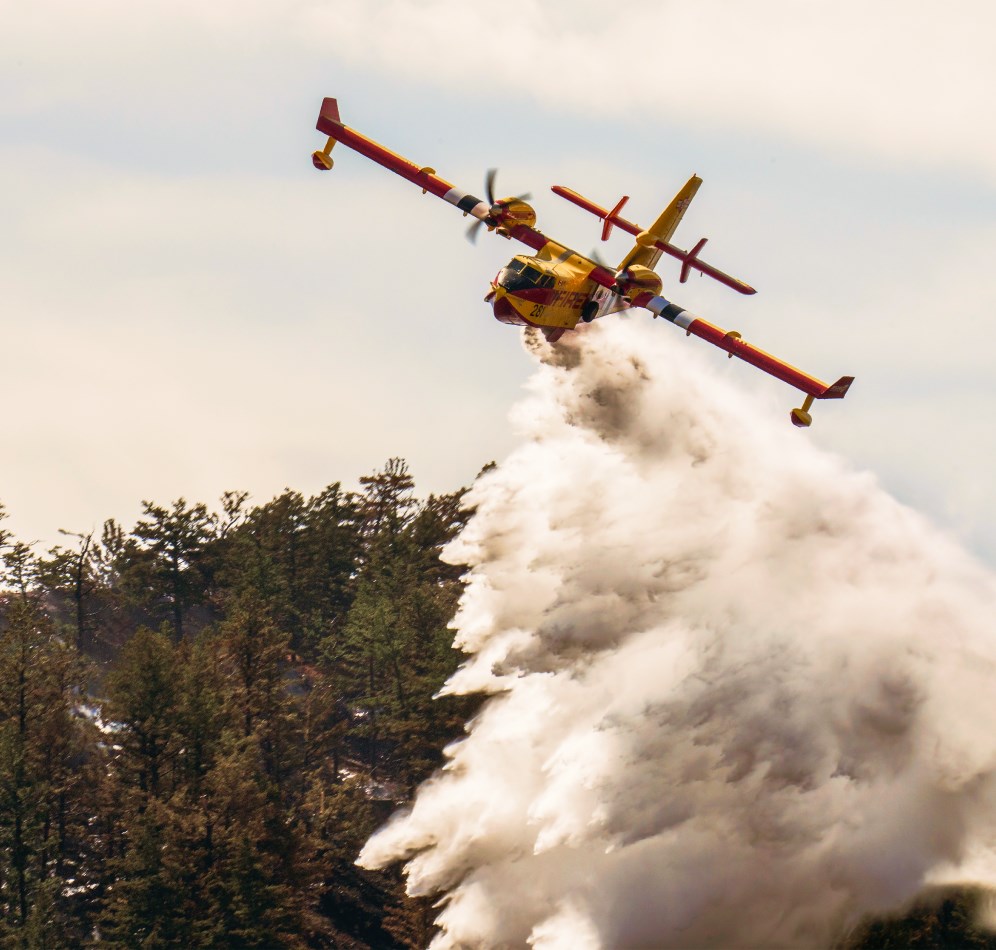
The tempting way to value aerial firefighting is as a bet on a busier fire season. Bridger Aerospace’s longer 2026 standby commitments support a more dependable revenue case, but its cash flow shows how far predictable billing can remain from predictable funding.[1][2]
Evidence cut-off: September 19, 2026. Financial comparisons below concern the quarter or half-year ended June 30, as specified; this is an analysis of contract economics, without a share-price target.
The aircraft earns before it flies
Bridger’s revenue policy separates daily standby charges, earned when an aircraft is available at a fire base, from hourly flight charges associated with customer-requested operations. The service includes the aircraft, pilots, and field maintenance personnel. Revenue is recognized as that daily service is provided.[2]
That distinction changes the investment question. Counting fires measures potential need. Counting paid availability measures how much of the operator’s calendar a customer has actually bought. Flight activity can add revenue, but an aircraft need not be dropping water to be delivering a contracted service.
In May, Bridger announced Forest Service task orders covering four Super Scoopers for 160 days each, up from 120 days the previous year. The company put the commitments at at least $30 million in standby revenue, with the second order extending coverage into the fourth quarter.[1]
The improvement is duration on existing aircraft. It gives the operator a longer period over which to recover the cost of keeping people and equipment ready. Yet the announcement does not establish the profit on those extra days, or say that the cash was received when the orders arrived. A revenue commitment belongs in a forecast; a customer payment belongs in the bank balance.
Buying a season changes the bargain
This distinction predates Bridger’s latest awards. A 2018 Government Accountability Office decision examined a different fleet: single-engine airtankers contracted for the Bureau of Land Management. It described separate procurement models for an assured seasonal fleet and for aircraft called upon as needs arose. Both could involve daily and hourly charges, but their commitments differed.[3]
The distinction was substantial enough that GAO sustained a protest against procuring extended, guaranteed service under the on-call contracts at issue. That historical ruling does not challenge Bridger’s current awards. It shows why an investor should read the actual task order rather than infer a guaranteed season from membership in a government contracting programme.[3]
My valuation inference is that a longer commitment can reduce uncertainty about revenue while leaving considerable uncertainty about returns. A low price for a long commitment may be less attractive than a shorter, well-priced deployment. Duration and margin must be examined together.
A fuller calendar still has a cost
Bridger’s second-quarter release offers a useful counterweight to the contract headlines. Excluding non-recurring work to return aircraft to service, revenue rose 16% from a year earlier. Cost of revenues, excluding the corresponding work, rose 32%. The company attributed the cost increase principally to aircraft depreciation, fuel, and workforce expenses; reported adjusted EBITDA declined.[4]
These are company-disclosed comparisons, not a calculation of the new orders’ profitability. They cover more than those orders, and depreciation is not a current cash payment. Still, they constrain the optimistic argument: growth in the operating business had not yet produced better quarterly adjusted earnings.
The practical test is what the extra paid days leave behind after delivering the service. A larger calendar helps only if the pricing and operating performance make those days worthwhile. There is no reason to capitalize every additional dollar of contracted revenue at the same value.
Collections decide how much financing is needed
For the first half of 2026, Bridger used $36.8 million in operating cash. The cash-flow statement includes a $17.3 million outflow from increased accounts receivable. Those amounts describe the whole company; they cannot be assigned solely to the new standby orders.[2]
Receivables are an especially useful boundary here. They record revenue awaiting payment, not automatically bad debts. Nevertheless, the company must fund the interval between performing work and collecting the bill. Successful deployment can enlarge that interval’s financing requirement if activity rises faster than receipts.
The strongest counterargument is seasonality: a midyear cash outflow need not describe the full year. Management said cash, expected operating inflows, and available borrowing capacity should fund the following year’s operations.[2] Its earnings release also attributed the decline in cash since year-end to seasonal working capital and receipt timing.[4]
That explanation is testable. The thesis that longer commitments improve funding resilience fails if completed deployments and subsequent collections still leave recurring operations dependent on progressively greater borrowing, after separating expansion spending. A larger fleet financed for growth would be a different claim; an existing operation that cannot replenish its working capital would directly undermine this one.
The next evidence to watch
- At the third-quarter 2026 results: compare operating cash flow and receivables with the progress of deployments. Look for cash catching up with revenue, while allowing for work still under way.
- At completion of the task orders extending into the fourth quarter: examine disclosed service costs and margins alongside paid days. The question is whether the longer calendar improved earnings after the cost of readiness.[1]
- At the full-year 2026 results and next season’s awards: distinguish borrowing for additional aircraft from borrowing to finance recurring operations. Then check whether customers renew the longer commitments on commercially useful terms.
Sources
- Bridger Aerospace, “Bridger Aerospace Secures 160 Day Task Orders for Four of its Super Scoopers” (May 11, 2026) — duration, standby revenue, and deployment timing.
- Bridger Aerospace, Form 10-Q for the quarter ended June 30, 2026 — revenue recognition, cash-flow statement, and liquidity discussion.
- U.S. Government Accountability Office, Western Pilot Service and other protesters, decision B-415732 and related cases (March 6, 2018) — distinct on-call and exclusive-use service models in a historical single-engine airtanker procurement.
- Bridger Aerospace, “Bridger Aerospace Reports Second Quarter 2026 Results” (August 6, 2026) — comparable revenue and cost growth excluding return-to-service work, adjusted earnings, and seasonal cash usage.
- ASDNews, “Bridger Aerospace Secures Record 120 Day Task Orders for 4 of its Super Scoopers” (May 22, 2025) — source of the photograph, credited to Bridger Aerospace.