Most first-time Zurich visits flatten the center too quickly. People walk out of the Hauptbahnhof, drift toward Bahnhofstrasse or the river, then keep the whole city at street level as if Zurich were only shop windows plus a lake finish. The cleaner local move is sharper and smaller. Start at Central, take the Polybahn up once, step out onto the Polyterrasse, and let one steep civic lift explain how the old town, the university hill, and the working city actually fit together.[1][2][3]
That sequence matters because the Polybahn is not a decorative nostalgia ride attached to a viewpoint. Zurich Tourism still describes it as one of the city's most legendary means of transport, running from Central to the Polyterrasse in 100 seconds and carrying up to two million passengers a year.[2] The operator's own page adds the more practical layer: the red funicular runs every 5 minutes, costs CHF 1.20 on its special ticket, and is already included in ZVV zone 110, so no extra fare is needed if you are already travelling inside the city ticket zone.[1] This is local infrastructure first, postcard second.
The terrace at the top completes the logic. Zurich Tourism's Polyterrasse page notes that the ETH main building dates to 1864, the neighboring University of Zurich building came later, and the two institutions together are visited by more than 30,000 workers and students every day.[3] The terrace is open to the public all day, quick to reach from the Polybahn, and governed by rules that tell you immediately what kind of place it is: no alcohol between 6 p.m. and 9 p.m., no littering, no barbecuing, no music.[3] That is useful local information, not civic scolding. It tells you the terrace is meant to stay readable as shared city space rather than tip into a casual party deck.
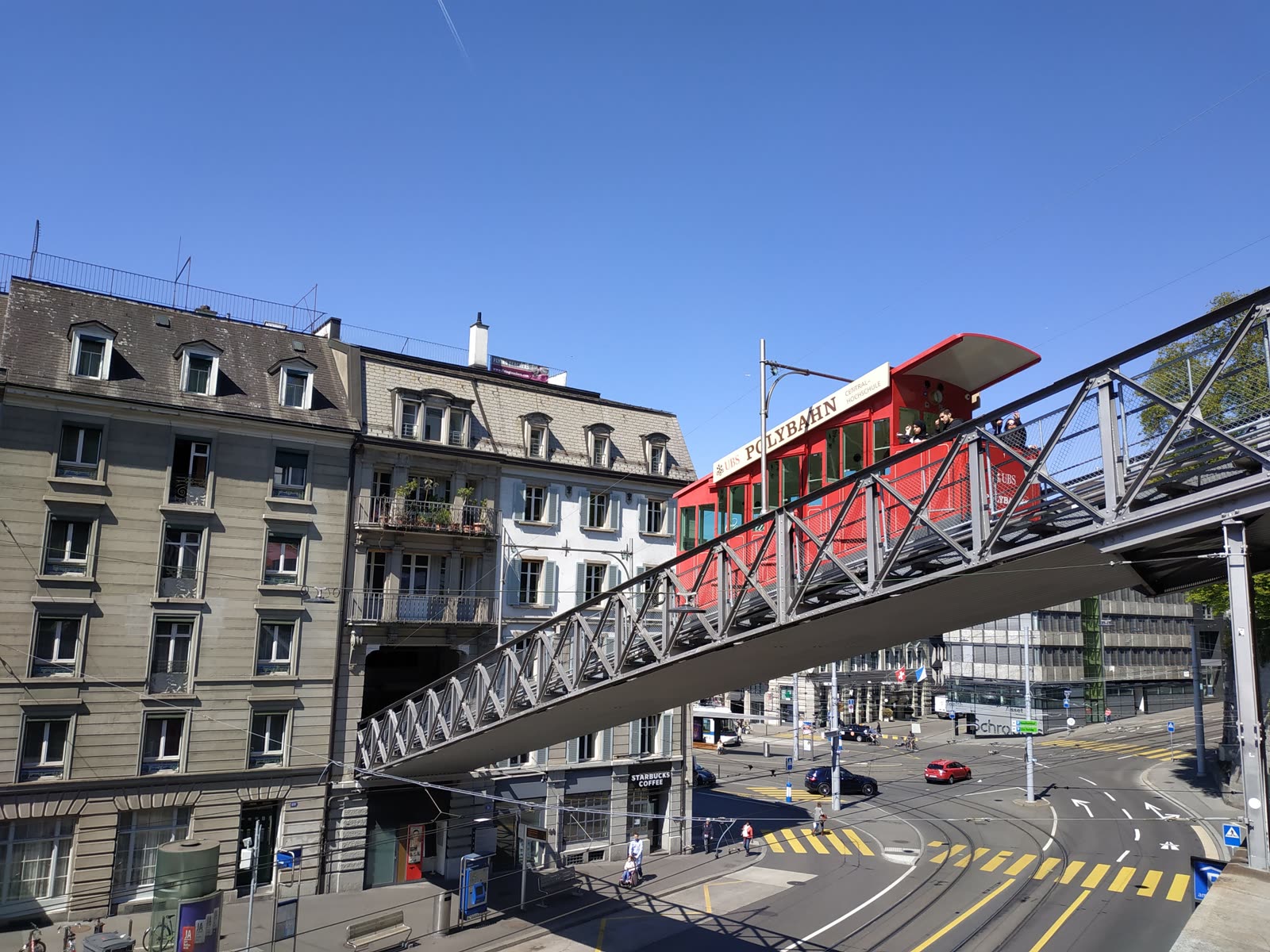
Image context: the cover uses a real Wikimedia Commons photograph of the Polybahn taken in 2019. It belongs here because this article is about arrival behavior, not generic skyline beauty. Without the red car and the Central hillside, the route loses its working Zurich cue.[8]
Why the evening rise is the clean version
The best working window is usually 6:15 to 7:45 p.m. from spring into early autumn, and a little earlier in colder months.
That timing works because the route improves when two different Zurich rhythms overlap. The Polybahn still runs until 9:00 p.m. every day, but the lower station starts to feel less like a pure student conveyor once the hard daytime churn eases.[1][2] At the same time, the Polyterrasse's 6 p.m. to 9 p.m. alcohol restriction helps keep the top calmer than many visitors expect.[3] You still get city light and rooftop depth, but the terrace is less likely to slide into a drink-in-hand lookout routine.
There is also a negative timing lesson here. Zurich Tourism says the institutions around the terrace absorb more than 30,000 workers and students a day, while the operator's recent annual report confirms the line is still part of that daily movement rather than a tourist sidecar.[3][4] That is exactly why this route works better as a deliberate shoulder-hour ritual than as a midday impulse.
The order that makes Zurich cohere
Begin at Central, not halfway up the slope.[2][6] The point is to feel the grade. If you approach from above or emerge from a tram already level with the hill, you lose the suddenness that makes this route useful. Zurich is one city at the river and another city once you gain height over the old roofs.
Before boarding, solve the ticket logic. The operator states the special Polybahn single fare is CHF 1.20, the six-ride card is CHF 7.20, and the line is included inside ZVV tariff zone 110.[1] In practical terms, that means the cleanest budget move is either to use the ticket you already have for central Zurich or to buy the dedicated one-way ticket and walk down later.
Once the car arrives, do not over-romanticize the queue. This line is functional city transport, and the point of the ritual is not to linger at the platform but to let the short ride do its work.[1][4] If the station is bunching, board briskly and keep your attention for the terrace. The ride itself is short enough that you do not need to optimize for a perfect compartment position. The real payoff comes after the doors open.
At the top, exit to the right. LikeALocal's Zurich note is oddly useful on this point: step out, turn right, and the terrace reveals itself within a few paces.[5] That small directional instruction saves the common first-visit wobble where people drift toward the ETH building frontage first and only then realize the public panorama deck is immediately beside them.
Then stop climbing. The terrace is the finish, not a launchpad for more ascent. Zurich Tourism puts the distance from the main station at 473 meters and about 9 minutes on foot, but that number hides the experiential difference between a flat approach and a steep public lift.[3] The reason to use the Polybahn is not laziness. It is to compress the transition.
8 local moves that make this Zurich ritual work
- Start at Central and take the hill seriously. The route only works if you begin at the bottom and let the ascent reset the city scale.[2][6]
- Use your existing city ticket if you already have zone 110. If not, the dedicated Polybahn fare is only CHF 1.20.[1]
- Aim for the evening shoulder, not lunch or class-change crush. With more than 30,000 daily workers and students around the terrace, this route is better once the hardest churn eases.[3][4]
- Board fast and stop fussing over the perfect car. The ride lasts 100 seconds. Precision matters more at the terrace than on the funicular itself.[2]
- Exit right at the top. That is the fastest way onto the open terrace rather than into a campus-side hesitation.[5]
- Treat the 6 p.m.-9 p.m. alcohol rule as a feature. It keeps the space legible, calmer, and more local in tone.[3]
- Hold the terrace for 20 to 40 minutes, not an entire evening. This is a control move, not your whole Zurich night.
- Walk down afterward if the top already feels complete. Zurich Tourism puts the terrace only 473 meters and about 9 minutes from the main station on foot, which makes the downhill exit the easy half.[3]
Non-local trapline: 4 mistakes and the better move
Mistake 1: treating the Polybahn like a cute extra after Bahnhofstrasse
Better move: make it the opening move. The whole point is to understand Zurich's vertical structure before the shopping streets flatten your read of the center.[2][3]
Mistake 2: arriving in the thick of daytime queue behavior
Better move: use the evening shoulder. The service still runs until 9:00 p.m., and the upper terrace gets a calmer civic tone once the day begins to loosen.[1][3][4]
Mistake 3: bringing the wrong terrace behavior
Better move: read the local rules before you arrive. No alcohol from 6 p.m. to 9 p.m., no music, no barbecues, no littering.[3]
Mistake 4: thinking the terrace is only a panorama selfie deck
Better move: notice what the platform actually does. It sits between institutions used by more than 30,000 workers and students a day, which is why it feels like a city room, not only a lookout.[3]
One-screen logistics card
- Anchor 1: Polybahn lower station at Central / Limmatquai 144.[1][2]
- Anchor 2: Polyterrasse beside ETH Zurich.[2][3]
- Best window: roughly 6:15-7:45 p.m. in the warmer months; shift earlier in winter.
- Ride time: 100 seconds.[2]
- Service rhythm: every 5 minutes; 6:30 a.m.-9:00 p.m. Monday to Friday, 7:30 a.m.-9:00 p.m. Saturday, 9:00 a.m.-9:00 p.m. Sunday and public holidays.[1][2]
- Fare logic: CHF 1.20 one way on the special ticket, or already included in ZVV zone 110; free if you are already covered by that zone or a Zürich Card.[1][2]
- Expected spend: CHF 0-2.40, depending on whether you already hold a city ticket and whether you walk down.
- Queue / reservation reality: no reservations; the only friction is avoidable bunching around the line's daytime working use.[3][4][6]
- Behavior rule worth remembering: no alcohol on the terrace from 6 p.m. to 9 p.m.; no music, barbecuing, or littering.[3]
- Navigation cue:
Central -> Polybahn -> exit right -> Polyterrasse -> walk down through the old town
Zurich does not need a giant itinerary to become clear. One short red car, one steep rise, one terrace beside the ETH, and the city stops behaving like a luxury shopping frontage. It becomes what it actually is: a compact river city with a sudden academic hill sitting right above its old roofs.[2][3][4][5]
Sources
- UBS Polybahn, "Shortest connection from Central to ETH Zurich" - official schedule, CHF 1.20 special fare, 6-ride price, zone 110 inclusion, 50-passenger cars, and operating notes.
- Zürich Tourism, "Polybahn" - official city page with the 100-second ride, 1889 opening, 130-plus-year service history, every-2-to-5-minute frequency, and Zürich Card inclusion.
- Zürich Tourism, "Polyterrasse, Federal Institute of Technology and Zurich University" - official page with the ETH 1864 date, 30,000 daily workers/students, all-day public access, and terrace behavior rules.
- UBS Polybahn, "Geschäftsbericht 2024" (published June 22, 2025) - recent operator report confirming the line's current role in Zurich's daily movement.
- LikeALocal Guide, "Polyterrasse" - local guide note on exiting right from the Polybahn, the terrace's south-facing warmth, and its use as a student hangout.
- Google Maps community listing, "Polybahn Zurich" - current navigation and local review surface for the lower station.
- Google Maps community listing, "Polyterrasse Zurich" - current navigation and local review surface for the terrace.
- Wikimedia Commons, "File:Polybahn, Zürich (2019) - 1.jpg" - documentary photograph used for the cover image.