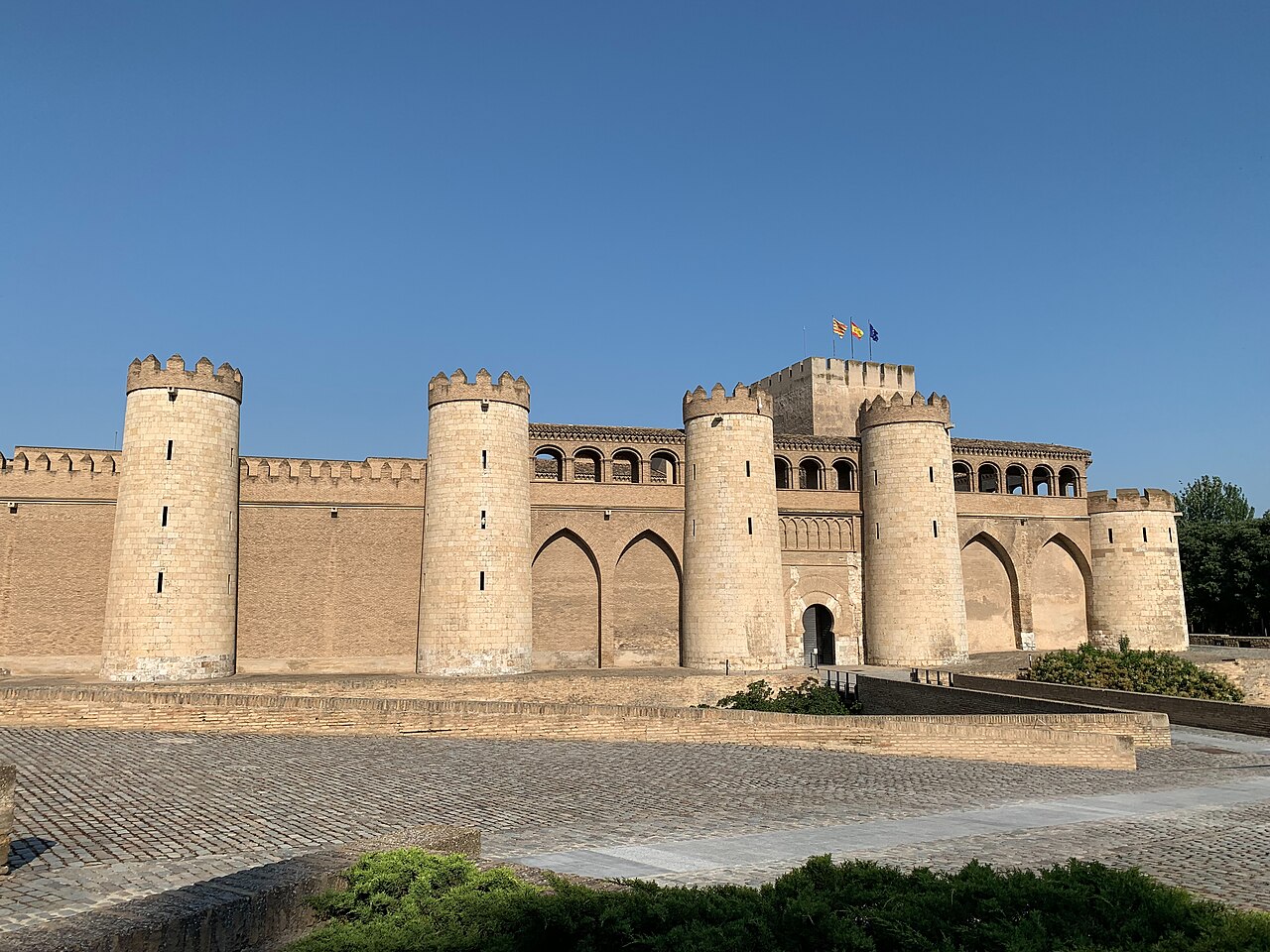
Zaragoza is easy to flatten into a Plaza del Pilar stop: basilica, river view, tapas, train onward. The cleaner local correction sits about 1.5 kilometers away from that postcard center. Walk or ride toward Calle de los Diputados, stop before the ticket desk, and let the Aljaferia behave first as a city edge: walls, towers, open space, parliament security, neighborhood traffic, and a palace that still feels slightly outside the old ceremonial core.[1][2]
That order matters. Zaragoza Turismo calls the Aljaferia one of the peaks of Hispano-Muslim art, the northernmost Islamic palace in Europe, and a former "Palace of Joy" built outside the Muslim city among orchards and irrigation channels.[1] Today it is also the seat of the Cortes de Aragon, which means the building is not a dead monument waiting politely for visitors. It is a working civic object with a long memory: taifa palace, Christian royal residence, Mudejar palace, Inquisition space, fortress, barracks, restored monument, and regional parliament.[1][3]
Use Place Portrait logic rather than museum-completion logic. The anchor is the palace edge itself, especially the exterior read from Calle de los Diputados, not a fantasy of seeing every decorated room in one efficient burst. ZaragozaGo's local guide makes the practical viewing cue explicit: the ticket-office side on Calle Diputados gives one of the best frontal views, with the access door and six main towers setting the facade in order.[4] Stand there first. If you enter immediately, you miss the way the building announces its double identity: fortified and ornamental, remote and central, public and controlled.
The best ordinary window is late morning or mid-afternoon, but not late-late. The current Zaragoza monument-hours sheet lists the Aljaferia as open Monday-Sunday, 10:00-18:00, with general admission 7 euros, guided entry 9 euros, and last access 45 minutes before closing.[2] That turns 16:15-16:45 into the useful latest arrival band if you want a composed visit rather than a closing-time negotiation. Earlier is calmer if you want guided interpretation; the same sheet lists Spanish guided palace tours at 10:30, 12:30, 13:30, and 15:00.[2]
The local move is to separate looking from entering. First, approach from Plaza Espana or the old-center side if you have the legs; ZaragozaGo puts the walk from Plaza Espana at about 20 minutes.[4] Second, stop across the open edge before crossing into the ticket flow. Third, identify the Torre del Trovador, the higher square tower that ZaragozaGo flags as the easiest exterior recognition cue on the Almozara-facing side.[4] Fourth, if you are entering, buy or reserve with the last-access rule in mind rather than assuming a palace seat of parliament works like an always-open church.[2]
The fifth move is to keep the visit quiet. UNESCO's World Heritage description frames Aragonese Mudejar as a building culture shaped by Christian, Muslim, and Jewish exchange, with the Aljaferia's surviving Mudejar features included among the inscribed components.[3] That is not a license to turn every room into a label hunt. It is a reason to notice transitions: Islamic arches and oratory memory, Mudejar wood and plaster, later royal and institutional layers, and the modern parliamentary use that keeps the building protected but also bounded.[1][3]
Sixth, treat free-entry timing as a crowd variable, not only a bargain. The official hours sheet notes free access on the first Sunday and Monday of the month.[2] That can be useful if budget matters, but the better first read may be a paid, quieter slot when the exterior and interior are not being pulled apart by bargain-day traffic. Expected spend is therefore 0-9 euros depending on free-day eligibility, standard entry, or guided visit.[2]
Seventh, use the palace as a Zaragoza orientation device. A recent r/esHistoria thread from May 2026 drew a striking local claim: a commenter saying they are from Zaragoza called the Aljaferia the best visit in the city and noted that guided visits reflect its role as the seat of the autonomous parliament.[5] That is a community signal, not a planning law, but it captures the right correction. The Aljaferia is not secondary because it sits away from the basilica. It is the place where Zaragoza's Islamic, Aragonese royal, Mudejar, military, and parliamentary stories collide in one address.
The visitor mistakes are predictable. Mistake one is making Aljaferia the last loose item of the day. Better move: give it a bounded 75-110 minute slot and arrive before the 45-minute last-access rule can shape your pace.[2] Mistake two is entering before you have read the facade. Better move: stand on the Calle Diputados side long enough for the six-tower rhythm to register, then decide whether the guided interior is worth the extra structure.[4] Mistake three is treating it as "Zaragoza's Alhambra." The city page itself makes the comparison to Granada and Cordoba, but the useful reading is more local: this is a fortified palace turned parliament, not a substitute for anywhere else.[1]
Mistake four is assuming the site is disconnected from ordinary Zaragoza because it feels set apart. The better alternative is to use the walk back toward the old center as part of the visit. The palace was originally outside the Muslim city, and that old edge condition still helps you feel Zaragoza's scale: not only the river-and-basilica axis, but a wider civic field where medieval power, neighborhood streets, and modern government do not line up neatly.[1][6]
For live navigation, keep a current map surface open only for status, not for imagination. The Google Maps listing is useful for confirming the pin, recent review texture, and approach friction around the palace, but it will not tell you how to look.[6] The looking rule is simpler: exterior first, ticket clock second, interior third, old-center return last. If you do that, the Aljaferia stops being a detour and becomes the hinge that makes Zaragoza feel less like a single square and more like a city built in historical layers.
Sources
- Zaragoza Turismo, "Palacio de La Aljaferia" - official city page on the palace's Islamic, Mudejar, royal, Inquisition, fortress and parliamentary layers.
- Zaragoza Turismo, "Museums and Monuments Opening Hours" - current official monument-hours PDF with Aljaferia hours, prices, guided-tour times, free-entry notes and last-access rule.
- UNESCO World Heritage Centre, "Mudejar Architecture of Aragon" - official World Heritage description including the surviving Mudejar features of the Aljaferia Palace.
- ZaragozaGo, "Palacio de la Aljaferia de Zaragoza" - local guide with Calle Diputados approach notes, six-tower facade cue, Torre del Trovador cue and Plaza Espana walking estimate.
- Reddit r/esHistoria, "Hoy os presento el magnifico Palacio de la Aljaferia..." (May 2026) - recent community thread with local commentary on the palace as a top Zaragoza visit and guided-visit/parliament context.
- Google Maps search, "Palacio de la Aljaferia Zaragoza" - current community-review and place-status surface for live navigation.
- Robot8A, "Palacio de la Aljaferia, vista exterior.jpg," Wikimedia Commons - photographic source for the article image.