Do not go to Ostrów Tumski only to "see the lamplighter." Go to let Wrocław slow down until the city is lit by hand.
The anchor is tiny and specific: one former cathedral island, one dusk window, one worker moving through a network of gas lamps. ZDiUM, Wrocław's road and city-maintenance authority, says it looks after 98 historic gas lamps on Ostrów Tumski, that the system has been under its care since 1996, and that the tradition of lighting them by a lamplighter continues today [1]. That turns the visit from folklore into urban infrastructure. The best version is not a hunt for a man in a cape. It is a 75-minute seasonal moment where the old church precinct, the river approaches, and the first flames line up.
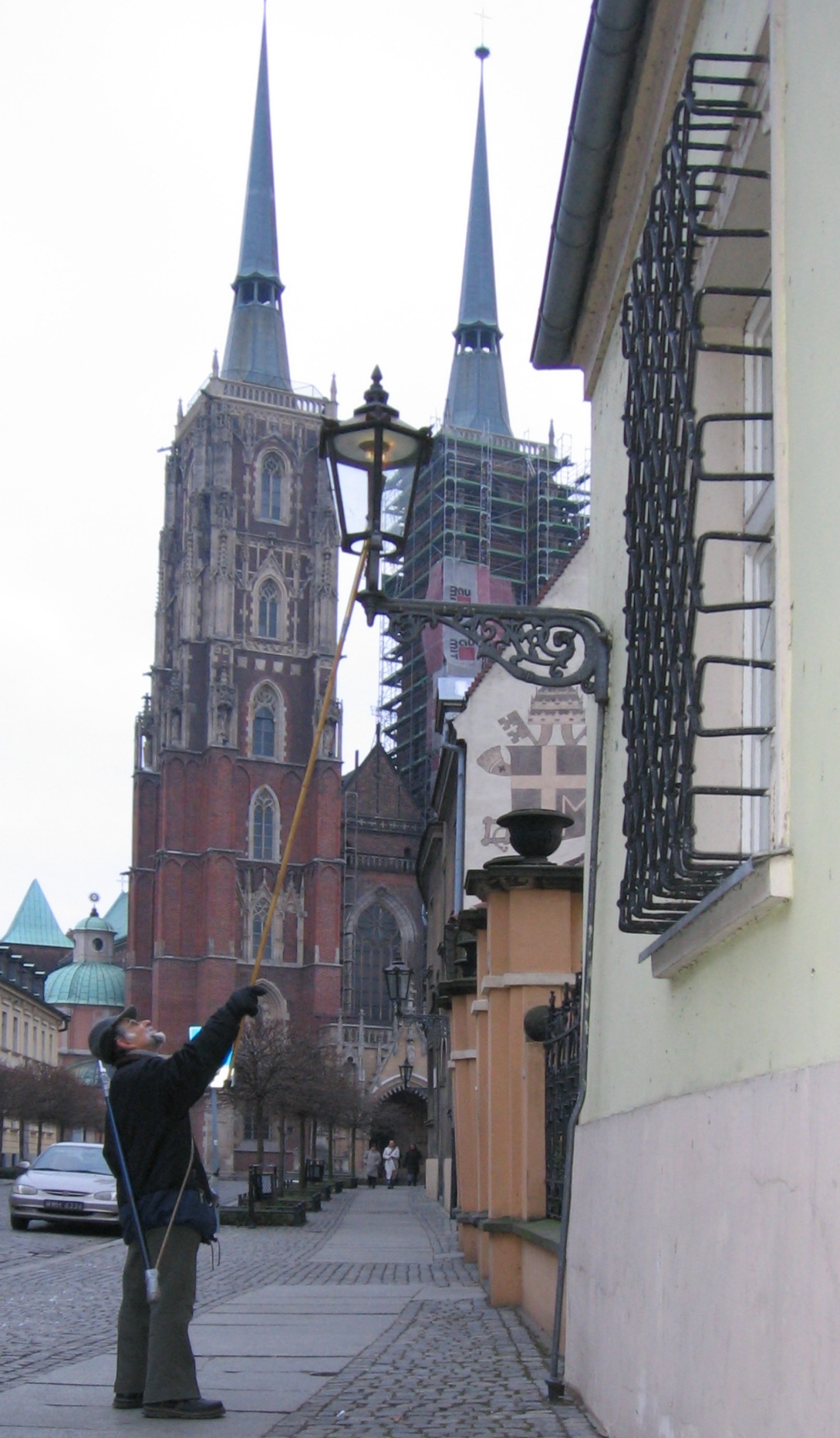
The useful window is dusk, not "night." In summer, ZDiUM has described the evening lighting round as ending around 20:45, while winter shifts much earlier; a current local guide is right to warn that the times are seasonal and that there is no single hour that works all year [2][4]. The local move is to arrive 20 to 30 minutes before the expected lighting, before the island is fully dark and before everyone starts drifting toward the same glowing lamp. In June, that means treating roughly 20:10 to 21:00 as the golden operating window, then checking the day's sunset and weather rather than trusting a fixed itinerary.
Start from the city side, not from the cathedral door. If you are coming by tram, the official tourism page points visitors toward the Katedra or pl. Bema stops and lists tram lines serving the area; it also notes that MPK tickets can be bought at stop machines or in vehicles by contactless card, with the ticket coded to the payment card [3]. For spend, this can be a free walk if you are already central, or a small transit move: Wrocław's 2026 fare page lists a normal 30-minute ticket at 4.00 PLN and a 15-minute ticket at 3.20 PLN [5]. Budget 0 to 15 PLN for the core ritual unless you add the cathedral tower, a museum, or a later drink.
The first trap is arriving too late. If all the lamps are already on, Ostrów Tumski is still beautiful, but you missed the mechanism. The better alternative is to stand at the edge of the island while some lamps are still dark. Use the unlit ones as breadcrumbs. If you see three lamps burning and the next two still cold, you know which way the round is moving. This is a better navigation cue than chasing a crowd with phones raised.
The second trap is treating the lamplighter as street theater. ZDiUM's own 2023 maintenance notice makes the job sound less romantic and more serious: daily lighting and extinguishing, inspections, a service log, fault reporting, repairs, cleaning, leak checks, and work on lamps that are often around 3 metres high and sometimes over 4 metres [2]. So keep your group small, stay out of the worker's line, and do not block a lamp just because the frame looks good. If you photograph, step aside after one or two shots. The ritual is intimate because it is routine.
The route should stay compact. Give yourself 60 to 90 minutes, which matches the local-guide estimate for a classic Ostrów Tumski visit [4]. Come in from the river, pause near the first lamps, drift toward the cathedral, then loop back before the island becomes only silhouettes and floodlit stone. Do not overbuild the evening with every nearby island, every church, and a full restaurant plan. The point is to feel the changeover from practical daylight to hand-lit night.
The third trap is standing in the middle of a narrow passage waiting for the perfect shot. Better: stand near a wall, gate, or open corner and let the lamplighter pass through your field of view. A recent Wrocław community thread is useful because locals recommend Ostrów Tumski both by day and by night, not as a one-second attraction but as a place worth returning to under different light [7]. That is the right mindset. The island is not a backdrop. It has morning stone, late-afternoon church traffic, dusk lamps, and quiet after-dark intervals.
The fourth trap is assuming this is only for tourists. A recent travel-community post still describes the lamplighter appearing every evening on Cathedral Island, which is useful confirmation that the ritual remains visible to visitors [8]. But the better local behavior is low-friction: keep voices down near church entrances, do not lean into private-looking doorways, skip flash against windows, and let residents and clergy move normally. If a lamp is being handled, give the worker the pavement.
Where should you stand or sit? Stand first; sit later. Start on the approach where you can see the lamps in sequence, then move toward plac Katedralny once the first flames are on. If you need a pause, use a bench or low wall after the lighting has passed rather than occupying the active route. Do not make a cafe your first stop unless the weather is bad. The whole lesson is outside.
The non-food texture is what makes this Wrocław rather than a generic old-town walk. Gas lighting appeared in the city in the mid-19th century, and WrocławGuide traces the first gas lantern to 1846 while noting that many gas lamps disappeared during later modernization except on Cathedral Island [1][6]. That survival matters because Ostrów Tumski is not just "old." It is a pocket where maintenance policy, church property, visitor attention, and resident habit have preserved a visible pre-electric rhythm inside a modern tram city.
Plan it as a simple evening: tram or walk in, arrive before dusk, follow the lamps that have not yet been lit, give the worker space, let the cathedral remain background, and leave before the island turns into a photo queue. The success condition is not whether you caught the exact first flame. It is whether, for half an hour, Wrocław stopped feeling like a list and started feeling like a city that still knows how to turn itself on by hand.
Sources
- ZDiUM Wrocław, "Oświetlenie i iluminacja" - official infrastructure page on Wrocław street lighting, Ostrów Tumski gas lamps, maintenance responsibility, cost, and history.
- ZDiUM Wrocław, "Oświetlenie gazowe na Ostrowie Tumskim w 2023 r." - official notice describing daily lamp-lighting duties, summer timing example, lamp count, worker clothing, and maintenance tasks.
- VisitWroclaw.eu, "Ostrów Tumski i Katedra" - official tourism page with access, tram-stop, parking, and MPK ticket-purchase details.
- WroclawTurysta, "Ostrów Tumski in Wrocław - the oldest part of the city" - local guide updated January 16, 2026, with timing, classic-route, and dusk advice.
- Wrocław.pl, "MPK Wrocław - ceny i rodzaje biletów, rozkłady jazdy" - official 2026 public-transport fare page.
- WroclawGuide.com, "The Lamplighter in Wroclaw - all you need to know" - local guide on the lamplighter tradition, gas-lighting history, and visitor timing.
- Reddit r/wroclaw, "First time visiting - what to not miss?" - recent local/community thread recommending Ostrów Tumski by day and night.
- Reddit r/Europetravel, "The Lamplighter of Wroclaw Poland - Preserving A Tradition" - June 2026 community confirmation of the visible evening lamplighter ritual.
- Julo, "Wroclaw latarnik na Ostrowie Tumskim.jpg," Wikimedia Commons - archival photographic source for the article image.